




Estimated reading time at 200 wpm: 11 minutes
Author’s Note: The following article provides an objective analysis of the legal and geopolitical framework surrounding the extraction of Nicolás Maduro, as presented in official indictments, court documents, and international reporting. The narrative details the legal arguments and strategic rationales employed by the US Department of Justice and military command as documented in the public record. This summary of events and legal theories is based entirely on the referenced sources and does not constitute an endorsement of the actions taken, nor does it reflect the personal opinions or political stance of the author. Conclusions arrived at result from evidence and reasoning of various sources. They do not represent ownership by the author. The author is ‘not saying’ that the US is justified! FFS! Readers may depart and find arguments against the US administration.
Whether or not you agree our Fat Disclaimer applies
I. Operation Southern Spear: The End of the Impasse
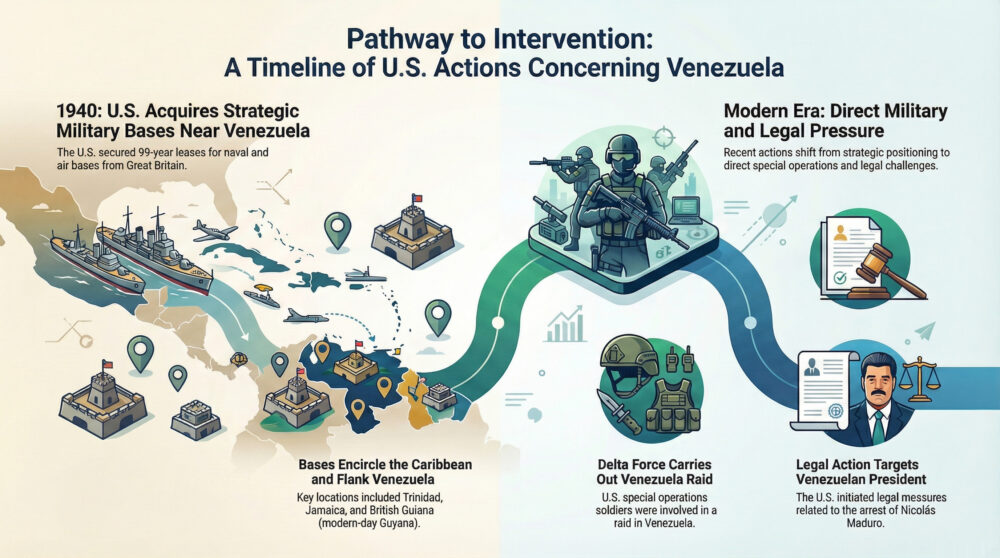
In the early hours of 3 January 2026, the diplomatic deadlock that had paralysed Western policy towards Venezuela for over a decade was shattered not by a treaty, but by a kinetic extraction. Under the cover of darkness, US Special Forces executed ‘Operation Southern Spear’, a high-risk mission in Caracas that resulted in the detention of Nicolás Maduro and his wife, Cilia Flores [1, 2]. For years, the international community had treated the crisis in Venezuela as a diplomatic puzzle to be solved through sanctions and negotiation. This operation, however, signalled a definitive shift in strategy: the United States ceased treating the Maduro administration as a rogue government and began addressing it as a criminal enterprise [3].
The raid effectively pierced the veil of sovereign immunity that typically protects a head of state. While critics in Washington immediately questioned the lack of congressional authorisation for the strike, the legal justification relied heavily on historical precedent [3, 4]. Much like the 1989 capture of Manuel Noriega in Panama, the extraction was predicated on the argument that immunity is a privilege of the state, not a personal right of an individual engaged in private criminal activity. By detaining Maduro under a federal indictment rather than a declaration of war, the operation bypassed the traditional requirements for congressional approval, reframing a geopolitical intervention as a large-scale law enforcement action [3].
This transition from ‘contested sovereign’ to ‘criminal defendant’ fundamentally alters the global response to the Venezuelan crisis. For years, Maduro held power as a de facto ruler, insulated by the formalities of international law. The execution of the arrest warrant has stripped away those protections, asserting that the machinery of the state had been so thoroughly corrupted that it no longer merited the deference usually afforded to sovereign nations.
II. The Charge: ‘Flooding’ the United States with Cocaine
At the heart of this legal offensive is not a generic allegation of corruption, but a specific and devastating charge of narco-terrorism. The indictment, unsealed in the Southern District of New York, relies principally on 21 U.S.C. § 960a, a statute that grants the United States extraterritorial jurisdiction over individuals who provide material support to terrorist organisations [4, 5]. The prosecutors allege that for more than two decades, Maduro and his inner circle did not merely tolerate drug trafficking—they institutionalised it, transforming the Venezuelan state into a syndicate known as the Cártel de Los Soles, or the ‘Cartel of the Suns’ [6].
The name itself is derived from the sun insignias worn on the uniforms of high-ranking Venezuelan military officials, symbolising the complete fusion of the armed forces with the narcotics trade. The indictment paints a picture of a conspiracy that utilised the full apparatus of the state—including the military, the intelligence services, and the judiciary—to facilitate the movement of massive quantities of cocaine. Perhaps most damning is the alleged motive: the prosecutors contend that the cartel’s objective was not solely financial enrichment. They argue that Maduro and his co-conspirators expressly intended to ‘flood’ the United States with cocaine, weaponising the drug’s addictive and harmful effects to undermine the social fabric of their adversary [5].
To achieve this, the regime allegedly forged a symbiotic partnership with the Fuerzas Armadas Revolucionarias de Colombia (FARC) [6]. This alliance went far beyond simple logistics. The evidence suggests a sophisticated trade-off wherein the Cartel of the Suns provided the FARC with military-grade weaponry—including machine guns and rocket launchers—and the sanctuary of Venezuelan territory. In return, the FARC supplied the cocaine and the armed security necessary to transport it. This collaboration effectively erased the border between Venezuela and Colombia for traffickers, creating a protected corridor that allowed tons of narcotics to flow northward, shielded by the very institutions designed to stop them.
III. The Evidence: The ‘Overt Acts’
The indictment is notable for its departure from theoretical accusations, grounding its charges in a series of verifiable ‘Overt Acts’—specific, documented events that prosecutors argue prove the existence of the conspiracy [6]. These receipts, gathered over a twenty-five-year period, detail a pattern of brazen logistical operations that could only have been achieved with state-level clearance.
One of the most significant incidents cited occurred in 2006, when a DC-9 jet was loaded with 5.6 tons of cocaine at the presidential hangar of Simón Bolívar International Airport in Maiquetía [6]. The aircraft, which departed under the guise of an official flight plan, was eventually seized by Mexican authorities upon landing in Campeche. The fallout from this seizure allegedly required immediate damage control from the highest levels of the Venezuelan government; prosecutors claim that a bribe of approximately $2.5 million was paid to Diosdado Cabello Rondón to ensure that the airport staff involved would not be arrested, thereby protecting the conspiracy’s infrastructure.
The impunity with which the cartel operated was further highlighted by the infamous ‘Air France’ incident in September 2013 [6]. Authorities in Paris seized 1.3 tons of cocaine that had been transported on a commercial flight from Caracas. The indictment alleges that following this seizure, Maduro himself convened a meeting with his top lieutenants. Rather than condemning the trafficking, he reportedly reprimanded them for the sloppiness of using the country’s main commercial airport so blatantly, instructing them to revert to more clandestine routes to avoid international scrutiny.
Perhaps the most damaging evidence comes from within Maduro’s own family. In late 2015, two of the First Lady’s nephews, Efraín Campo Flores and Franqui Francisco Flores de Freitas, were recorded in meetings with DEA sources planning to ship hundreds of kilograms of cocaine [6]. They explicitly discussed using the presidential hangar for the operation and stated their intent to use the proceeds—estimated at $20 million—to fund Cilia Flores’s campaign for the National Assembly. Their subsequent conviction in New York in 2016 provided the US justice system with a direct forensic link to the presidential palace, establishing a precedent that the inner circle was not beyond the reach of federal law.
IV. The Legal Strategy: Piercing Sovereign Immunity
The detention of a sitting head of state is a legal minefield, typically guarded by the doctrine of sovereign immunity, which protects national leaders from foreign prosecution. However, the US Department of Justice has navigated this by leveraging the ‘Noriega Precedent’, established during the 1989 prosecution of the Panamanian dictator [3]. The core legal argument is that head-of-state immunity is a privilege that belongs to the sovereign state itself, not the individual. By formally designating the Maduro administration as a ‘Criminal Enterprise’ engaged in narco-terrorism, prosecutors argue that his actions constitute private criminal conduct rather than legitimate acts of state, thereby voiding his immunity [4].
This strategy relies heavily on the specific application of 21 U.S.C. § 960a, the narco-terrorism statute. This law provides the United States with a ‘jurisdictional bypass’, allowing federal courts to prosecute foreign actors if their drug trafficking supports a designated terrorist organisation, in this case, the FARC [4]. By proving a nexus between the Cartel of the Suns and the FARC, the US successfully claimed extraterritorial jurisdiction, arguing that the regime’s activities posed a direct threat to American national security.
Furthermore, the legal framework treats the Venezuelan state under Maduro not as a political entity, but as a racketeering organisation. This reclassification allows the US to bypass the ‘Act of State’ doctrine, which usually prevents US courts from judging the official acts of a foreign government [4]. By arguing that the presidency was usurped and utilised solely for the advancement of a drug trafficking conspiracy, the indictment strips Maduro of the ceremonial protections of his office, reducing him in the eyes of the court to a ‘functional non-sovereign’. This careful legal architecture was designed to withstand the inevitable challenges in federal court, ensuring that the extraction was not just a military success, but a legally defensible law enforcement action.
V. The Aftermath: What Happens to the Money?
With Maduro in federal custody, the focus of the prosecution will inevitably expand from the man to the money. The reclassification of the regime as a criminal enterprise has profound implications for Venezuela’s sovereign debt and the global energy markets. A key legal battleground will be the concept of ‘Odious Debt’ [4]. In international law, this doctrine holds that national debt incurred by a despotic regime for purposes that do not serve the best interests of the nation—such as suppressing the population or facilitating criminal enterprises—should not be enforceable against a successor government.
By proving that the Maduro administration operated as a racketeering organisation, the US Department of Justice effectively hands a future democratic government in Caracas a powerful tool to repudiate billions in debt. Any contract signed under Maduro’s controversial ‘Anti-Blockade Law’ or involving assets of the state oil company, PDVSA, is now legally precarious. Creditors who lent money to the regime during the height of the alleged narco-terrorism conspiracy may find their claims subordinated, with US courts treating these financial instruments not as sovereign obligations, but as the tools of a criminal enterprise.
Furthermore, the indictment explicitly seeks the forfeiture of all assets derived from the conspiracy [6]. The Department of Justice is not merely seeking incarceration; it is pursuing a massive asset recovery operation. This places multinational corporations and financial institutions that engaged with the regime in a position of strict liability. If the prosecution can demonstrate that funds moving through the global banking system were proceeds of the Cartel of the Suns, those assets are subject to civil forfeiture. There is already legislative momentum, specifically surrounding the proposed PANA Act, to transition these seized billions into a ‘Venezuela Restoration Fund’, intended to finance the reconstruction of the country’s decimated infrastructure [4].
VI. Conclusion
The extraction of Nicolás Maduro is the culmination of a twenty-five-year investigation into the slow, deliberate corrosion of Venezuela’s institutions. What began as allegations of corruption in the late 1990s evolved into a verified case of state-sponsored narco-terrorism, supported by physical evidence of multi-ton cocaine shipments and the testimony of regime defectors. The operation to capture him was not merely a military strike; it was the execution of a meticulously constructed legal strategy that stripped a dictator of his sovereign shield.
Geopolitically, this event establishes a new precedent—a ‘Trump Doctrine’ for the twenty-first century—which signals that the protections of sovereignty are no longer absolute [3, 7]. The unprecedented action sends an unambiguous message to other pariah states: when a government effectively morphs into a criminal syndicate that threatens the security of its neighbours, the traditional rules of international diplomacy may no longer apply. The capture of the Venezuelan president serves as a stark warning that the veil of statehood can be pierced, and that for regimes built on illicit enterprise, there is no statute of limitations on justice.
This article is not a monograph intent on presenting ‘both sides’ of an ‘argument’. It’s focus is on how the US justified its actions.
References
[1] Schogol, J., & Slayton, N. (2026, January 3). Delta Force, other special operations soldiers carried out Venezuela raid. Task & Purpose.
[2] Gordon, C. (2026, January 3). US Airpower Paved Way for Special Ops to Capture Venezuela’s Maduro. Air & Space Forces Magazine.
[3] Turley, J. (2026, January 3). Why capture of Maduro didn’t require approval from Congress. Fox News.
[4] Daniel, G. (2026, January 3). Maduro Arrest: Legal Analysis of 21 U.S.C. § 960a & Liability. Lawyer Monthly.
[5] U.S. Department of Justice. (2020, March 26). Nicolás Maduro Moros and 14 Current and Former Venezuelan Officials Charged with Narco-Terrorism, Corruption, Drug Trafficking and Other Criminal Charges.
[6] United States District Court Southern District of New York. United States v. Nicolas Maduro Moros, Case No. 1:11-CR-205.
[7] Thakkar, M. (2026, January 4). Trump dethroning Nicolas Maduro: A warning to China to not mess with America in its neighborhood. The Economic Times.