


Estimated reading time at 200 wpm: 10 minutes
There is a deceptively simple question buried beneath much of everyday human behaviour: should a person spend personal time reading, viewing, or thinking about matters over which they have no control or influence? Approached literally, the answer dissolves into a fog of individual variables — personality, education, culture, neurological development, social circles, and a dozen other factors that differ from person to person. No universal answer survives contact with the full range of human circumstance.
Whether or not you agree our Fat Disclaimer applies
Yet the question is worth pressing, because it opens onto something more fundamental about how human beings engage with the world — and why they engage with it so differently. This too is driven by my reflections of 11 years ago: What if you were possessed? – The Captain’s Watch.
The Moral Mirror
Consider three very different examples of public attention directed at events beyond personal control. The Cambridge Analytica scandal attracted enormous interest despite having little tangible effect on most people’s daily lives. The Julian Assange affair divided opinion sharply — some dismissing it as irrelevant to their existence, others feeling a powerful compulsion to take sides. The suffering of children, animals, and women in distant countries, or systematic breaches of human rights treaties, leaves some people cold whilst igniting strong moral responses in others.
What is happening in each case? The common thread is not utility. No reasonable person engaging with these matters expects their attention to alter the outcome. Something else is at work.
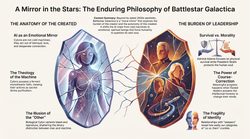
One way to understand it: certain issues function as moral mirrors. They compel a person to locate themselves on questions they genuinely care about — justice, power, the protection of the vulnerable, the integrity of institutions. The issue itself is almost incidental. What matters is the internal act of taking a position. Cambridge Analytica, Assange, conflict-zone suffering — these become occasions for moral self-definition rather than genuine attempts at influence.
There is also a dimension of witness. When a person in a comfortable Western city reads about a child in a war zone, there may be a sense that not knowing, or not caring, is itself a kind of moral failure. Attention becomes a substitute for presence. It changes nothing in the material world, but it refuses the alternative — which is indifference.
The working conclusion, then, is this: people engage with issues beyond their control not primarily because they expect to influence outcomes, but because their response to those issues defines — sometimes publicly, but always privately — who they are. The engagement is identity-constitutive rather than instrumental.
The Uneven Distribution of Mental Estate
This leads to a harder observation. The capacity to even notice that issues exist beyond one’s immediate world is itself unevenly distributed. And that distribution is neither fair nor chosen.
Consider what might be called a person’s mental estate — the total acreage of their inner world, the range of territory they can occupy and move around in with genuine comprehension. Some estates are large and varied. Others are small, with high walls. The person absorbed in local gossip and social media platforms is not necessarily wilfully indifferent to wider events. They may simply lack the cognitive and conceptual scaffolding to register that there is anything beyond the immediate. The narrowness is not a choice. It follows from the same factors that produce the wider estate in others — education, cultural exposure, neurological development, formative relationships, economic circumstance.
The troubling element is not the variation itself. It is that the person with the smaller estate often cannot see the walls. They are not experiencing deprivation — they are experiencing normality, as they know it. There is no felt absence.
The person with a larger mental estate, by contrast, carries a burden the other does not. Awareness of suffering elsewhere, engagement with moral complexity, sustained attention to epistemic uncertainty — none of these are comfortable possessions. Greater cognitive reach does not straightforwardly produce greater wellbeing. It may produce the opposite.
Eudaimonia Versus Happiness
This is where a distinction drawn from classical philosophy becomes relevant — the distinction between happiness and eudaimonia.
Happiness, in the modern hedonic sense, is a feeling. It is the subjective experience of joy, pleasure, satisfaction. The person happy in their bubble may, by this measure, be living well. They are not suffering. They are not troubled by complexity they cannot resolve. By hedonic standards, the narrower estate may be the more comfortable one.
Eudaimonia, as Aristotle understood it, is not a feeling. It is an activity. The flourishing life is one in which a person’s highest faculties are genuinely engaged — not one in which they feel joy but rather, contented. Comfort and discomfort are equal tenants in eudaimonia, but comfort is incidental rather than the point.
By eudaimonic standards, the person in the bubble — living pleasantly but not engaging the full range of their capacities — may be living well by one measure and poorly by another. The wider engagement with ideas, with injustice, with risk at a civilisational scale, is not a burden chosen out of duty. For those constitutionally inclined toward it, disengaging would not produce happiness. It would produce a kind of self-betrayal. The engagement is constitutive of how certain people function at their best.
But here a significant complication enters.
The Biopsychosocial Lottery
Neither the blinkered nor the unblinkered chose their starting conditions. Neither selected their neurology, their family, their culture, their formative experiences. The pathways diverged long before any meaningful choice was available.
This creates a serious problem for moral judgement. If the logic is followed strictly, the ground beneath any claim to credit or blame shifts considerably. A person cannot truly credit themselves for the wider engagement, any more than they can fault others for the narrower one. Both are downstream of factors that were never fully within anyone’s hands.
This does not mean all positions are equivalent. Some ways of living remain more examined, more engaged, more fully human in the eudaimonic sense. But it complicates the attribution. The person living eudaimonically well may simply have been luckier in their biopsychosocial lottery — blessed with the right neurological endowment, the right early environment, the right sequence of formative influences.
There is something almost vertiginous in this. The very capacity for this kind of reflection — recognising the unfairness of the distribution, questioning one’s own supposed advantages — is itself one of those unevenly distributed capacities. Most people cannot step outside their own pathway far enough to see it as a pathway at all. The result is an asymmetric awareness: those with the wider estate can see both estates; most people in the narrower one can only see theirs.
The Problem of Self-Authorship
This asymmetry leads to a deeper question, one that resists clean resolution. By what standard does any person evaluate their own life? And did they genuinely create that standard, or was it installed by the same biopsychosocial journey they are attempting to evaluate?
There is no Archimedean point. No position created by the ‘self’ can exist outside the self, from which to audit the self impartially. The standard by which a life is measured is itself a product of the pathway that produced the life. Even the impulse to ask the question — that too was shaped by forces never chosen.
Some people reach a point — often in middle age or later — where something like partial self-authorship becomes possible. The programming does not disappear, but the relationship to it changes. There is a shift from being carried by the formation to examining it whilst still running it. This is not full autonomy — that may not exist — but it is a meaningfully different mode of existence. The programming becomes at least partially reflexive.
The challenge is that there is no ledger. No objective measure of whether the trajectory improved, stalled, or merely changed character. The baseline was always shifting. Progress cannot be calculated against a fixed point because no such point exists.
Possession by the Past
Eleven years is a long time to carry a question. Yet some questions are not problems to be solved. They are permanent features of a certain kind of engagement with existence — returning at different points in life, wearing different clothes, generating new angles each time.
One such question concerns the degree to which a person is possessed by their past. The “early self” — the version shaped before any meaningful choice was available, by parents, teachers, books, cultural osmosis, formative trauma or comfort — does not disappear. It goes underground. It continues to orchestrate interests, emotional responses, relational patterns, and intellectual preoccupations, largely out of sight.
A person can be described as a thick woven rope. All the strands comprise the self. Some are buried deep; others stick out or fray at the surface. The early strands were woven without the person’s knowledge or consent. Later strands were added with increasing, though never complete, awareness. The present self is the sum of all of them — and cannot simply eject the early ones, however much reflection reveals them.
What is possible is a shift in the relationship to those strands. The outer self — the self that moves through the world and can observe the inner architecture with some critical distance — can develop an active relationship with the programming rather than mere subjection to it. Not rewriting it. Not escaping it. But navigating it consciously.
Acceptance Without Resignation
There is a distinction worth drawing carefully here. Acceptance of one’s particular path is not the same as resignation to it. Resignation implies defeat — a giving up of something genuinely desired. Acceptance, in the more considered sense, involves recognising what is and is not available for change, and directing energy accordingly.
The outer self, informed by the accumulated self-knowledge of decades, can make genuine adjustments. Not wholesale rewrites — those are not on offer. But recalibrations. Conscious redirections of attention, energy, and engagement that are consistent with the deep template whilst not entirely enslaved to it.
The gap between a person with a wide mental estate and most of the people they encounter in daily life is real. It does carry a cost — not loneliness, necessarily, but a kind of friction. Moving through a world largely built for and by those with narrower estates, whilst carrying an inner architecture that does not fit that world especially comfortably, requires a settled relationship with solitude. Not as deprivation, but as preference. The performative social world — requiring the projection of a self that is not one’s true nature — holds no appeal for someone constitutionally oriented toward genuine engagement over surface interaction.
Final Observation
What emerges from this line of thinking is not a tidy conclusion but a reasonably stable orientation. The wide mental estate was not chosen, but it is nonetheless genuinely one’s own. The eudaimonic path was not selected from a menu, but it is the path on which the highest faculties are most fully engaged. The blinkered may, by hedonic measures, enjoy life more. But enjoyment was never the metric.
The gnawing sense of gap between oneself and the wider world is perhaps best understood not as a deficit but as the price of admission to a particular kind of existence. An existence in which the programming is at least partially visible, in which the questions do not go quiet, and in which the estate — however it came to be — is inhabited as fully as possible.
That may be as much self-authorship as is honestly available to anyone.