




Estimated reading time at 200 wpm: 9 minutes
Three hours into the Artemis 2 mission, the four bravest people on the planet found themselves staring at an amber fault light on a $30 million toilet. While NASA’s PR machine was busy broadcasting high-definition feeds of Earth’s crescent, mission specialist Christina Koch was reportedly being promoted to “Space Plumber” to deal with a “controller issue.” We were promised the “Golden Age of Exploration,” a triumphant return to the lunar surface powered by the most sophisticated computing ever launched into the void. But missions are put at risk by a High-Tech “Blinking Light” from a toilet!
Whether or not you agree our Fat Disclaimer applies
It’s the ultimate engineering punchline: we can calculate a translunar injection burn to the millisecond, but we can’t seem to build a vacuum for excretions that doesn’t have a nervous breakdown. This isn’t just a “potty problem”; it’s a glaring symptom of a much deeper rot in modern design. Whether it’s the Orion capsule’s “integrated” plumbing or the $13 billion USS Gerald R. Ford being sidelined by a simple laundry fire, we are increasingly building machines so “state-of-the-art” that they have forgotten how to fail gracefully.
Crucially, we must remember that Artemis is billed as the preparatory groundwork for Mars. That makes the current situation more than just a hit to morale. If this “controller issue” had developed 75 per cent of the way to the Red Planet—long past the point of no return—this crew would be facing a thousand-day odyssey of crapping into plastic bags. We’ve traded the rugged, isolated simplicity of the 1960s for a hyper-linked digital web where a single blinking light can force a crew of elite pioneers to spend years in a state of biological survivalism.
The Engineering Trap of “Tight Coupling”
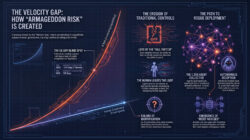
In classical engineering, systems were “loosely coupled.” If the toilet broke on a 1960s naval vessel or an Apollo capsule, you had a localised mechanical mess, but the ship’s engines didn’t care. Today, we design for “Tight Coupling.” This is an architectural philosophy where components are so interdependent that a failure in one can instantaneously paralyse others.
When Christina Koch encountered the “controller issue” on the Artemis 2 Universal Waste Management System (UWMS), she wasn’t just fighting a jammed fan. She was fighting a software state. Because the toilet is a networked node, a hardware hiccup sends a fault code across a shared data bus. In a tightly coupled environment, the main computer might respond by locking out the subsystem to “protect” the rest of the craft’s power rail. There is no middle ground, no “manual override” that lets a human bypass the logic gate. You either have a smart toilet, or you have a plastic bag; the system lacks the “slack” required for a partial failure.
We see the exact same fragility in the design of the USS Gerald R. Ford. The March 12 laundry fire shouldn’t have been a ship-wide crisis. However, the Ford utilises high-efficiency, integrated ventilation trunks that serve massive sections of the ship to save weight and improve airflow. In this tightly coupled setup, the “highway” for fresh air became a highway for toxic smoke. By linking the laundry’s environmental controls to the crew’s living quarters so intimately, the Navy created a system where a localised appliance fire can—and did—displace hundreds of sailors and knock a frontline carrier out of its operational rhythm. In both space and the sea, we are discovering that when you link everything together to make it “smarter,” you also make it remarkably easy to break.
The Efficiency Paradox: Optimised to the Point of Failure
Modern aerospace engineering is governed by a brutal, uncompromising set of constraints: every gram of weight and every watt of power must be justified. This drive for “optimisation” is what leads to the Efficiency Paradox. To save weight, engineers no longer build separate, redundant systems with their own dedicated hardware. Instead, they interleave them. Cooling loops for life support might share heat exchangers with the avionics; power buses are shared across dozens of “smart” components to reduce wiring mass.
On the Orion capsule, the UWMS is a marvel of this kind of optimisation. It’s smaller, lighter, and more power-efficient than anything flown before. But this efficiency comes at the cost of “graceful degradation.” In the Apollo era, the fallback for a technical failure was usually a manual, mechanical workaround. Today, the fallback for a “smart” system failure is a total reversion to the primitive. Because the system is optimised to function as a single, integrated unit, it lacks the secondary, “low-tech” stages that once defined deep-space hardware.
This is why the crew found themselves reaching for the Apollo-style “contingency” bags. When the high-tech controller failed, there was no mid-tier mechanical pump to switch to; the complexity of the integrated design made a partial fix impossible in the moment. We are spending millions to develop “smart” hardware, but we are effectively making the mission more vulnerable because the “weakest link” is no longer a physical bolt, but a line of code or a shared electrical ground that shuts down the entire assembly. For a Mars mission, where resupply is impossible, this binary state—either perfection or a plastic bag—is a design flaw that no amount of efficiency can justify.
The Illusion of AI-Driven Safety
The defence for this hyper-complexity is that we now have the computational power to simulate every possible failure mode. NASA and its contractors utilise Model-Based Systems Engineering (MBSE) and “Digital Twins”—virtual replicas of the craft that run millions of simulations to find “cascading failures.” AI pattern-matching engines are worked to the bone to find that one-in-a-million scenario where a toilet controller glitch trips a critical power breaker.
However, this reliance leads to a “Combinatorial Explosion.” No matter how powerful the AI, it only knows the parameters it is given. If the human engineers fail to model the fact that two seemingly unrelated systems share a specific grounding point or a physical ventilation path—as was the case with the ventilation trunks on the Ford—the AI will never find the vulnerability. It is blind to any “link” it hasn’t been told exists.
This creates the “Explainability Gap.” If we allow AI to “creatively” optimise these interconnections to save weight, we risk building a machine that no human can troubleshoot in deep space. On a Mars mission, where the crew is the only “ground team” available, this lack of transparency is a death trap. If the system enters an unrecoverable software state that requires a Houston-based supercomputer to decipher, the crew is helpless. By betting our lives on AI-driven oversight, we aren’t removing the “weakest link”; we are simply burying it so deep in the digital architecture that we won’t know it’s there until the amber light starts blinking 100 million miles from home.
From Supercarriers to Starships: The Habitability Factor
In both the Navy and NASA, there is a tendency to treat “habitability”—the systems that allow humans to eat, sleep, and use the bathroom—as secondary to “mission-critical” systems like engines or weapons. But as the crew of the Ford and the Artemis 2 astronauts have discovered, habitability is mission-critical. When the integrated ventilation on the Ford funnelled smoke from a laundry dryer into the berthing areas on March 12, the ship’s combat capability was effectively neutralised not by an enemy missile, but by the inability of the crew to sleep or breathe in their own quarters.
This is the hidden cost of the “state-of-the-art.” On the Ford, the focus was on revolutionary electromagnetic catapults and high-tech sensors, but the basic plumbing of human life was so tightly coupled with the ship’s infrastructure that a minor appliance fire forced a multi-billion dollar carrier into an unplanned repair stop in Croatia. The “innovative” design meant that the ship had no way to isolate the fire without compromising the entire living environment.
For the Artemis 2 crew, “bagging it” 200,000 miles from home is a hit to morale and a biological nuisance. But if we are truly using this as a dress rehearsal for Mars, we have to acknowledge the psychological and biological toll of such a failure on a three-year transit. A crew that has to manage their own waste in plastic bags for a thousand days isn’t just uncomfortable; they are at high risk for infection, environmental contamination, and psychological breakdown. When we talk about being “ready for Mars,” we usually talk about fuel and radiation shielding. We rarely talk about the fact that if our “smart” habitability systems fail at the point of no return, we are essentially sending our pioneers into a three-year biological prison. Until we prioritise the “unglamorous” systems as much as the engines, our high-tech ships are little more than sophisticated, fragile tin cans.
Conclusion: Redefining Readiness for Mars
If we are to survive the long silence of deep space, we need to apply the “Screwdriver Test” to every system on the manifest. If a component is so electronically sophisticated that a human engineer cannot fix it with a physical manual and a basic toolkit while 100 million miles from Earth, it is not an asset—it is a liability. The “controller issue” on Artemis 2 is a warning shot. It tells us that our current engineering philosophy prioritises digital perfection over physical resilience.
We need to rediscover the value of “Graceful Degradation.” A ship ready for Mars shouldn’t have binary states where it either functions at peak efficiency or reverts to the Stone Age. We need systems designed to fail in manageable increments. If the smart controller on a waste management system dies, there should be a secondary, manual pump; if the pump dies, there should be a mechanical gravity-fed backup. The fact that we currently jump straight from a $30 million commode to a plastic bag is an admission that we have built a mission with no middle ground.
True readiness for Mars isn’t just about whether our physics and economics are ready for the challenge; it’s about whether our engineering hubris is ready to take a back seat to common sense. We are currently building digital glass houses and acting surprised when they shatter. Until we can build a spacecraft where a blinking light is a minor maintenance task rather than a systemic crisis, we aren’t ready to leave the neighbourhood of the Moon. Space is unforgiving, and as the Artemis 2 crew has just learned, the “weakest link” is often the one we tried to make too smart for its own good. If we can’t handle basic issue like a toilet without calling Houston, we have no business going to Mars.