



Estimated reading time at 200 wpm: 15 minutes
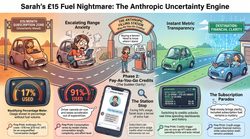
What exactly do you get for roughly £15 a month with Claude Pro? Anthropic describes usage limits, reset periods and the factors affecting consumption, but that doesn’t necessarily tell a subscriber how much useful work remains when the meter starts climbing. The following petrol-tank analogy with poor Sarah, has some fun with that uncertainty.
Whether or not you agree our Fat Disclaimer applies
A factual summary of the real Claude arrangement, with sources, follows at the end. Readers can get the story from the podcast video.
Sarah’s situation
Sarah is 30. She owns a fairly ordinary car and has recently signed up for a rather unusual way of buying fuel.
For about £15 a month, she subscribes to the Anthropic Pro Fuel Plan.
The proposition sounds attractive. Instead of paying for every journey, her monthly subscription includes an allowance of fuel.
Sarah has only one question.
Sarah: How much?
Anthropic Sales: The Pro plan gives you more usage than the Free plan.
Sarah: Yes. I mean how much fuel do I actually get?
Anthropic Sales: You receive your included Pro usage allowance.
Sarah: In litres?
Anthropic Sales: No.
Sarah: Gallons?
Anthropic Sales: No.
Sarah: Money’s worth?
Anthropic Sales: No. Your plan provides an included usage allowance, subject to usage limits.
Sarah considers this.
Sarah: So how much usage do I get?
Anthropic Sales: That depends on how you use it.
Not quite the answer she was after, but Sarah isn’t unreasonable.
Cars differ. Roads differ. Driving styles differ. Fuel consumption varies.
And there is, after all, a gauge on the dashboard.
So off she goes.
A Very Good Gauge
At first, the system seems perfectly satisfactory.
The gauge says:
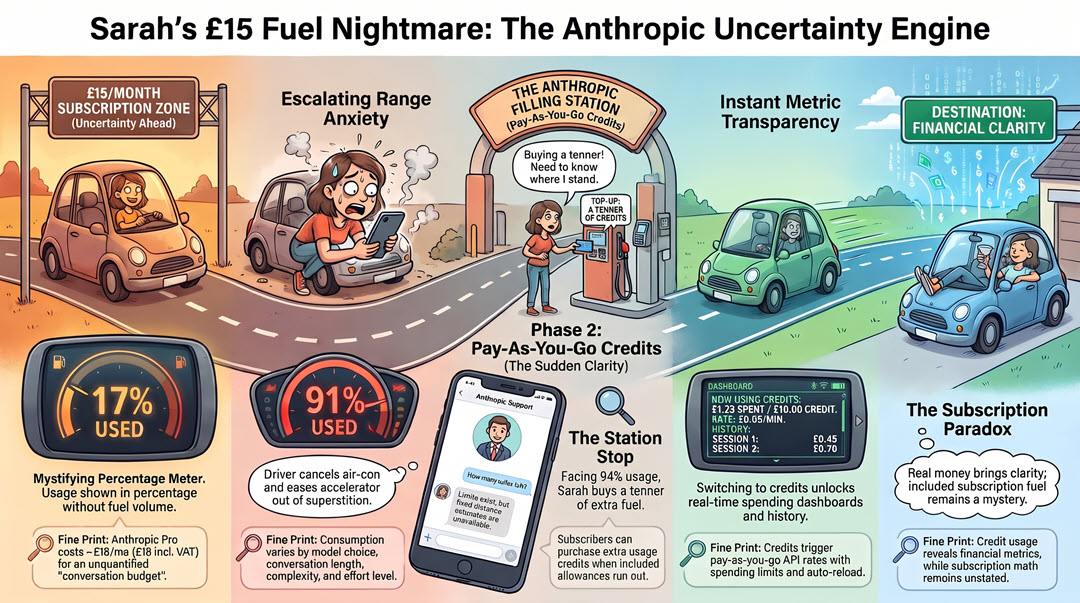
CURRENT USAGE: 17%
Later:
CURRENT USAGE: 32%
Then:
CURRENT USAGE: 54%
Sarah doesn’t give it much thought.
She has clearly bought something.
She is clearly consuming it.
And this extremely confident little instrument is measuring it to the nearest percentage.
The fact that Sarah doesn’t know the absolute quantity being measured seems more of an intellectual curiosity than a practical problem.
Until the gauge says:
CURRENT USAGE: 80%
Sarah looks at the road ahead.
She still has quite a long way to go.
She looks back at the gauge.
80%
For the first time, Sarah would rather like to know 80% of what.
The First Lay-by
Being a sensible driver, Sarah pulls into a lay-by.
She switches off the engine.
She takes out her phone and opens a Customer Service chat.
Anthropic Customer Service: Hello, Sarah. How can I help you today?
Sarah: Hi. My gauge says I’ve used 80% of my allowance and I’ve still got quite a way to go. I’m trying to work out whether I’ve got enough fuel to finish the journey.
Anthropic Customer Service: Certainly. Your fuel consumption can vary depending on several factors, including the length and complexity of your journey, the operating mode you’re using and the demands you’re placing on the vehicle.
Sarah: Yes, that makes sense. How far will the 20% I’ve got left take me?
Anthropic Customer Service: Unfortunately, we can’t provide a fixed distance because consumption varies according to usage.
Sarah: OK. How much fuel have I actually got left?
Anthropic Customer Service: Your gauge shows that you have 20% of your current allowance remaining.
Sarah: Yes. I know that bit. Twenty per cent of how much?
Anthropic Customer Service: Your included Pro allowance isn’t expressed as a fixed quantity of fuel in litres.
Sarah looks through the windscreen.
A white van passes.
She tries another approach.
Sarah: All right. How much did I have when I left home?
Anthropic Customer Service: You began with your full included allowance.
Sarah: Yes. How much was that?
Anthropic Customer Service: Your allowance isn’t expressed as a fixed quantity of fuel.
There is a pause.
Sarah: But you know I’ve used exactly 80% of it.
Anthropic Customer Service: Your dashboard shows your current usage, yes.
Another pause.
Sarah: Right.
Customer Service is unfailingly polite.
Sarah cannot actually fault anything she has been told.
She thanks them and ends the chat.
She still has absolutely no idea whether she is going to get home.
Sarah Develops Range Anxiety
Sarah rejoins the road.
She now drives differently.
Until ten minutes ago, she had been driving normally.
Now she is driving with the intense concentration of someone transporting nitroglycerine.
She eases off the accelerator.
There is a faster route ahead, but it looks rather demanding. She takes the gentler one.
She notices that the car is in Sport mode.
Sport mode is immediately cancelled.
The air conditioning is switched off.
Sarah pauses.
Does the air conditioning even count?
She has no idea.
She turns it off anyway.
At 80%, this is still resource management.
At 90%, it will become superstition.
The gauge advances.
83%
Sarah drives even more gently.
86%
She avoids an unnecessary overtake.
She has no way of knowing what effect this has on her allowance.
It feels economical.
That will have to do.
89%
Sarah begins glancing at the fuel gauge more often than the speedometer.
91%
The display changes.
CURRENT USAGE: 91%
Sarah: Oh, for God’s sake.
Another lay-by.
Indicator.
Pull in.
Handbrake.
Engine off.
Sarah opens the chat again.
Anthropic Customer Service: Hello, Sarah. How can I help you?
Sarah: Hello. It’s me again.
Anthropic Customer Service: Hello, Sarah.
Sarah: I’m at 91%.
Anthropic Customer Service: I can help explain how your usage limits work.
Sarah: I think I’m getting quite good at those. What I need to know is whether 9% is enough to finish the journey.
Anthropic Customer Service: That will depend on your consumption. Fuel usage can vary according to the type of journey and how the vehicle is being used.
Sarah: Yes. I know.
Sarah stares at the display.
91%
She has another thought.
Sarah: What happens if I run out?
Anthropic Customer Service: You can purchase additional usage credits to continue your journey after exhausting your included allowance.
Sarah sits upright.
Sarah: I can buy more?
Anthropic Customer Service: Yes.
At last.
Something concrete.
Sarah: Where?
Customer Service directs her to a nearby Anthropic filling station.
Sarah checks the route.
It’s not far away.
Relief.
Then the obvious question occurs to her.
Sarah: How much extra fuel will I need to buy to finish the journey?
Anthropic Customer Service: That will depend on your usage.
Sarah stares at the phone.
She considers several possible replies.
Most would probably get her barred from Customer Service.
Sarah: Right. Thank you.
93%
Sarah rejoins the road.
The Anthropic filling station is up ahead.
The gauge says:
93%
Now Sarah has a decision to make.
She still has 7%.
Seven per cent might easily get her home.
Or it might not.
There is an Anthropic filling station coming up.
If she drives past it and the remaining allowance isn’t enough, she may regret that decision.
If she stops, she might be buying additional fuel she didn’t need.
What she requires to make this decision is something motorists have traditionally found useful.
Range.
Not a percentage.
Not a warning.
Not an explanation that consumption varies.
Something along the lines of:
APPROXIMATE RANGE REMAINING: 46 MILES
Sarah’s car does not offer this.
It says:
93% USED
Sarah: Yes, you’ve been very clear about that.
A sign appears.
ANTHROPIC FILLING STATION 1 MILE
Sarah looks at the sign.
Then at the gauge.
94%
She indicates left.
Sarah: I’m stopping.
There comes a point at which uncertainty itself makes the decision.
The Anthropic Filling Station
Sarah pulls onto the forecourt.
An attendant walks over.
Anthropic Attendant: Good afternoon.
Sarah: Hello. I’ve nearly run out of usage.
Sarah hears the sentence only after she has spoken it.
Anthropic Attendant: No problem. You can use usage credits to continue once your included allowance is exhausted.
Sarah: Yes. Customer Service explained that.
Anthropic Attendant: Excellent.
Sarah: I’ve still got 6%.
Anthropic Attendant: I see.
Sarah: Is that enough to get me home?
Anthropic Attendant: That would depend on your usage.
Sarah smiles.
It isn’t a particularly happy smile.
Sarah: Yes. I’ve heard about usage.
Anthropic Attendant: Would you like to purchase some credits?
Sarah: I think so.
Anthropic Attendant: Certainly. How much would you like?
Sarah: I don’t know.
Anthropic Attendant: You can choose the amount you wish to purchase.
Sarah: Yes. The problem is I don’t know how much I need.
The attendant waits politely.
Sarah: How much extra fuel will a tenner buy me?
The explanation is different now.
Additional fuel isn’t part of Sarah’s included subscription allowance.
This is additional consumption.
It is paid for using credits.
Those credits have a monetary balance.
That balance will be consumed as Sarah uses the service.
There are applicable rates.
Sarah can also control how much additional money she is prepared to spend.
Sarah listens carefully.
For the first time all afternoon, she becomes intrigued rather than frightened.
Sarah: Hang on.
Anthropic Attendant: Yes?
Sarah: This stuff has a balance?
Anthropic Attendant: Your usage credits do, yes.
Sarah: A balance involving actual money?
Anthropic Attendant: Yes.
Sarah: And I can set a limit on how much I’m prepared to spend?
Anthropic Attendant: Yes.
Sarah looks back at her car.
The dashboard is still displaying:
94% USED
She looks at her debit card.
Then at the attendant.
Sarah: That’s interesting.
Anthropic Attendant: Is there anything you’d like me to clarify?
Sarah: I’m just thinking.
A few seconds pass.
Sarah: All afternoon I had fuel I’d already paid for, and the car could tell me I’d used 80%, 91%, 94%…
Anthropic Attendant: Yes.
Sarah: …but I couldn’t get an answer to “how much have I actually got?” or “will it get me home?”
Anthropic Attendant: Your included allowance is determined by your usage limits.
Sarah: Yes. Usage. I remember.
She holds up her debit card.
Sarah: But once this comes out, suddenly we’re talking about balances, rates and spending limits.
The attendant says nothing.
There isn’t really anything he needs to say.
Sarah looks again at the card.
Sarah: Funny what happens when the fuel meets money.
Fill Her Up
There is still the practical problem.
Sarah needs to get home.
Anthropic Attendant: How much would you like to purchase?
Sarah considers asking again how much she needs.
She decides against it.
She has been on this road before.
Metaphorically and, by now, almost literally.
Sarah: Oh, okay.. I’ll put a tenner on it.
Anthropic Attendant: Certainly.
She taps her card.
BEEP.
Payment accepted.
Sarah gets back into the car.
The display changes.
NOW USING CREDITS
She stares at it.
Then she laughs.
Not because anything is particularly funny anymore.
More because it is either that or start screaming.
She lowers the window.
Sarah: So I’m definitely using credits now?
Anthropic Attendant: That’s right.
Sarah: Good. I’d hate for there to be any uncertainty.
She starts the engine.
Anthropic Attendant: Have a safe journey.
Sarah: I’ll do my best.
Sarah begins to pull away.
Then the attendant remembers something.
Anthropic Attendant: Sarah?
She stops and lowers the window again.
Sarah: Yes?
Anthropic Attendant: Would you like to enable automatic top-up for future journeys?
Sarah looks at him.
Then at the road ahead.
Then at the fuel gauge.
Then at the debit card still in her hand.
Sarah: Let’s just see if the tenner gets me home first.
Something Strange Happens to the Dashboard
Sarah pulls back onto the road.
She still has the last few drops of her included allowance, whatever they might be.
The familiar gauge continues its solemn countdown.
96% USED
Then:
98% USED
Sarah drives as though there were an egg balanced on the accelerator.
The air conditioning remains off.
She isn’t entirely sure why.
At this stage she isn’t taking any chances.
99% USED
Then comes a soft electronic chime.
PING.
The dashboard flickers.
For a moment it goes blank.
Then:
INCLUDED ALLOWANCE EXHAUSTED
A second message appears.
NOW USING CREDITS
And suddenly the dashboard seems rather more interested in Sarah’s fuel.
New information appears.
Her purchased credit balance is visible.
There is information about current consumption and spending.
There is even usage history.
Sarah nearly misses her turning.
Sarah: Bloody hell.
She slows down.
Sarah: Where have you lot been all afternoon?
For most of the journey she had been driving with a percentage gauge attached to a quantity she couldn’t translate into anything particularly useful.
Now that the fuel is coming out of her additional tenner, the dashboard has become positively chatty.
Sarah watches it for another few miles.
The new information doesn’t tell her everything. It doesn’t suddenly provide a guaranteed mileage for every penny.
But Sarah can now see enough about the paid fuel and its consumption to feel considerably less blind than she did twenty minutes ago.
She looks at the distance remaining.
Then at the new displays.
Then back at the road.
For the first time since the gauge reached 80%, she begins to think:
I’m going to make it.
The Last Few Miles
Sarah continues carefully.
Not quite as carefully as before.
The air conditioning goes back on.
This feels almost rebellious.
For the last few miles she keeps glancing at the new information on the dashboard.
Money is being consumed.
Fuel is being consumed.
The house is getting closer.
Everything appears to be heading in approximately the right direction.
Sarah begins to relax.
Then she becomes annoyed that she is relaxing.
She has, after all, paid £15 for a monthly fuel plan, spent half the afternoon anxious about whether she had enough of an unquantified allowance to complete an ordinary journey, pulled into two lay-bys, contacted Customer Service twice, altered her driving behaviour, stopped at the company’s filling station and handed over another tenner.
And now she is feeling grateful because the car appears likely to get her home.
Sarah: This is ridiculous.
The dashboard offers no opinion.
Ten minutes later, Sarah turns into her street.
Then into her drive.
She stops the car.
Handbrake.
Engine off.
Silence.
Home.
Sarah remains in the driver’s seat for several seconds.
She looks at the dashboard one final time.
Earlier that afternoon it had confidently told her that she had used 80%, then 91%, then 94% of an allowance whose absolute size she had been unable to establish.
Now it is displaying considerably more information about the additional fuel she has paid for.
Sarah looks at it.
The dashboard looks back.
Sarah: I still don’t know what the bloody £15 bought me.
She gets out.
Journey Completed
Sarah walks into the house.
Keys on the table.
Coat off.
Shoes off.
Kitchen.
Cupboard.
Gin.
A substantial measure goes into the glass.
Sarah considers it.
Adds a little more.
Tonic.
Ice.
She carries the drink into the sitting room and collapses onto the sofa.
Her phone buzzes.
Sarah looks at it suspiciously.
For one horrible moment she thinks it might be Anthropic Customer Service.
It isn’t.
She puts the phone face down.
Then she considers the day’s achievement.
She has arrived home safely.
She has learnt that her £15 subscription includes an allowance.
She has learnt that the allowance has limits.
She has learnt that numerous things affect how quickly those limits are reached.
She has learnt that the gauge can tell her with remarkable confidence when she is approaching those limits.
She has learnt that none of this necessarily tells her what she really wants to know when she’s at 80% and still has somewhere important to get to.
And she has learnt that, should matters become sufficiently desperate, the Anthropic filling station takes cards.
Sarah takes a long sip of gin and tonic.
A thought occurs to her.
Tomorrow, her journey continues.
She reaches for the gin bottle.
Sarah: Better make that a double.
A note on what Claude Pro actually does
The petrol-tank story above is satire, not a literal description of how Claude measures computation. The underlying features it plays with, however, are real.
Anthropic describes a Claude usage limit as a “conversation budget”. Paid plans generally have a session limit that resets every five hours and weekly limits that reset once a week. Anthropic says usage is affected by factors including the length and complexity of conversations, the features used, the Claude model selected and the effort level selected. It also states that usage limits may be adjusted at its discretion to manage capacity and ensure fair access. See Anthropic’s explanation of usage and length limits.
What Anthropic’s published consumer explanation does not provide is a simple absolute quantity behind that included Pro “conversation budget” that would let a subscriber translate, for example, 80% usage into a predictable quantity of remaining work. The Usage page does show how much of the current session has been used and when it resets, but the amount of work possible within the allowance varies with the factors above.
Anthropic separately offers usage credits to subscribers on paid plans who want to continue after exhausting an included limit. Once an included limit has been fully used, and usage credits are enabled and funded, subsequent requests switch to pay-as-you-go pricing at standard API rates. Claude then displays “Now using credits.”
Anthropic says purchased usage credits can be monitored through a Usage dashboard showing real-time consumption, month-to-date usage-credit costs, and usage history. The dashboard distinguishes this paid credit consumption from the usage included in the subscription. Users can also set a monthly spending limit and, on the web, configure automatic reloading of credits. See Anthropic’s guide to usage credits for paid Claude plans.
Anthropic does not describe this consumer usage history as a prompt-by-prompt or conversation-by-conversation financial ledger. Accordingly, the satire should not be read as claiming that purchasing credits suddenly gives the subscriber perfect knowledge of future consumption. The point of the analogy is narrower: the subscriber can see movement towards an included usage limit without being given an absolute measure that makes the remaining allowance readily predictable, while consumption beyond that limit enters a separately funded, consumption-priced system with additional cost and usage information.
Links checked against Anthropic’s published documentation, 7 November 2026.

The £15 Anthropic Fuel Plan: complete with digital range anxiety
Captain Walker