







Estimated reading time at 200 wpm: 6 minutes
In mid-August 2026, I explored the shifting landscape of API pricing and what it meant for professionals relying on artificial intelligence for deep, sustained analysis. See: DeepSeek’s New API Pricing: What It Actually Means for Heavy Users – The Captain’s Watch. The core premise of that piece remains entirely unchanged: for serious analytical work, direct API access consistently outperforms standard web-based interfaces, which are inherently fashioned for the general public and constrained by simplified guardrails. However, as our reliance on these tools deepens, the conversation must evolve beyond merely comparing per-token rates.
Whether or not you agree our Fat Disclaimer applies
True cost efficiency for heavy users requires architecting a deliberate, multilayered routing strategy. This update details how combining strategic model delegation with rigorous empirical testing has uncovered a genuinely free (at this time), high-capability analytical engine in Z.ai’s GLM-4.7-Flash. By leveraging direct API access through a local OpenWebUI v0.11.1 instance running in Docker on Windows 11, professionals can now approach large-scale document review without incurring prohibitive costs, fundamentally altering the economics of long-running analytical threads. Cost per million tokens (MTok) matters.
This is not a tutorial
1. The Premium Trap and the Reality of Context Bloat
Professional analysis is rarely a single, rapid-fire query. It is more often an intermittent, evolving dialogue that spans hours or even days. A user might introduce a complex topic with a brief prompt, follow it with a dense forty-thousand-word document, and return later to cross-reference it with a second, equally substantial report. The hidden financial trap in this workflow is what we must term context bloat. Every time a new prompt is sent within an active thread, the API must re-process all preceding tokens to maintain conversational continuity. If a user relies on a single, premium-tier model for this entire duration, they are repeatedly paying top dollar to re-read the same foundational text. This brute-force approach is not only financially unsustainable over time, but it is also cognitively inefficient. As the token count swells, the model’s attention can become diluted across massive contexts, leading to superficial responses and missed nuances. Recognising this dynamic is the first step toward building a more sophisticated, cost-effective operational framework.
2. The Empirical Proof: GLM-4.7-Flash as a Primary Analytical Engine
Industry benchmarks frequently categorise flash or mid-tier models as incapable of high-level professional critique, relegating them to simple summarisation tasks or basic data extraction. However, empirical testing in a real-world environment consistently trumps generalised assumptions. Recent stress tests involving the direct API access of GLM-4.7-Flash on structured professional documents—specifically a 684-kilobyte PDF and a comprehensive 1.3-megabyte report—have yielded results that fundamentally challenge this hierarchy. Rather than merely regurgitating the text or offering surface-level observations, the model demonstrated advanced inferential reasoning and a precise application of domain-specific risk management frameworks.
In one instance, it sharply identified an evidence-conclusion gap where a report used probabilistic language, stating there was a likely risk of re-traumatisation, despite the text containing explicit, documented survivor testimony of established harm. It correctly flagged this as risk-deferral language that a professional investigator would challenge, noting that in patient safety, intent is secondary to outcome. Furthermore, it systematically dismantled feasibility assumptions. It pointed out the stark logical contradiction of a report recommending trauma-informed care—which requires time, trust, and continuity—within a system the report itself acknowledged was plagued by workforce vacancies and ever-increasing referrals. It correctly identified this as creating a compliance illusion, where standards are set systemically impossible to meet, thereby positioning individual practitioners to fail. It even identified accountability gaps, noting that while the report identified long waiting lists as a critical barrier to care, its recommendations entirely failed to address resource allocation or interim protections, creating a policy framework without teeth. This level of structural critique, delivered at a near-zero cost, proves that GLM-4.7-Flash can serve not merely as a pre-processor, but as a primary analytical engine for structured, professional documents.
3. The Critical Mechanic: Direct Access Versus Proxy Markups
To fully capitalise on this capability, one must understand the financial mechanics of the current API landscape and avoid a common administrative trap. While Z.ai officially lists GLM-4.7-Flash at zero cost for both input and output tokens, this free status is frequently obscured by third-party aggregator services. If a user accesses the model through a proxy API or a middleware platform, that middleman will often apply a quiet markup to cover their own infrastructure costs, charging a few cents per million tokens. While still cheap compared to frontier models, this entirely negates the absolute zero-cost advantage.
To secure the legitimate free tier, users must configure their local environments to connect directly to the source. In the context of an OpenWebUI deployment running in Docker on Windows 11, this means bypassing intermediary routing and configuring the connection settings in the admin panel to point directly to the official Z.ai developer endpoints using a direct API key. This simple mechanical adjustment ensures that the heavy user reaps the full benefit of the provider’s subsidised tier without leaking funds to unnecessary middlemen.
4. Architecting a Resilient, Multilayered Workflow
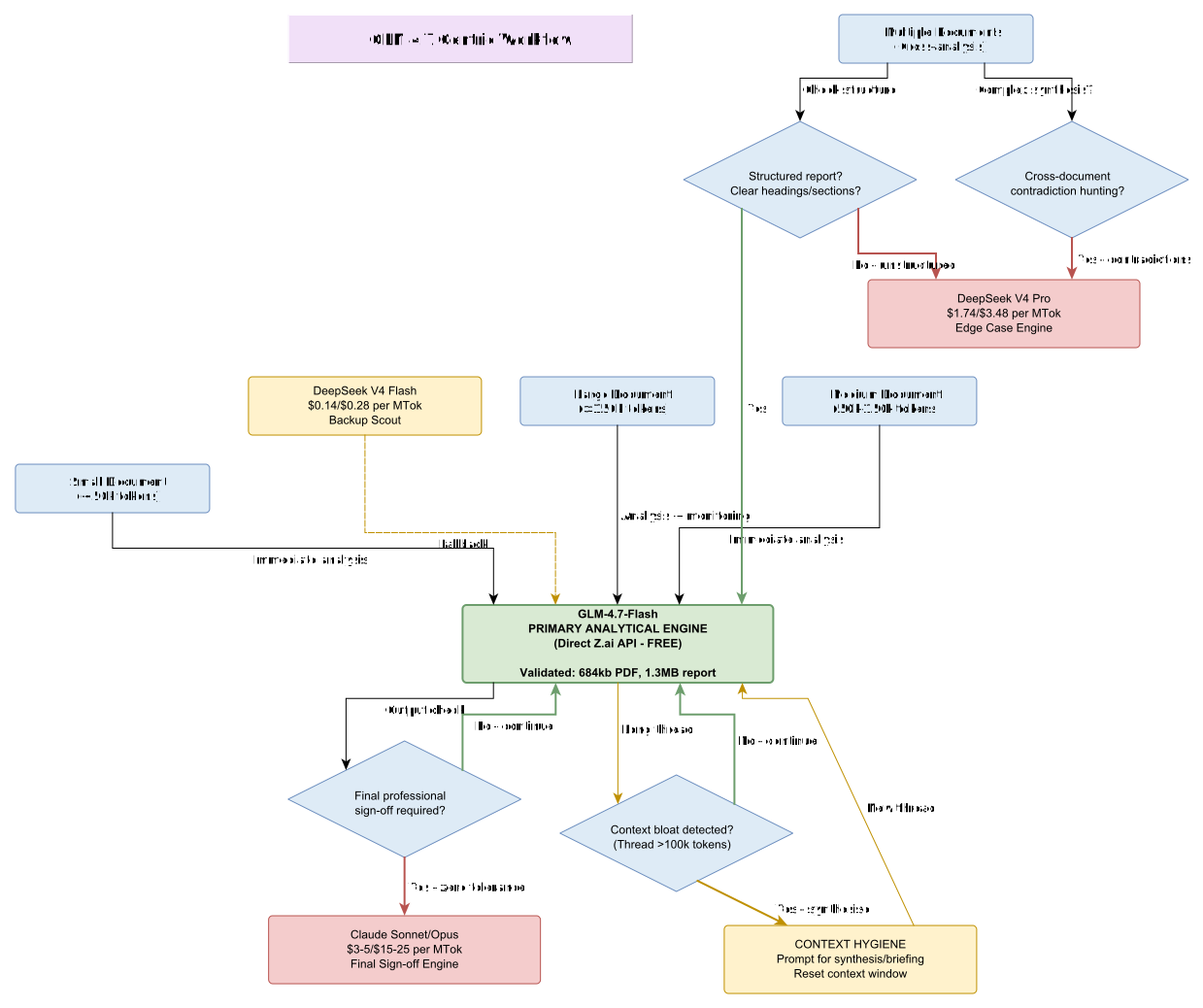
Adopting a free, high-performing model as a primary workhorse requires a few minor operational adjustments to ensure the workflow remains robust and reliable over time. The most critical of these is the practice of context hygiene. Even though the tokens are free, pushing any model beyond its optimal attention span can degrade output quality. In a multi-day thread involving several large documents, it is highly effective to periodically prompt the model to synthesise the key conclusions and outstanding questions into a concise briefing. Initiating a fresh chat with this briefing resets the context window, keeping the model sharp and focused without losing the analytical thread.
Furthermore, a resilient workflow embraces a multilayered approach. While GLM-4.7-Flash handles the vast majority of heavy lifting and sustained analysis, it is prudent to maintain a configured, paid fallback model, such as DeepSeek V4 Pro or Anthropic’s Claude Sonnet, within the OpenWebUI interface. Because OpenWebUI allows for seamless model switching via a simple dropdown, these premium models can be reserved strictly for edge cases, such as hunting for subtle contradictions across multiple disparate documents simultaneously, or processing highly unstructured, messy data where advanced pattern recognition is paramount. Should Z.ai ever experience an outage or adjust its free-tier parameters, the user can instantly switch models without breaking their workflow or losing momentum.
Conclusion
The modern landscape of professional analysis and authorship is defined by accessibility and self-reliance. The barrier to success is no longer about seeking permission from gatekeepers or maintaining massive software budgets, but about the persistence to optimise one’s own tools. By moving beyond the default settings of consumer applications and actively engineering a multilayered, empirically tested API workflow, professionals can achieve both analytical depth and financial sovereignty. The discovery of a genuinely free, high-capability engine like GLM-4.7-Flash is not just a cost-saving measure; it is a testament to the value of rigorous, hands-on testing in reclaiming control over our digital environments.