



Estimated reading time at 200 wpm: 11 minutes
Imagine you’re on a cruise of your lifetime. You paid your money. You’ve been sipping pina coladas on sprawling sun-bathed decks over the last few days. You end another day in paradise, you get into bed with a smile. But then you are awakened by an announcement, ‘We are sorry to announce that the Endless Cruise has come to an end. We thought it would be best to let you know early. Further details will follow.’ What the hell!
Whether or not you agree our Fat Disclaimer applies
You fall into a state of confusion. You find a leaflet that has been slid under the door to your cabin. That’s the story here. Read on.
Eight hours to leave
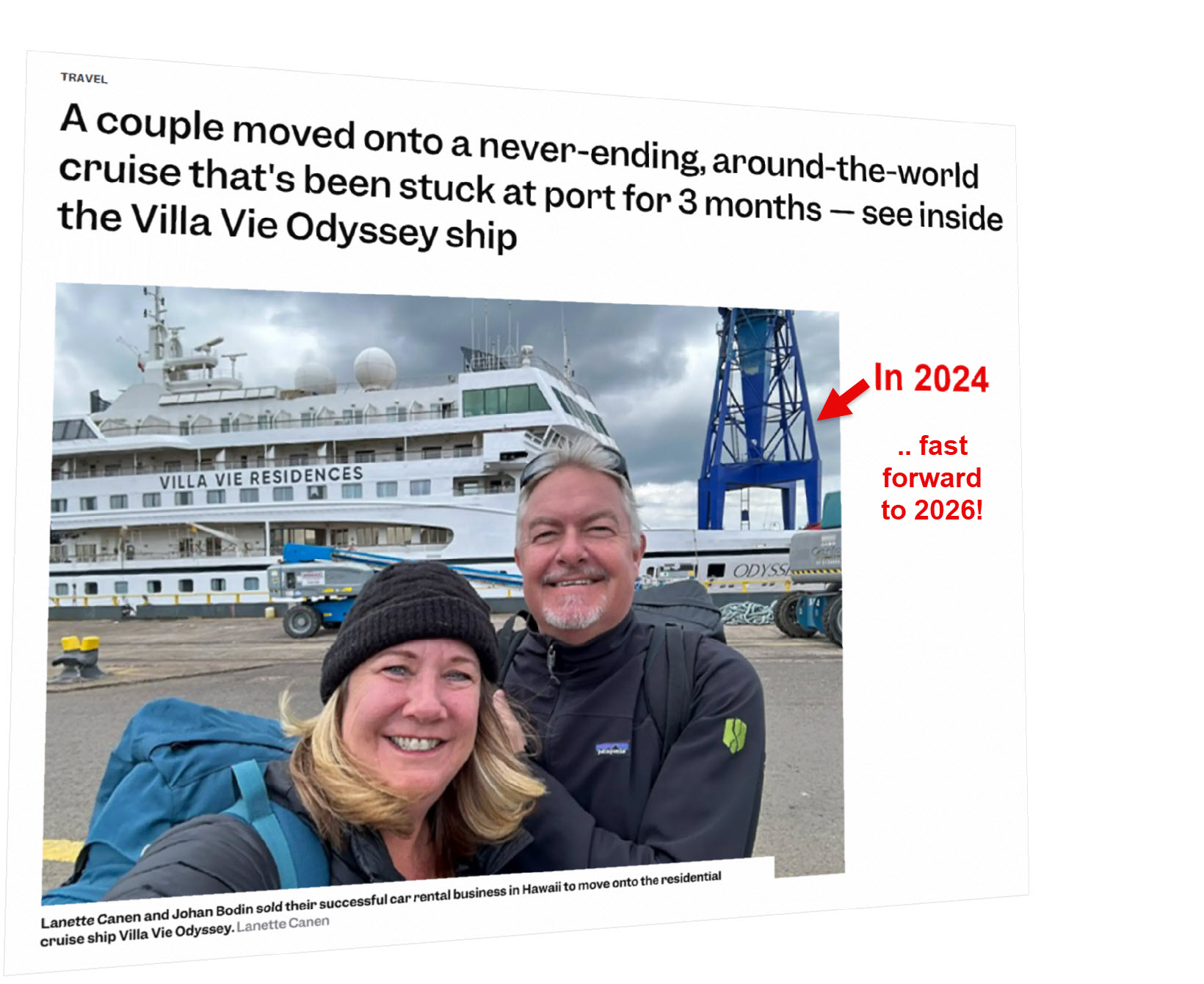
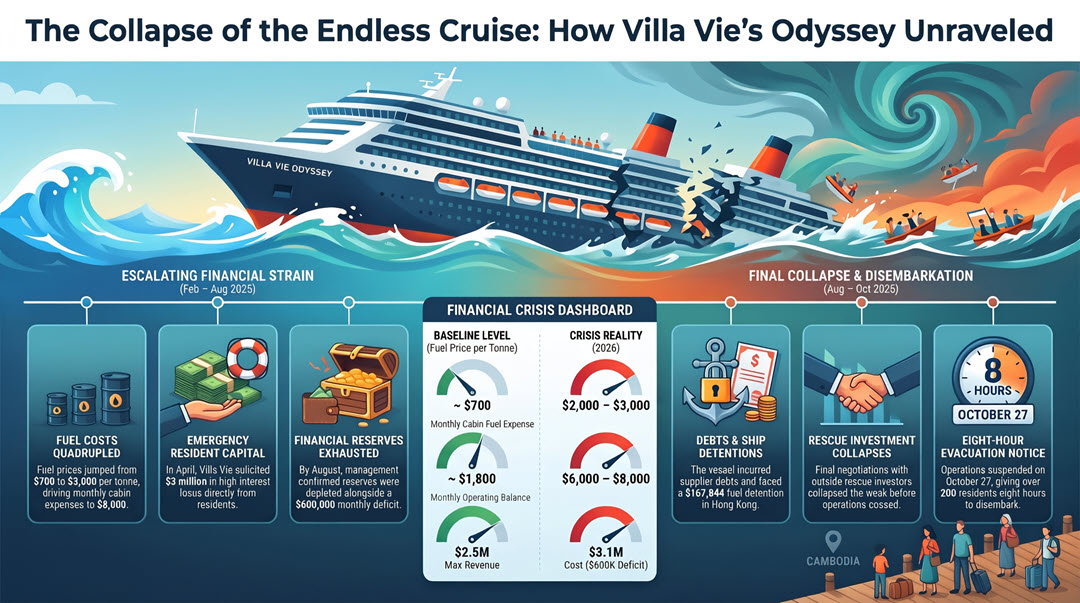
At about 6 a.m. on 27 October 2026, Lanette Canen and Johan Bodin received a notice aboard the Villa Vie Odyssey. Everyone had to leave by 2 p.m. The couple had lived on the ship since its voyage began. They now had eight hours to pack their belongings and say goodbye to their home.
They were not alone. More than 200 residents were required to disembark in Cambodia after Villa Vie Residences suspended operations. Crew would remain aboard to maintain essential systems. The people who had bought or rented a life at sea had to find somewhere else to live.
Canen and Bodin told Business Insider that they knew departure was possible. The speed of it still shocked them. They described a “deep sense of heartbreak” as they packed.
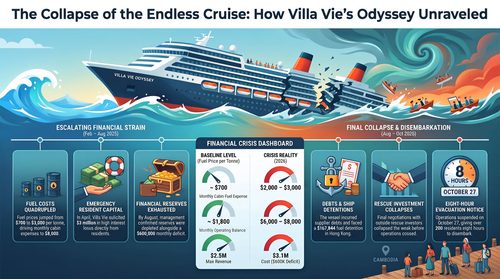
Villa Vie blamed an extraordinary increase in fuel costs following the outbreak of war involving Iran in February. It said slower sailing and longer port stays had failed to offset the increase. The company could no longer carry the resulting operating losses.
That explanation identifies the immediate pressure. It does not explain the condition of the business that received it. An adequately capitalised operation might struggle with such a shock. Villa Vie had already been asking residents for emergency loans. By August its chief executive said available reserves were exhausted. Internal documents showed debts, urgent fundraising and warnings that operations could stop.
The central question is therefore not whether management could have predicted the exact date of suspension. It is when those running Villa Vie knew that the Odyssey could not continue on its existing finances without new money or a material change in circumstances.
The product was continuity
Villa Vie was not selling an ordinary cruise. Its marketing invited customers to “make the Odyssey your permanent home”. It offered cabin and residency rights, rentals and rent-to-own arrangements. Business Insider reported prices for permanent cabins from $119,999 to $439,999. Five-year residencies started at $59,999. The promised itinerary included more than 400 ports and a circumnavigation every three and a half years.
The appeal was easy to understand. Residents could travel without repeatedly flying, packing or changing accommodation. Their neighbours could become a settled community while the view outside changed.
The purchase also required more trust than a conventional holiday. A cruise passenger needs an operator to provide a voyage of fixed duration. A resident committing a large sum needs the operator to run a ship for years. The cabin’s value depended on fuel, crew, insurance, maintenance, suppliers and access to ports. It depended on the company’s ability to keep paying for all of them.
Villa Vie was selling accommodation, but the attraction lay in continuity. A cabin on a ship travelling around the world could be a home. The same cabin on a ship that could not sail was a very different asset.
That distinction matters when assessing the company’s conduct. Financial weakness did not simply threaten future profits. It threatened the service on which the entire residential proposition rested.
From fuel shock to financial emergency
The earliest striking episode in the public record dates from April 2026. Villa Vie sought $3 million in emergency loans from residents. A letter reviewed by Cruise Industry News offered annual interest of between 12 and 24 per cent. It proposed monthly interest-only payments and repayment of the principal after 12 months. The publication could not establish how much money was raised.
The request showed that Villa Vie needed money beyond its ordinary resources. It also turned residents into potential creditors of the company responsible for keeping their homes in service.
Fuel explains much of the urgency. Mikael Petterson told CBS News that Villa Vie had paid an average of about $700 per tonne before the war. Afterwards it paid between $2,000 and $3,000. He said the Odyssey consumed approximately 700 to 800 tonnes each month.
Villa Vie’s own figures described the problem in residential terms. It said monthly fuel expense per cabin had historically averaged about $1,800. In parts of Asia it had recently reached an estimated $6,000 to $8,000. Passing the full increase on to residents was not considered realistic.
The company tried to reduce consumption. It slowed the itinerary and spent longer in port. Petterson said the ship remained in some ports for five or six days while management hoped conditions in the Middle East would improve.
These measures could reduce fuel use. They could not remove the need to buy it. Nor could they continue indefinitely without changing the experience residents had purchased.
By 1 August, the language from management had become much starker. In an “urgent” operational update, chief executive Kathy Villalba told residents that previous contributions had covered only part of the additional fuel costs. The company had “exhausted its available reserves” while covering the shortfall and keeping the ship moving.
“We have now reached a critical point,” she wrote.
This was a contemporaneous acknowledgement from Villa Vie’s chief executive almost three months before the suspension. Villalba described an immediate cash-flow problem. She asked residents for support beyond their contractual payments so that the company could buy fuel and preserve the voyage.
Reporting by CBS News subsequently revealed the wider position. Internal documents showed that Villa Vie was several million dollars in the hole while the ship was in Singapore. Hundreds of thousands of dollars were owed to a port agent, fuel companies, food suppliers and crew.
At a town hall on 4 August, residents were warned that operations could stop. Staff could be laid off and crew repatriated. Documents reviewed by CBS indicated that the ship was potentially days away from losing its insurance.
One document pointed to a problem beyond the immediate shortage of cash. It put average monthly operating costs at $3.1 million. Revenue at full occupancy would have been $2.5 million, even with every resident paying full fees. That implied a monthly loss of $600,000 before considering any unsold cabins.
A source close to the company disputed the cost figure. The source claimed that monthly operating costs were under $1 million. Those competing accounts cannot be reconciled from the public reporting. The document should therefore be treated with caution. It remains significant because CBS reviewed it alongside evidence of debts and explicit warnings about cessation.
The company’s observable conduct is less ambiguous. While the Odyssey was stuck in Singapore, passengers raised money to help it continue. Sources told CBS that $400,000 was paid to a fuel supplier directly from one resident’s personal current account.
Later, court records showed that the ship was detained in Hong Kong until Villa Vie paid $167,844.48 to a fuel provider. These were practical demonstrations of how close the financial problems had come to the basic requirements of operating the vessel.
The search for money continued. According to sources aboard, Villa Vie asked residents for another $360,000 for fuel shortly before the suspension. Petterson later said that the company had borrowed money and stretched payrolls while searching for a financial partner. He had expected an investment until talks broke down during the week before the suspension.
The fuel shock was real. So were the attempts to mitigate it. By late October, however, Villa Vie had spent months relying on borrowing, resident contributions, cost reductions and the prospect of outside investment. None had produced a durable solution.
Rescue attempts and customer money
The fundraising evidence requires careful treatment. Seeking rescue capital is consistent with management trying to save a business. It does not demonstrate an intention to let the venture fail.
A source close to Villa Vie told CBS that external cabin sales stopped after 4 August. Current residents were still offered discounted cabins through an emergency Villa Incentive Program. By 18 August the company reported commitments for more than 20 cabins. A presentation about the programme ended with the words “Funds are due today”.
Existing residents were not approached without any knowledge of the difficulties. They had received appeals for money and warnings about the ship’s position. What each person understood before contributing would depend on the communications they received.
The position of newer customers is less clear from the public record. Lisa McKay, a former teacher from Queensland, used her superannuation to pay A$63,500 towards a retirement at sea. She was due to board in Kuala Lumpur on 15 November.
McKay told the Australian Broadcasting Corporation that she had raised concerns about Villa Vie’s finances before paying. Messages seen by the ABC showed a booking agent reassuring her. The agent said she would not be working for the company if she thought it was in trouble. She also said Villa Vie would arrange another ship if the Odyssey could no longer operate.
The report does not establish the date of McKay’s payment. Her case therefore cannot show by itself that Villa Vie accepted her money after the August warnings. It does show how the consequences extended beyond those already living aboard. Establishing misleading conduct would require evidence about individual transactions and the authority behind particular sales assurances.
That uncertainty should not be used to avoid the separate question of management knowledge. The public evidence is much stronger on that issue.
What management knew
The available record does not include Villa Vie’s internal cash-flow forecasts. It cannot show the first moment at which a particular executive concluded that the operation was unsustainable. Nor can it establish that everyone in management shared the same understanding.
Those limitations matter. They do not erase what the company said and did.
By 1 August, Villalba had acknowledged that reserves were exhausted. Within days, residents were being warned that operations could stop. Villa Vie was seeking emergency funds while suppliers and crew were owed money. Its chief executive had described continued operation as dependent on support beyond existing contractual payments.
Management also had information unavailable to outside observers. Those responsible for the business could see its income, liabilities, cash position and supplier bills. They knew how much fuel the ship consumed and how quickly its price had risen. They knew how much additional money was required to fill the gap.
Several outcomes remained possible. Fuel prices could fall. Creditors could allow more time. New residents could provide revenue. An investor could rescue the company. Management was entitled to pursue those possibilities and may sincerely have believed that one would succeed.
Hope of rescue, however, does not change the condition that made rescue necessary.
Conclusion
There is an important difference between knowing that failure is inevitable and knowing that continuation has become conditional. The evidence supports the second conclusion. Villa Vie could have survived if investment arrived or circumstances improved sufficiently. Its existing resources were no longer enough.
On the balance of probabilities, management knew by August that the Odyssey could not continue on its established financial course without substantial new money or a material improvement in conditions. That conclusion does not require proof of fraud. It does not establish that customers were deliberately deceived. It also does not diminish the efforts made to save the venture.
Villa Vie formally suspended operations on 27 October. Its announcement said that fuel costs had placed the operating model under “unsustainable financial pressure”. The company proposed to pursue restructuring and recapitalisation over the following 60 days. It also cautioned that no financing or transaction had been finalised and that no outcome was assured.
The company had spent months trying to avoid the outcome that residents experienced in a single morning. Those efforts deserve acknowledgement. They also reveal how narrow its margin for survival had become.
Villa Vie did not need to know the day the dream would end. By August, its management knew that continuation depended on rescue. When rescue failed, people who had bought into the promise of a permanent home had eight hours to leave.