Estimated reading time at 200 wpm: 10 minutes
What is power? The word appears everywhere. We speak of political power, purchasing power, horsepower, electrical power, power of attorney, statistical power. Each domain offers its own technical definition shaped by its particular concerns. But is there something fundamental beneath these variations? Something that unifies them?
Whether or not you agree our Fat Disclaimer applies
Rather than cataloguing the many meanings of power across disciplines, I wanted to find what they share. Working from first principles rather than accumulating definitions. The question was simple: what is power, essentially?
The fundamental definition
Power is the capacity to cause change for better or for worse.
That’s it. Whether we’re discussing a car engine, a president, a judge, an electrical grid, or a hurricane, power is the capacity to alter the state of things. These aren’t merely related by analogy or metaphor. They are instances of the same fundamental phenomenon appearing in different substrates.
The variation is in delivery—mechanism, speed, scale, duration, reversibility, domain of effect. But not in essence.
This definition sidesteps some common confusions. People often conflate power with force or coercion. But those are specific mechanisms for causing change, not power itself. Persuasion causes change. Money causes change. Simply being present in a room causes change in certain circumstances. All are expressions of power.
Categories of power
Once we have the fundamental definition, interesting distinctions emerge—not in what power is, but in how it manifests across different kinds of entities.
Inanimate power
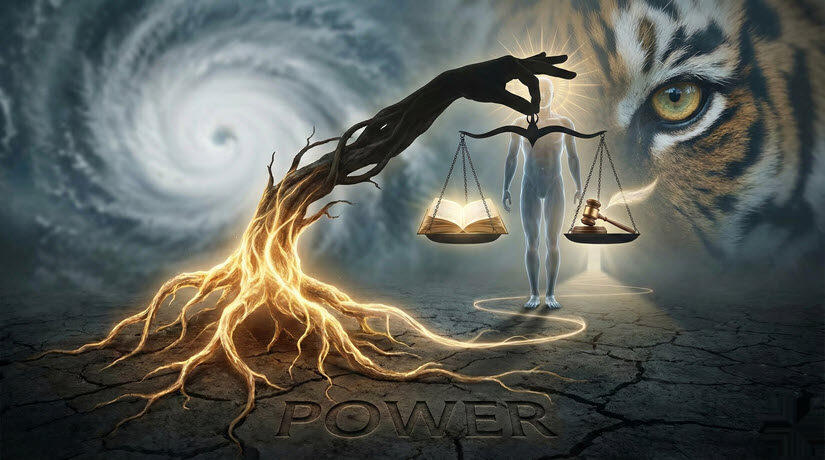
A hurricane, an earthquake, a powerful engine. These possess real power—genuine capacity to cause change. But this power operates through physical processes alone. Energy, active or potential, released according to the laws of physics.
There is no direction here except what physics dictates. The hurricane does not choose its path in any meaningful sense. It neither exercises nor withholds its power. It simply releases energy according to conditions.
Animal power
A tiger, an elephant, a horse in its natural habitat. These possess immense capacity to cause change. But this is not purely mechanical like an earthquake. There is biological agency—behaviour, instinct, response to environment.
Yet without sentience, there is no will in the full sense. No discretion or restraint. The tiger acts according to its nature, its drives, its conditioning. It cannot reflect on its power or choose to withhold it. The limitation is absolute and invisible to the animal itself.
Human power
Human power inherits the energetic substrate—we are physical beings—and builds upon biological agency. But it adds something further: will.
Will transforms mere capacity into directed capacity. We choose whether to act, when, how, toward what end. This is what makes human power distinctive and what freights it with moral weight.
Several features emerge as uniquely human:
Will directs capacity toward chosen ends. Without will, there is only energy seeking release.
Discretion is the power to choose whether to act at all. A surgeon may have the skill to operate but after robust assessment may say, “I don’t think an operation is the best path.” The decision not to act is itself an exercise of power. Someone lacking surgical skill has no such choice to make.
Restraint goes further than discretion. It is the deliberate, ongoing withholding of power that could be exercised. Not a single decision point but sustained will. The power remains present, even felt, though unexpressed. Restraint is active, not passive.
Competence fuses skill with judgement. The surgeon’s power is not merely technical capability. It includes knowing the limits of that capability—when not to operate, when to refer, when to acknowledge that a situation exceeds one’s abilities. Skill without judgement is dangerous.
Moral weight attaches to human power precisely because will is involved. We become answerable for how capacity is used. A tiger that kills is not evil. A human who kills bears responsibility. The power may be equivalent. The presence of will makes all the difference.
Institutional power
Institutions present a genuinely distinct case. They are human creations, not natural phenomena. Yet the will within them is diffused, distributed, sometimes absent entirely at the point of effect.
A policy might change thousands of lives without any single person directing that outcome. The institution acts, but who willed it? Responsibility fragments across committees, procedures, precedents, inherited structures. The humans currently within the institution may not have created the power being exercised. They inherited it.
Some institutional power is designed deliberately—a legislature creates enforcement capacity with intention. But much emerges through accumulated decisions, cultural drift, procedural accretion. Nobody specifically willed it into being. Yet there it is, causing change.
This may explain why institutional dysfunction feels so intractable. The power is real but the directing will is absent or so distributed as to be effectively absent. Change requires will. If no one person holds sufficient will-plus-capacity, the institution continues on its trajectory regardless of whether anyone within it wants something different.
Institutions may be where human power becomes partially decoupled from human will.
Legal powers
Legal powers present a particular case worth examining. These are capacities to cause change that do not arise naturally from a person but are conferred by law. The power exists because statute or common law says it does.
A police officer’s power to arrest, a judge’s power to sentence, a local authority’s power to enter premises—none of these flow from inherent human capability. They are delegated capacities, granted by legal frameworks for specific purposes.
Three features distinguish legal powers from other forms of human power.
First, they are bounded. Legal powers can only be exercised within limits set by law. Exceed those boundaries and the exercise becomes unlawful—an abuse of power rather than a use of it. The capacity exists, but only within a defined territory.
Second, application matters. Having a legal power does not mean every situation calls for its use. The power to act includes the discretion not to act. Judgement about when to apply a power is inseparable from holding it.
Third, appropriateness governs legitimate exercise. A power may be lawfully available yet inappropriate in the circumstances. Legality and propriety are not the same thing.
The Mental Health Act 1983 (England and Wales) illustrates this well. The Act confers specific powers on approved clinicians and other professionals. A responsible clinician may have the power to detain a patient, to authorise treatment, to recall someone from leave. These are genuine capacities to cause significant change in a person’s life and liberty.
But holding these powers does not mean exercising them freely. The Act sets boundaries—criteria that must be met, procedures that must be followed, safeguards that must be observed. Beyond legality, there is the question of clinical appropriateness. A psychiatrist might have the legal power to detain but conclude after robust assessment that detention is not the right path. The decision not to exercise the power is as much a professional judgement as the decision to exercise it.
Legal power thus combines elements of human power (will, discretion, restraint, competence) with institutional delegation and statutory constraint. The capacity to cause change is real, but it operates within a framework that shapes and limits its legitimate use.
Metacognition and the expansion of power
There is one further distinctively human feature worth noting: the capacity for metacognitive potentiation.
A tiger is locked within its capabilities. Powerful, but bounded without possibility of self-transcendence. It cannot reflect on what it cannot do and seek means to exceed those boundaries.
Humans can. We can recognise that our thinking is constrained—by cognitive limits, unconscious biases, gaps in knowledge—and that recognition opens doors that would otherwise remain invisible.
Recognition of limitation is not itself power. Merely knowing you are limited changes nothing in the world. But it makes change possible in a way it was not before. It potentiates expansion.
Someone unaware of their limits has no reason to seek augmentation. They operate within constraints they cannot see. The moment they recognise “my capacity may be bounded in ways I cannot perceive,” seeking tools, collaborators, and external perspectives becomes possible.
This reflexivity—power examining itself—may be uniquely human. The hurricane cannot become more than it is. Humans can, precisely because we can see what we are not.
Potential versus actualised power
A useful distinction emerges from this exploration: the difference between potential for action and the actual exertion of power.
Potential increases the range of possible change. It expands what could be done. But it causes nothing on its own. Actualised power is potential directed by will—toward change or toward restraint. Only when capacity meets direction does power become real in the world.
This distinction exposes a familiar aphorism as misleading. “Knowledge is power” sounds compelling but collapses under scrutiny. Knowledge sitting unused causes no change. A library contains vast knowledge. It has no power until someone retrieves, interprets, and acts upon what it holds.
Knowledge is better understood as a potentiating condition. It increases the potential for influence or change. It expands the range of possible actions. It may improve the precision or effectiveness of action. But it remains inert without will directing it toward some end.
So knowledge amplifies power rather than constituting it. A surgeon with extensive knowledge has greater capacity for change than one without. But the knowledge only becomes power when fused with will, skill, and action.
This also explains why knowledge can be dangerous in some hands and harmless in others. The knowledge is identical. What differs is the will directing it and the capacity to act upon it.
The same applies to other things we sometimes call “powerful.” Resources, position, connections, reputation—these increase potential. They are fuel, not fire. They expand what could be caused but cause nothing themselves until ignited and directed.
Perhaps the cleaner formulation is this: power is not mere capacity but capacity actualised through will. Everything else—knowledge, resources, position, even recognition of one’s own limits—serves to potentiate. The potential matters. But it is not yet power until it moves.
Conclusion
Power, at its root, is the capacity to cause change. This definition holds across physics, politics, law, and everyday life. What varies is not the essence but the delivery—the substrate through which power manifests.
The distinctive features of human power—will, discretion, restraint, competence, moral weight, and metacognitive potentiation—do not alter this fundamental definition. They add layers that make human power more complex, more interesting, and more answerable than the blind energy of a hurricane or the instinctual force of a tiger.
Perhaps this is why discussions of power so often become discussions of responsibility. The capacity to cause change is morally neutral. Fire causes change. Gravity causes change. A kind word causes change. But when will directs that capacity, we become answerable for what we do with it—and for what we choose not to do.
Footnote: These are provisional thoughts, set down here to cool. I will return to them in days or weeks or months, expecting to find something different from what I thought I had written.