




Estimated reading time at 200 wpm: 5 minutes
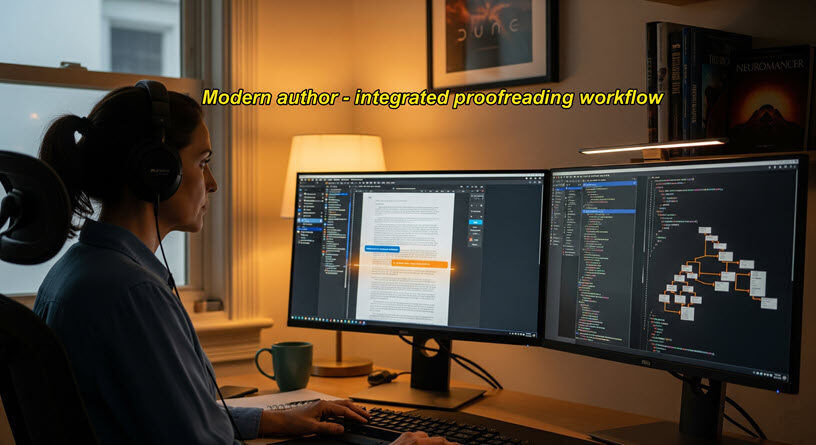
For the independent author, the “final pass” of proofreading is often the most daunting phase of production. Traditional advice suggests separating the creative act of writing from the analytical act of editing. However, with the advent of sophisticated AI and custom automation, a new “proactive” strategy has emerged: the Integrated Workflow.
Whether or not you agree our Fat Disclaimer applies
By managing proofreading iteratively during the drafting phase, authors can significantly reduce “editorial debt,” combat brain fatigue, and achieve an error rate that rivals professionally edited manuscripts.
1. The Proactive Mindset: Editing “As You Go”
The core of this strategy is the rejection of the “edit at the end” dogma. By treating proofreading as a continuous process, authors catch “micro-errors” (grammar, syntax, and typos) while the context is fresh. This method is not just about precision; it is a vital strategy for financial sustainability in independent publishing.
Professional human proofreading is a significant investment that can easily consume an author’s entire production budget. In the current UK market, professional rates for basic proofreading typically range from £8 to £15 per 1,000 words. For a 50,000-word novella, an author can expect to pay between £400 and £750 just for a final pass. If the manuscript requires deeper copy-editing—fixing style, flow, and consistency—those costs frequently double to £1,500 or more.
By adopting a proactive mindset, authors can bypass these “gatekeeper” costs:
- Cost-Efficiency: Iterative AI tools and custom scripts act as a “first-pass” editor at a fraction of the cost, ensuring the manuscript is 95% clean before it even reaches a final review.
- Continuous Correction: Using AI assistants during the writing process ensures that errors do not become ingrained habits, preventing the need for expensive, large-scale “structural surgery” later.
- Macro-Management: Handling plot logic and world-building consistency (“the forest“) while simultaneously polishing the prose (“the trees”) ensures structural integrity from the first chapter to the last, effectively performing the role of a developmental editor alongside the proofreading process.
2. Leveraging “Brutal” AI Feedback
Generic spellcheckers are often too lenient. High-performance workflows utilise more aggressive AI tools (such as Kutools AI or specialised grammar engines) to provide rigorous feedback on:
- Tautologies and Redundancy: Identifying repetitive sentence starters and “pet words.”
- Syntax and Flow: Forcing the author to justify passive voice or wordy constructions in real-time.
- Pattern Recognition: Catching homophone errors (their/there/they’re) and duplicate words that standard tools might overlook.
3. Audio-Assisted Review: The Anti-Fatigue Measure
“Word blindness”—where the brain skips over errors because it knows the intended meaning—is the author’s greatest enemy. The most effective countermeasure is the Read Aloud with MS Word or Text Aloud plugin for MS Word.
- Multi-Sensory Tracking: Utilising plugins that highlight one to three words as they are read aloud forces the eyes to stay tethered to the actual text, preventing the brain from switching to “autopilot.”
- Pacing and Tone: Hearing the text helps identify clunky dialogue, awkward phrasing, and rhythm issues that are often invisible on the screen.
- Reduced Eye Strain: Relying on audio reduces the pressure on the visual cortex, allowing for longer, more accurate review sessions without the onset of brain fatigue.
4. Custom Automation and Technical Consistency
Consistency is the hallmark of professional publishing. Authors can use simple programming and macros to automate the “janitorial” tasks of formatting.
- Regional Localisation: Custom Python scripts can automatically convert regional spellings (e.g., US to UK) with 100% accuracy, ensuring the manuscript adheres to the target market’s conventions.
- Typography Macros: Automated tools can convert “straight quotes” to “curly quotes” and handle specialised formatting, such as italicising dialogue, with absolute consistency.
- The “Rule-Breaker’s” Safeguard: Automation allows authors to intentionally break standard grammatical rules for stylistic effect. When an unconventional choice (like italicised speech) is automated, it appears to the reader as a sophisticated stylistic choice rather than a mistake.
5. The Goal: The “Three Typos” Standard
While no book is ever truly “perfect,” the goal of the integrated workflow is to approach the industry’s highest standards independently. Even “Big Five” traditional publications often hit the shelves with minor errors.
Achieving a near-flawless manuscript (often referred to as the “Three Typos” badge of honour) is entirely possible when an author combines AI Rigor, Custom Automation, and Audio Verification. By the time the final chapter is written, the manuscript is not a “rough draft,” but a polished, almost production-ready master file.
Conclusion: Empowering the Creative Voice
The shift from traditional post-draft proofreading to a proactive, integrated workflow represents more than just a technical upgrade; it is a fundamental reclamation of both an author’s creative agency and their financial independence. By building a custom “stack” of AI feedback, Python automation, and audio-visual tracking, the writer is no longer a prisoner to the grueling, late-stage fatigue—or the prohibitive costs—that often lead to errors.
Instead, the technical machinery hums in the background, safeguarding unique stylistic choices and ensuring regional precision with every keystroke. Ultimately, this approach liberates the storyteller to focus on the “forest”—the complex emotional arcs and world-building logic—confident that the “trees” are already polished. By reclaiming the hundreds of pounds typically lost to gatekeeper fees, the author isn’t just finishing a book; they are building a sustainable career.