




Estimated reading time at 200 wpm: 4 minutes
On 13 May 1997, just two weeks after the general election that swept Tony Blair into power, Jeremy Paxman interviewed the former Home Secretary Michael Howard on BBC Newsnight. The subject was the dismissal of Derek Lewis, the Director General of the Prison Service, following a security breach at Parkhurst prison. The central allegation: that Howard had improperly threatened to overrule Lewis on an operational matter—the suspension of a prison governor—and had then misled Parliament about his conduct.
Whether or not you agree our Fat Disclaimer applies
What followed became the most famous political interview in British television history. Paxman asked the same question twelve times: “Did you threaten to overrule him?” Howard refused to answer directly, offering instead a series of legalistic deflections about what he was “entitled” to do. The exchange has been analysed for decades as a masterclass in journalistic persistence—and political evasion.
I covered this story before on 07 June 2025: The Paxman Principle: Extracting Evasiveness can Lead to the Answer. Something kept bugging me: ‘How could Paxman allow himself to be taken round the houses?”
Persistent analyses by many, including me, focused on what Howard said. It has not focused on what he did to the verb. That most important verb in the question. And now the technique Howard used is finally revealed!
How the evasiveness happened at all
The question Paxman asked contained an operative verb: threaten. To threaten someone is to communicate an intention to cause harm or loss unless they comply, in an unsavoury manner. It requires no legal authority. It requires no entitlement. A threat can be made by anyone to anyone. That is why it would have been improper for a Home Secretary.
Yet watch Howard’s answers closely. He does not deny threatening. He does not affirm it. He simply replaces the verb.
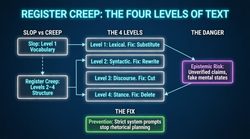
| Paxman’s verb | Howard’s substituted verbs |
|---|---|
| threaten | consult |
| threaten | instruct |
| threaten | overrule |
| threaten | express an opinion |
| threaten | discuss |
| threaten | give the benefit of my opinion |
Each of these is a different action that Howard reached for. Each carries different truth conditions. And each, crucially, is something Howard could deny or affirm without ever touching the original question with one important verb.
Consider the architecture of the evasion:
- “I did not instruct him” – but Paxman did not ask about instructing.
- “I did not overrule him” – but Paxman did not ask about overruling.
- “I expressed an opinion in strong language” – but expressing an opinion is not the same as threatening to overrule.
- “Well, you see the question is what was I entitled to do and what was I not entitled to do?” – Is Howard interviewing himself? He changes he question and answers that.
Howard built a path not on lies but on substitution. He answered different issues that were not asked about. Paxman, locked onto the repetition of his own words, never challenged the substitution itself.
Why it worked
The human brain processes for truth. When Howard says “I did not instruct him,” the listener registers a true statement and relaxes. The cognitive effort required to notice that instruct is not threaten is higher than most viewers—or journalists—can sustain in real time. Howard exploited that cognitive asymmetry ruthlessly.
Had Paxman stopped the exchange and said, “Mr Howard, the operative verb is ‘threaten’. I am not asking about instructing, overruling, or expressing opinions. Did you threaten to overrule him?” – the evasion would have been naked. But he did not. And Howard walked away having never denied the one thing he was asked to confirm or deny.
The lesson
Watch for the verb. When someone replaces the action you asked about and answers with a different action, they are not answering. They are changing the question by manipulating verbs. To allow evasiveness is as bad as the evasiveness itself. Don’t be occupied with the evasiveness itself.