




Estimated reading time at 200 wpm: 6 minutes
This article examines a brief, everyday exchange on a WhatsApp to identify a common cognitive pattern: the treatment of internal, subjective states as if they were objective, external facts, and the use of that false equivalence to justify decisions or behaviours.
Whether or not you agree our Fat Disclaimer applies
The analysis draws out key points about the gap between perception and reality, a pattern that extends far beyond a single interaction. It plays out in many areas; a common one is where someone feels offended by words – usually in text-based form. Context is largely missing form text-based exchanges, but not everybody knows that. People form ideas in their minds. That leads to feelings. Feelings are real. The reality is not in sight; only the feeling. So actions or reactions are based on feelings.
The Initial Request and Response
No it’s not another ‘WhatsApp palaver.’ It was a minor thing that demonstrated a the theory surrounding my observations of ‘the humans’.
Person A: Please make read receipts visible (on WhatsApp)
Person B: I need the freedom to reply whenever I want to so I don’t want others to know if I have read haha
Person A: Strange. I didn’t know that a read receipt impacts on your freedom or my freedom to reply. I’ll analyse that with AI.
Person B: I feel this obligation to reply if the person knows I have read it
Person A: AI analysed your statement and said > Read-receipts simply show whether someone has read a message, but they don’t actually constrain anyone’s freedom to reply—someone can read a message and choose to reply later, or not at all, regardless of whether read-receipts are on.
So from a factual standpoint, her statement doesn’t hold up as a logical objection. What I’m pointing out is that her words aren’t functioning as a reasoned argument here—they’re more like a social deflection, a way to avoid the request without engaging with its actual mechanics.
The “haha” at the end reinforces that it’s a casual brush-off rather than a serious explanation. So I’m treating the message as linguistic data (tokens) rather than as a valid logical chain, because the logic doesn’t actually track . You remain free to make your choices. Logic does not dictate human actions.<
The Follow-Up Reply
Person B: Of course I know I don’t have to reply if I don’t want to! 🤣 to me it’s just a matter of courtesy suppose
Person A: You remain logically free to respond whenever you like, ‘read-receipts’ activated or not. The feeling of obligation is ‘your internal fact’ that is unarguable. The reality beyond your mind is also unarguable. I’ve seen the gap before on the same thing with others. You articulated well my theory (in my mind). So now I have objective evidence of it to support my theory (beyond my mind). My interest in human nature began long before I started in ‘psychiatry’.
Internal States Versus External Reality
Two different things are at work in this exchange, and they are easy to conflate.
The first is an internal state. Person B feels an obligation to reply once a message is seen. That feeling is real. It sits inside their mind, and no one can argue it away. If someone tells you they feel obliged, you cannot say they are wrong. The feeling is a fact about their experience.
The second is external reality. A read receipt records one thing only: whether a message has been opened. It does not compel a reply. It does not set a deadline. It carries no rule. The freedom to answer now, later, or never remains untouched. That too is a fact, but a fact about the world rather than about the mind.
The trouble begins when the two are treated as one. Person B moves from “I feel obliged” to talking as though the read receipt itself removes their freedom. It does no such thing. The receipt has not changed what they are able to do. It has only made a private feeling harder to ignore.
The Pattern of False Equivalence
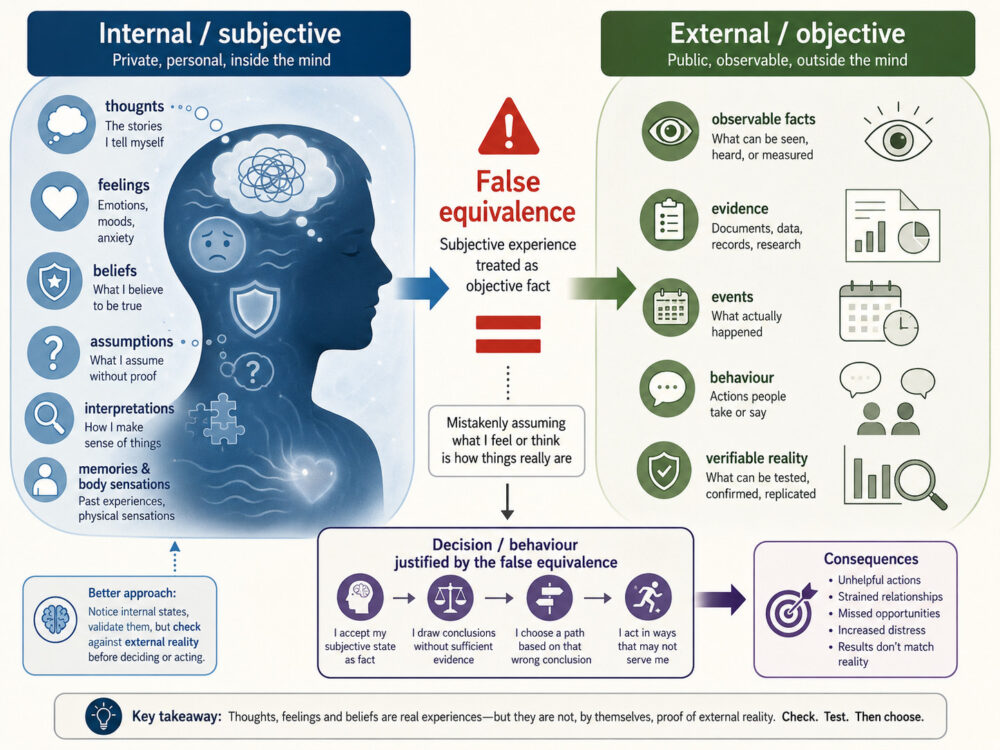
False equivalence here means placing an internal state and an external fact on the same footing, then reasoning as if they carry equal weight.
The move usually runs in one direction. A feeling is presented as a constraint. “I don’t want others to know if I have read” stands in for “I feel uncomfortable when they know.” The discomfort is genuine. The claimed constraint is not. Nothing external is doing the constraining.
Why does this matter? Because the swap allows a decision to be defended without examining it. The feeling supplies the conclusion. The language then dresses that conclusion up as a reasoned objection about freedom. The “haha” softens the exchange and signals that no deeper account is coming.
There is nothing unusual or shameful in this. Most people do it daily. We reach for a tidy external reason because it feels sturdier than “this makes me uneasy.” The cost is small in a chat about read receipts. It grows larger when the same habit shapes bigger choices, and the person never notices the gap between what they feel and what is actually so.
Conclusion
The exchange is trivial on its surface. Its value lies in how cleanly it shows a pattern. It’s a pattern I’ve been tracking for years across many individuals.
An internal fact and an external fact are both real. They are not the same kind of thing, and they do not answer to each other. A feeling of obligation cannot be argued with. A read receipt’s actual function cannot be wished away. Confusion arrives when one is used to explain the other.
Naming the gap does not settle the difference of perspective, nor should it. Person B remains free to keep read receipts off, for reasons of comfort or preference. That choice is entirely theirs. The point is only that the choice rests on a feeling, not on a constraint the receipt imposes.
When a decision is defended by an appeal to some outside force, it is worth pausing to ask whether the force is real, or whether a private state has quietly been promoted to the status of external fact.
So what does it mean? It means that the fact of internal feelings is a powerful determinant of human action. ‘Reasoning’ is applied to the discomfort of the internal state – or avoidance of worsening it. The logic is weak, even when the same intellect operating he logic, assesses the gap between internal and external reality.