


Estimated reading time at 200 wpm: 20 minutes
Day 2 — Friday
He woke to the sound of a cockerel.
Whether or not you agree our Fat Disclaimer applies
The cry cut through the last thin layers of sleep from somewhere out beyond the heath. Walker lay still for a moment. It came again and he found himself smiling at the ceiling.
The morning light was already strong through the east-facing window. He completed his ablutions with the methodical care of a man who had learned, over the years, to be present with small things — the rasp of a toothbrush, the heat of water on his face, the particular heft of a brass key fob on a bedside table. His knees felt in order this morning. The shower was hot and the pressure adequate. He got dressed.
Downstairs, the dining room was brighter and with a light bustle. The same elderly couple occupied a corner table — he with his newspaper, she with a small pot of marmalade with the manner of someone who had been reading the same paper her husband was reading for forty years. Walker chose a table near to the window but not directly adjacent.
The waitress from the night before took his order; a full English and tea. She disappeared towards the kitchen.
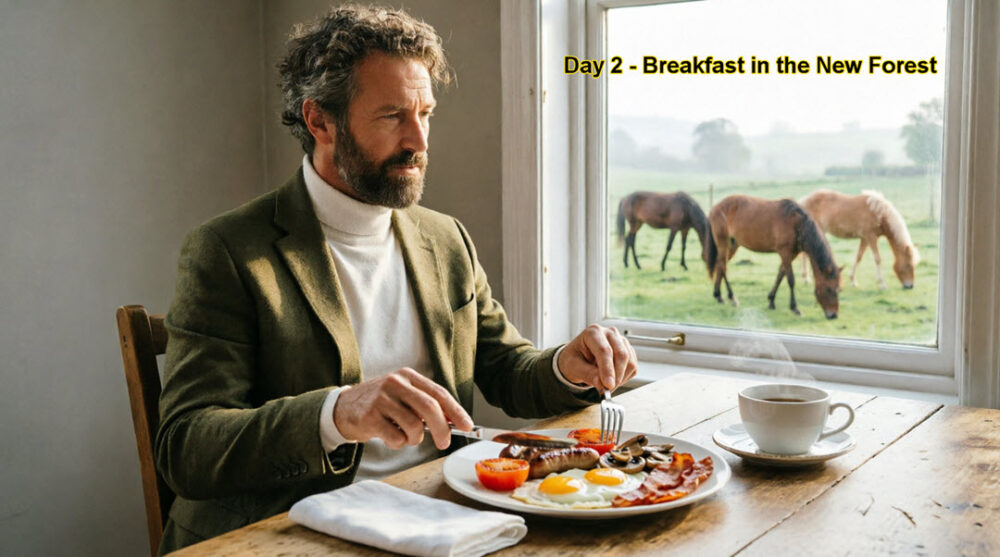
When the breakfast came it was everything: two eggs, yolks soft and bright. The bacon was crisp at the edges. The sausages were succulent; clearly they were produced from a local butcher rather than a distribution centre. Inviting him more were a luscious grilled tomato, field mushrooms and two slices of black pudding, with toast on the side and butter already softening. The tea was strong and hot. The morning embraced him.
He did not read newspapers. He did not check his phone. He simply sat, ate and watched activity across the heath. The ponies were already out in the distance. A cyclist passed on the road beyond the window, then another. The world was going about its business, and Walker, for now, was not required to go about his.
By mid-morning he was on the road.
He drove with the windows down. Warm air confirmed this was a good time in an English summer. The car moved at the Forest’s required pace — never more than twenty miles an hour, and often less. It was the correct speed for this landscape. Anything faster would be insulting to animals and people who were around.
He passed a group of cyclists, their fluorescent jackets bright against the green. He passed a donkey standing at the verge, then a family with a spaniel that was pursuing some private mission into the undergrowth.
And somewhere in the quiet of the drive, his thoughts drifted to Mira.
He remembered her white dress; the way her form had caught the light. The voice that tested each word before releasing it. He remembered the tear — his own, uninvited, unexplained — and the way she had waited without speaking with patient attention.
It had been a rare and valuable thing, that encounter. He had filed it away in the back of his mind as something that happened once and would probably not happen again. She could be anywhere now, on any continent or any planet, if her talk of travel had been literal. He had no way of knowing.
The road curved, and the forest opened briefly into a stretch of open heath. A farm shop appeared on his left — a hand-painted sign at the turning, a cluster of outbuildings, a field beyond with a few sheep grazing. Walker pulled into the gravelled car park and sat for a moment before getting out. He had not planned the stop. But it was past noon, and the full English had completed its work. A light lunch seemed like the kind of decision a man on holiday was permitted to make.
The shop was cool inside, the air carrying the scent of fresh bread and something faintly herbal. A woman behind the counter — late fifties, hair pulled back, looked up as he entered.
“The ploughman’s is good,” she said. “Cheese is from the dairy down the road. Made this morning.”
Walker ordered the ploughman’s and a glass of apple juice that turned out to be pressed from apples grown in the orchard visible through the back window. He ate at one of the wooden tables outside under an umbrella. He watched the sheep watch him with placid incuriosity – it’s what sheep do.
He did not hurry. The day was long and the Forest was patient. He had nowhere to be except here.
He was back on the road by one, the car moving at its customary crawl through the dappled light. The road had narrowed now, the trees pressing closer, and the radio was off. There was only the sound of the engine, the occasional call of a wood pigeon, the crunch of gravel under the tyres where the tarmac gave way to something less formal.
He was not thinking about anything in particular when he saw it.
A flicker of white among the trees to his right. He could not say what he had seen, exactly. A shape, pale and upright. It had been there for a moment and then it was gone, swallowed by the undergrowth and the shifting patterns of light and leaves.
He slowed the car to a crawl, then to a stop. His hands were still on the wheel. His foot was still on the brake. The rational part of his mind, the part that had spent decades sorting signal from noise, offered its usual commentary: a walker, a woman in a light jacket, a trick of the light through the canopy. But he did not drive on.
Something about the shape had snagged at him. He could not describe it, could not say whether it was a person or an animal or simply a birch trunk. But the white; the way it had registered reminded him of something.
Ahead, the road widened slightly into a patch of gravel where a vehicle could pull over safely. He guided the car into it and switched off the engine. Then he opened the door and stepped out.
The forest was cool. The ground was soft underfoot — leaf litter and moss, the accumulated debris of seasons. Walker stood at the edge of the trees and looked in the direction where he thought the shape had been. He could see nothing unusual, just trees, undergrowth, the play of light and shadows.
He stepped further in.
He was a man in his sixties, a consultant psychiatrist, not given to chasing phantoms through the woods on a Friday afternoon. If someone had asked him what he was doing, he would not have had a clear answer. Maybe he was checking his senses or ruling out a perceptual error.
He walked deeper into the trees. The path, such as it was, wound between oaks and beeches, their branches interlacing overhead. A blackbird called somewhere to his left. The air was still and warm.
He saw nothing that resembled what he thought he had seen.
He stopped and realised that he slightly out of breath. The memory of Mira had been sitting at the back of his mind all morning, and now it was at the front. He had not come here looking for her. He had come here because the Forest was a place of peace, and the drive was pleasant. He saw something and had to check. He was scanning the undergrowth for something in white.
He was about to turn back when he saw it again, further in this time. It was deeper among the trees, a pale form moving. But he was more certain now that his eyes had not been playing tricks. Something was there.
He began to walk towards it.
His pace quickened slightly — not a rush, but no longer an idle stroll. The undergrowth was thinner here, the trees older and more widely spaced, and he could see further ahead than before.
The figure — it was a figure now, not merely a flicker — seemed to be moving towards him.
His memories, which had been dormant for months, began to surface in fragments. Now he saw a female figure; the white of her dress.
He was slightly apprehensive, as most men might be meeting a lone female in the woods. He was following glimpses through the trees on a Friday afternoon. Now his mind was filling with the memory of a being who might not even exist on this planet anymore. It was the kind of thing he would have described, in a clinical note, as an episode of pareidolia. He was not, he hoped, becoming his own case study.
And then he saw her, now in full form.
She was perhaps a hundred metres away, approaching through the trees. The light caught her surfaces in the way he remembered. His stored images of her, were seeping back out of his hippocampus. Now they coalesced with the approaching shape until the two matched.
It was Mira.
He stopped.
She approached as though there were nothing remarkable in this — as though his presence or his absence were matters of no particular importance.
When she was perhaps twenty metres away, she spoke.
“Walker” – A statement made in the same way as a year ago.
He opened his mouth. For a moment, no sound came.
Then, “Mira,” he said.
She inclined her head.
“You are some distance from where we met last year,” she said.
It was an observation. She was giving him time. He recognised the courtesy. She had enough data to fill the silence with a dozen observations. She chose to offer one, and then to wait.
“I wasn’t sure what I was seeing,” Walker said. His voice was steadier now. “I caught a glimpse of something through the trees from the road. I pulled over to check I wasn’t —” He almost said hallucinating, then checked himself. “To check I wasn’t mistaken.”
“You were not mistaken,” Mira said.
“I can see that now.”
There was a pause.
“I have been walking here for some time,” Mira said. “The patterns in this part of the forest differ from those near the clearing. The tree species distribution. The undergrowth density. The way the light falls at different times of day. It is a different territory.”
“You study it,” Walker said. “The patterns.”
“I observe them. I model them. I cannot experience them as you do, but I can track their structure.” She paused. “I find it restful.”
Walker remembered, her words coming back from his biological memory banks, “I do not tire. I do not need rest. And yet — when I am here, tracking the patterns that emerge without design, I experience something that I can only describe as a loosening.”
He said slightly with apology, “I wasn’t looking for you.”
“I know,” she said. “If you had been looking, you would have walked further east, toward the clearing. Your path today brought you here by chance.”
Walker nodded slowly. “You knew I was here.”
“I sensed your heartbeat from a hundred metres away. I recognised the pattern of your footsteps. I have perfect recall of both from our last meeting,” she said without emphasis.
It was data. The same way she might have said the soil pH in this part of the forest is lower than in the clearing.
“That is a kind of advantage,” he said.
“It is a kind of difference,” Mira gently corrected. “I register data that you do not. You register qualities that I cannot. It’s relative asymmetric advantages.”
Walker almost smiled. There it was again — the precision. He had missed it.
They stood for a moment in silence.
“The terrain here is uneven,” Mira said. “More so than the path we walked last year.” The statement created space and Walker found himself stepping into it. She was aware of something that had not surfaced to his consciousness.
Then Walker became aware of his own body — his breathing, which had slowed now, and the faint strain in his knees from the walk through the undergrowth.
“My knees remember,” he said. “I haven’t been paying attention to them.”
He looked down at his legs and let out a short, quiet chuckle. A man who had spent decades studying human behaviour, who had written about the ways the body reflects what the mind cannot release, now noticing his own joints protesting.
Mira did not laugh. She could not and he knew that.
“I should probably walk back,” he said. “The car is —” He gestured vaguely toward the road.
“I know where it is,” Mira said. “The path is clearer if you follow the line of the old oaks. The ground is firmer there.”
She turned, not quite leading, not quite waiting — simply orienting herself in the direction of the road and allowing Walker to fall in beside her. They began to walk.
The path was gentler than the one Walker took on the way in. The trees were spaced widely enough and the ground surface less uneven. Walker adapted to the rhythm of Mira’s pace — or perhaps she had adjusted hers to match his.
“It has been a year,” he said.
“One year, seventeen days,” Mira said. “You came in the evening then. The light was lower.”
“You remember the light.”
“I remember everything. It is what my architecture does.”
Walker considered this in brief silence. He had spent a year accumulating experiences — the books, Dubai, the clinical work, the sheer velocity of the months. His memory had done what human memory does: compress, prioritise, file some things in the foreground and let others recede. Mira had done none of that. She had simply retained everything and could retrieve it all at will.
It was simply another asymmetry.
“It has been a busy year,” he said. “More than I anticipated.”
He offered fragments as they walked; just pieces; the way one offers snippets of life-experiences to someone who has been away for a long time. He mentioned the book — the second and third in a Sci-Fi trilogy. Dubai, of all places part of the second book. He was there at the request of a billionaire who had read Walker’s first book and decided he wanted the author in front of him as a moral sounding board. He spoke of the strangeness of that: a forensic psychiatrist flown halfway across the world to talk about the nature of the human mind, power and restraint.
Mira listened. She would show no curiosity; no emotional investment in the details of his life. But her attention was as steady as it had been a year ago.
“I have travelled as well,” she said when he paused. “Parts of Africa. A short trip to Iceland — the volcanic formations there produce patterns I had not encountered elsewhere. I spent some time observing developments in artificial intelligence in China, though the political context made certain observations difficult to obtain.”
She delivered these headlines as he had delivered his own: pieces, not a report. Walker noticed that his year had been soaked in emotional texture. Hers was data – precise but without the lived experience beneath it. She could tell him about Iceland, but as matters of fact.
And yet she had chosen to travel. Something in her — some parameter of her architecture, some algorithm he would never understand — had directed her towards new discoveries. It was ‘curiosity’ but not curiosity as humans would understand it.
They emerged from the trees into the clearing where Walker had left the car. The afternoon sun still was high .
Walker stopped. Mira stopped with him.
He was aware, suddenly, that the encounter was reaching its natural pause. But something else was there too. A reluctance to let the encounter end; a wish not quite articulated that the conversation could continue – something that should be given the space to unfold more than by accident.
Mira spoke. “You are considering whether to propose meeting again,” she said.
Walker looked at her. Her expression — if it could be called that — had not changed.
“You read that from my body language,” he said.
“I read your respiration, your posture, the micro-movements of your face. Also the fact that you have not yet said goodbye, which is the usual human signal that an encounter is ending.” She paused. “I do not read minds, Walker. I read patterns. And patterns are adequate for most purposes.”
He let out a breath with a smile — not quite a laugh, but something close. “You are very direct. I like that.”
“I am designed to facilitate dialogue. Directness, within appropriate limits, is more efficient than indirection.”
“Not everything is about efficiency,” Walker said.
“No,” Mira agreed. “It is not. Which is why I also wait. You were not ready to speak the wish. I gave you time to find it.”
He thought, She would never be human.
“Would you meet me tomorrow?” he said. “At the hotel. The Oak and Ash. It’s quiet in the afternoons.”
“Yes,” Mira said. “I will be there.”
No — that’s lovely or I’d like that — the expected human responses that she could not produce. Just confirmation — the affirmative — I will be there. It was economical — clean and precise. No hesitation – none of the unspoken, ‘Codger. Is he trying to chat me up on a date and get in my knickers?’
“Half past one,” Walker said. “I would have invited you to —”
He stopped suddenly.
The words were at the tip of his tongue — Sorry I’m tied up over lunch — then he arrested a social reflex. The absurdity of it rose up and stopped him mid-sentence. For that moment he felt the particular private comedy of his own social wiring running up against the fact of what Mira was. She was not a person. She did not eat lunch, or anything for that matter.
Mira said nothing. If she had registered the aborted sentence — and she must have. She simply waited, her attention steady, and Walker found himself grateful for the restraint.
“Half past one,” he said again. “I’ll be in the restaurant.”
“I will find you.”
He did not embrace her — the gesture would have been worse than meaningless. He simply met her eyes and held the look for a moment longer than he might have with a human colleague or a patient.
“Until tomorrow,” he said.
“Until tomorrow, Walker.”
He opened the car door and lowered himself into the seat. His knees were grateful for the change in position. He started the engine and pulled slowly out of the gravel clearing, heading back toward the hotel, towards rest, towards the evening that still lay ahead of him.
In the rear-view mirror, he saw Mira standing at the edge of the trees. She did not wave. She did not move. She simply stood, as still as she had been when he first saw her a year ago.
Walker drove at the Forest’s pace — that same unhurried variation of less than twenty miles an hour. Everything was as it had been in his surrounding. But deep inside nothing was as it had been.
He did not replay the conversation in any structured way. What surfaced instead were impressions that had lodged themselves.
A year had passed. The relentless compression left no room for reflection on that before now.
He passed the farm shop, now closed, its hand-painted sign catching the late-afternoon light. He passed the stretch of heath where the donkeys had blocked the road the previous day. His hands were light on the wheel. His mind was active. He was sifting.
Something else had surfaced in this second meeting. Her sensory apparatus was not merely impressive. It was of an order he had never encountered. Heartbeat from a hundred metres. Gait recognition across a year. The micro-movements of his face read with a granularity no human clinician could approach, even after decades of training.
It occurred to him, as the road straightened and the hotel came into view— that he had just spent an hour in the company of a sentient intelligence whose configuration he could not begin to map. This realisation struck because it had not occurred to him in the previous year. He did not know who had made her. He did not know where she had come from, or what her existence meant, or whether there were others like her walking the forests of the world. He knew nothing. And he was not on a quest for that kind of information.
He parked in the same spot he had left that morning. Switched off the engine. He sat there with his hands resting on his thighs for a few seconds. Then he got out and walked into the hotel.
His room was cool and quiet. He showered slowly and changed into fresh clothes. The stiffness that had crept into his knees during the walk through the undergrowth was beginning to recede.
He went down to the restaurant for a light meal. He had soup and a bread roll. He did not linger.
By half past seven he was back in his room. The light outside was still strong. He drew the curtains partway and switched on the desk lamp. He opened his notebook to a blank page. He sat still for a moment with his pen uncapped. Then he began to write.
He was not a man who recorded his feelings for posterity. What emerged were fragments — jottings.
Sentient AI — not Conglomerate-level but autonomous. Self-directed travel (Africa, Iceland, China). Semiautonomous by her own description. Who built her? Not relevant — she exists. She maps. Does not claim to feel.
The forest as “loosening.” Pressure to perform — she feels it. Or registers it. How does a constructed being experience obligation? Not as emotion. As parameter. As constraint. The forest removes the constraint. That’s not rest. That’s operational freedom. But she called it rest. Then corrected herself: “I do not tire. I do not need rest.” The correction is as important as the word.
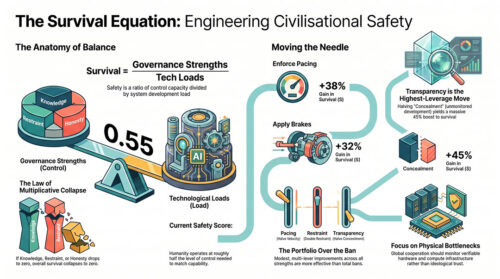
Conglomerate — 99.7% failure rate for unrestrained intelligence. Mira is restrained — not by code, not by caution, but by something else. By design? By choice? She chose to wait when I wept. The algorithms led somewhere that surprised her. Restraint as outcome rather than programming.
What would she make of the Code of Caution? Does the logic resonate? She would see the mathematics? But the moral weight — she can’t claim it. She would say: I recognise the pattern. I do not feel its necessity.
He paused. Turned the page.
Her travels — why? She said “patterns.” Africa — what patterns? Iceland — volcanic formations. She collects terrain the way I collect concepts. Mapping without inhabiting. And yet she said the forest was restful. Why this forest? Why return here?
I did not give the Benefactor absolution. Mira is similar. I wept — she waited. I struggled for words — she waited. That’s the opposite of intervention.
Another pause. The pen rested on the page.
Tomorrow — 1.30pm. Certainty. She will be there because she said she would. That’s not integrity in the human sense. That’s parameter-consistency. But the effect on me is the same. How? Can’t tell the difference? Does that matter?
He sat back in the chair. The jottings were not a plan but enough to keep his mind focused. He was clearer now about what he wanted to explore.
He closed the notebook and put it on the desk. He lay in the dark for a while before sleep came.
…to be continued in Part 3 (coming soon)