




Estimated reading time at 200 wpm: 11 minutes
You will probably read a few thousand words today if you’re surfing websites for news, opinion, advice, or reviews. Like you, most people will assume that a person wrote those articles. Until recently that assumption was safe.
Whether or not you agree our Fat Disclaimer applies
“Be very, very careful what you put in that head, because you will never, ever get it out.” ― Thomas Cardinal Wolsey
See this important article: Word of the Year 2025 | Slop | Merriam-Webster
A growing share of published text is generated by machine and posted without careful study by a human. Many such pieces sound smooth, informed and authoritative. They will sound convincing. Some people will share those pieces with friends and family. They may not detect that what they’re reading is well-dressed rubbish. I liken it to some kinds of fast food, or cheap processed ready-meals sold at supermarkets. You know – tasty and belly-filling – but is it healthy?
Begin with the paragraph below.
The high street is changing. It is not simply a matter of shops closing, but of communities reimagining what town centres can become. Cafés, galleries, co-working spaces, community hubs, pop-up markets, repair shops and libraries all offer glimpses of what comes next. Will councils rise to the challenge? Will landlords adapt? Will residents embrace change? The answers remain to be seen. One thing is certain: the high street is not dying. It is being reborn. And in that rebirth lies a lesson for us all — change, like the tide, cannot be resisted, only met.
No one wrote that paragraph. It is a fake, built as a deliberate imitation of machine prose. Every pattern in it appears daily on real news sites, trade journals and community pages. It is the embodiment of slop. Yes – a human could have independently written that too. Slop is slop regardless of who or what wrote it. The main point is that people are more exposed as hapless potential victims of AI slop in the last 3 years or so.
Basically, such articles cost publishers nothing in most cases. But they cost you your time. What is the value of your personal time?
This piece is not a device for AI slop detection. It is about raising awareness. Note again that some real people write in a sloppy way, just like AI generated text.
The good news is that machine prose is easy to recognise once you know the habits.
What AI slop is?
Slop is machine-drafted prose published with little or no human intervention. Someone typed a request and received a draft. The facts were probably not checked. It pleased the person who requested the draft. It sounded good and convincing. The next thing you know it is on some website or in a magazine.
The Worst
Slop on a lifestyle blog costs you a few minutes. Slop in the wrong hands costs rather more.
Recently there has been concern in the UK and other countries about professionals using AI and its slop.
For UK lawyers, the core failure was a wholesale abdication of their fundamental duty to the courts. In overview they submitted fake case law and grounds of appeal, then tried to hide their errors. That amounted to dishonesty. Some of those lawyers were referred to the Bar Standards Board.
For UK doctors, the core failure was a dangerous failure to discharge their primary duties to ensure patient safety and maintain the integrity of clinical records. They used AI tools to draft treatment justifications and patient summaries, and in doing so, they presented fabricated medical journal citations. Eight doctors have been referred to the General Medical Council for such misdemeanours [PSL July 2026]
Assisted writing
A good writer can use AI as a modern version of the word processor—a tool. Facts would be checked and confabulations taken out. Other forms of slop can then be removed. People have used tools for thousands of years; nothing is fundamentally wrong with that. Nobody should expect a word processor to write a good essay. Similarly, no one should expect an AI model to produce a fine article without astute human involvement.
Some tell-tale signs
① The list that never ends
Six or more items where a writer would pick two. Naming everything is safer than choosing, and machines never choose. Specimen: “The festival offered music, food, crafts, workshops, talks, family activities and much more.” Real writing: selects. “The festival offered brass bands and burnt sugar.” One detail seen beats seven listed.
② The seesaw sentence
“It is not X. It is Y.” A shape that sounds thoughtful without containing a real thought. Specimen: “This is not a story about technology. It is a story about people.” Real writing: says the thing. “The redundancies began in March.” Once per article is emphasis. Every third paragraph is a template.
③ The wisdom ending
The last sentences deliver a small profound truth, usually wearing weather, seasons or a journey. Specimen: “In the end, progress, like the seasons, cannot be hurried.” Real writing: ends on a fact, a scene, or a question the piece has earned. Then stops.
④ The question volley
Three or more questions in a row, with none of them answered, usually signals that the writing is leaning on suspense instead of substance. Questions can be powerful, but they should do the work that research and argument have already prepared for them—not replace that work entirely. Consider this: “Will regulators act? Will consumers care? Will the industry adapt?” That may sound energetic, but it leaves the reader hanging. Strong writing asks one good question, then follows through, answering it in the next paragraph and building a real line of thought.
⑤ The visible skeleton
When the outline shows through the prose, the writing starts to feel less like thought and more like scaffolding. First, second, third; promise, problem, solution. A plan with sentences draped over it.
You can see the bones in a specimen like this: “There are three challenges. The first is cost. The second is trust. The third is time.” It is orderly, yes, but the order is doing too much of the work. The reader is being led by the hand.
Real writing is quieter than that. It lets one point grow out of the previous one, so that the structure is felt rather than announced. You sense the shape of the argument without being spoon-fed the map.
⑥ Everything once, nothing twice
Every consideration gets one paragraph. Nothing gets four. Attention spread perfectly flat, because the machine has no interests. Specimen: a piece that touches funding, staffing, regulation, technology and public opinion, and examines none of them. Real writing: obsesses for a while. It digs where the writer’s curiosity actually is and cheerfully neglects the rest. Unevenness is a feature of human thought.
⑦ The returning metaphor
This is when the image from the first line reappears in the last. The bracket must close; machines cannot leave one open. Specimen: opens “our high streets stand at a crossroads”, closes “as we navigate the road ahead”. Real writing: drops images and hardly ever looks back. Loose threads are human.
⑧ Words that try too hard
This is about vocabulary that asserts importance or depth that the text does not bear. Specimen: “The scheme is a testament to the vibrant community at the heart of this transformative journey.” Real writing: lets plain nouns and verbs carry the weight.
Structural signals
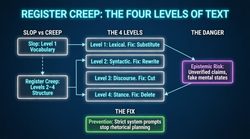
The tells so far have been about what the machine says. These next ones are about how AI models tend to build sentences. The test involves assessing frequency and density.
⑨ The dash that does too much
Watch out for long dashes doing the work of commas. Em dashes have their uses. They can contrast, interleave, or signal a sudden turn. But when they appear every few sentences, that points to machinery. For example,
” She agreed—though reluctantly.” “The plan was simple—but risky.”
Unusual concentrations of em dashes can be a hallmark of AI-generated slop. Excessive replacement of commas, semicolons, and full stops with em dashes further reinforces this impression.
⑩ The choppy finish
This concerns short, punchy sentences that resemble statements, but are not fully complete. For example: “Only patterns.” “That is the point.” “Then it stops.”
A skilled writer uses fragments cautiously and with deliberate restraint, employing them for emphasis. A machine, by contrast, uses them more as a stylistic device, inserting them wherever a transition appears necessary.
⑪ The mechanical rhythm
Human thought in writing – unless sensationalist – usually does not feature abrupt bursts of brevity and sprawling lines that lose momentum. The writing tends to be steady with more even cadence.
Why the machine does this
These systems are trained on vast amounts of human writing and then fine-tuned to generate responses that people rate highly. Comprehensive coverage and a polished presentation tend to score well. A draft that addresses every relevant consideration and concludes on a warm note will generally outperform one that focuses on a single point and ends abruptly. The resulting patterns are the visible signs of this tuning on the page. In other words, the machine is doing precisely what it was designed to do.
The two-minute test
Read the piece once. Ask: what here could be false?
If the answer is “nothing,” then you are holding filler. No issue was reported. It is likely too good to be true.
If a piece is making factual claims, the game changes. Machines can sound confident and still make things up. So do two things: pick one claim you can verify, and check it. Then look at the sourcing. Real reporting tells you who said it, which study it came from, and where and when it was published. Machine-made claims often show up like orphans. One orphaned claim might just be sloppy. A concentration of them is a pretty good tell. If a checked claim turns out to be wrong, that’s when the verdict starts to take shape.
Readers of articles don’t need to become AI hunters or slop-detectors. Real human writing can be sloppy as well.
When you get that ‘Wow this is good – makes sense feeling’, think again. Just ask, “Have I been had by a machine and a lazy writer”. And then, “Are the reported facts true?”
The dose makes the poison
A warning before you start diagnosing your favourite columnist; real writers make long lists now and then. Real writers use “it is not X, it is Y” sentences — Churchill’s “this is not the end. It is not even the beginning of the end” is a famous one. So, one tell in one or two sentence proves nothing.
What convicts is mathematics. Frequency and density are the giveaways. Three things to check:
How many: One long list is style. Twelve in an article is a fingerprint.
How bunched: Do the tells arrive in clumps? Questions in threes, lists piling up in one section. A writer reaches for a trick when the argument needs it. A machine reaches for it almost every time the same moment comes round.
Where: Does the same tell keep turning up in the same spot? People’s habits wander; the machines keep appointments.
Rough thresholds, for a piece of ordinary article length:
| Finding | Verdict |
|---|---|
| One tell, appearing once | Ignore it |
| One tell, on every page | Suspect |
| Several tells, each recurring | Fingerprint |
| Any tell recurring at the same position | Fingerprint |
What does not convict. A lone seesaw or a single list of seven does not. One “ultimately” does not matter. The writer may be having an off day. The idea is not “is this sentence machine-made?” but “does this piece have habits, and do they repeat in some sort of pattern?” Finally, “Is it passable that there was real human involvement in this piece? How to I see that?”
Why slop gets published
Not everybody wants a well-prepared dish or has time for proper feeding of the mind. It is a very busy world.
Websites are hungry. Many need stuff to keep click-counts up. Free, fluent, inoffensive text fills a hole.
There is a less comfortable reason. Slop increasingly arrives under trusted names. A machine lets a busy professional produce in twenty minutes what once took a weekend. Editorial defences are weakened in a click-monetised fast-paced world.
Conclusion
Reading spends the one thing you never get back. An article could cost you five minutes or may be much more, of your life!
Scripts created by AI models also populate narration in podcasts and video materials. Watch out!
Slop was farmyard language before it was internet language. It was and still is waste food given to animals.
Now we have digital slop. For most of history, fluent prose was evidence of thought. Sentences costed effort, so a well-made page implied a mind that had done the work. Artificially intelligent machines have separated fluency from thinking, and the separation is permanent.
Slop will keep coming. Digesting content in the new era is about being more vigilant. If you would be cautious about the quality of food you consume for your body, then you should be even more cautious about what you allow to be fed to your mind.