







Estimated reading time at 200 wpm: 12 minutes
Nobody hands you a manual for the mind. Go looking and you find a billion-pound industry on the shelves pretending otherwise.
Whether or not you agree our Fat Disclaimer applies
Here is a small everyday event but a manual here may not help. You see the sign in some shop: 80% off. The coffee machine, or the coat; it makes no difference. Before you can say “Jack Robinson”, it’s in your trolley before any thought has taken place. You gleefully pay up at the tills. A few days later it sits on the counter, staring at you kicking yourself. You don’t really know why you bought it.
Quietly, to yourself, the admission arrives: it was the sense of getting a bargain that took hold. “I feared missing out. I was hooked.” Coulda, shoulda, woulda. “What could I have done differently?” – you’re ashamed to admit your foolishness to anyone else.
By the time questions arise in your mind the money has been spent. The chance to think came and went in the shop doorway, in about a second.
This article is about that second. Who is Kahneman? What’s he got to with this? Stick around, you may learn something.
1. The answer that turned up by itself
Something in the shop doorway spoke before you did. It declared: bargain!! No arguments were presented, no permission was sought. The answer arrived complete, confident, and needing nothing from you.
A feeling of that kind has an old name: intuition. You did not really choose it, any more than you choose recognising a face or noticing that the queue has moved. Such things simply present themselves as knowledge.
Now look at what the feeling actually did. The sign said 80% off. The question worth asking was whether the coat had ever genuinely been worth £120. But you did not ask yourself the question at the time.
Whether they belong to the question you ought to be asking is a separate matter.
2. Two ways answers come to people
A coat marked from £120 down to £24: how much is that? Nothing arrives to help. No feeling hands you the number. The answer has to be assembled, step by step, and the assembling is slow.
A psychologist called Daniel Kahneman spent his working life studying how answers come to people. As a psychologist he was awarded the Nobel prize in socio-economics.
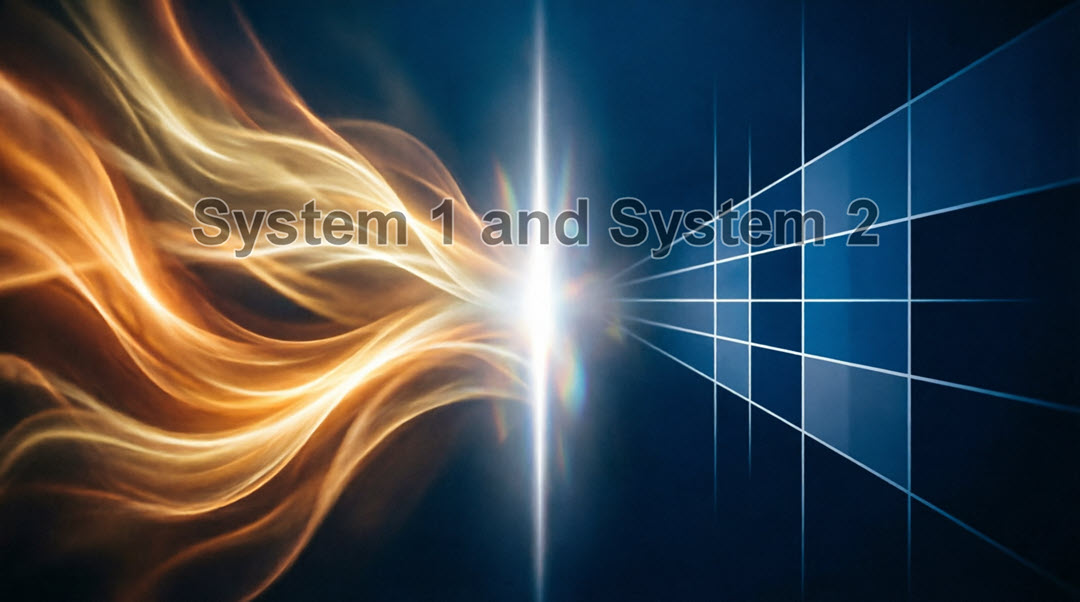
He used two short labels for the two ways: System 1 and System 2. System 1 is the answer that arrives. System 2 is the answer you have to work at.
The labels are shorthand, nothing more. They are not two little people in your head, one sensible and one reckless. Kahneman went out of his way to say so, and the next section explains why he needed to.
3. Not two characters in your head
The labels invite a picture: a wise judge perched on one shoulder, a reckless fool on the other, arguing about the coat. Kahneman went out of his way to warn against that picture. The labels are shorthand for two ways answers come to people.
The real arrangement is quieter. The slow system does not compete with the fast one. It sits above the incoming traffic and signs off on it. Almost everything the fast system proposes, the slow system endorses without examining, and almost always that is the right call. Most of what a person does all day is run this way, and most of it goes well.
The fast system is not the stupid one, either. Skill lives there. A strong chess player sees a good move without searching for it; a driver follows a familiar route while thinking about something else entirely. Those performances were built slowly, over years, and then handed down to the fast system to run at speed. That is competence, not weakness.
How lightly does the slow system check? Kahneman liked this puzzle. A bat and a ball cost £1.10 in total. The bat costs £1 more than the ball. How much is the ball? An answer arrives at once: ten pence. It is wrong.
In reality the ball costs five pence. Half the students at Princeton, among the most selected young people in the world, gave the answer that arrived and checked nothing.
The System 2 work is as follows:
Step 1 — Define variables
Let the cost of the ball = x
Since the bat costs £1 more than the ball, the bat = x + £1
Step 2 — Set up the equation Together they cost £1.10:
x + (x + 1) = 1.10
Step 3 — Solve
2x + 1 = 1.10
2x = 0.10
x = 0.05
Step 4 — Verify
- Ball = £0.05
- Bat = £0.05 + £1.00 = £1.05
- Total = £0.05 + £1.05 = £1.10 ✓
- Difference = £1.05 − £0.05 = £1.00 ✓
4. The door that closes
Take the same machinery out of the shop and into ordinary conversation. Someone says: “Katie Hopkins. Nothing she says interests me.” Or: “Tommy Robinson. Terrible man. Why should I hear what he has to say?” Another person hears a different name, Greta Thunberg, and their door shuts at the same speed. The door does not care whose name is on it. It is the same door. This is the Semmelweis reflex.
Watch the sequence. The name arrives. A feeling arrives attached to it: dislike, contempt, dismissal. The door closes. Between the name and the closure there is nothing. No pause, no question, no weighing. The response was not built. It was delivered, complete, the way the bargain feeling was delivered in the shop doorway.
What never happened in that moment is doubt. Doubt is work, and it belongs to the slow system: the capacity to hold two thoughts at the same time. This person might have something worth hearing, and I might be wrong about them. The words nothing they say interests me were spoken anyway, and spoken words have been signed off by the same system that waved through the ten pence.
Here is what the closed door costs, and it is not agreement. A person may or may not hold opinions worth hearing. There is no way to know from the doorway, because nothing was heard. The door did not close on an argument. It closed before an argument was heard. That is not rejection. It is a cancellation arranged in advance, and it was arranged in about a second.
5. The hinge you can reach
Back to the hallway, a few days after the purchase. The quiet admission: I was hooked. That admission deserves a second look. The capacity to check was there all along. It was late. The slow system finally examined the purchase and declined to sign it off, and by then the coat had been hanging there for days.
The same is true of the closed door. The capacity for doubt was available the moment the name was mentioned. It simply never ran. Nothing was broken; the equipment existed and went unused.
Between the arrival of an answer and its acceptance there is a moment of signature. The fast system proposes. The slow system, most days, stamps the proposal without reading it. Kahneman’s finding was that the stamping is casual: endorsements are granted lightly, in bulk, because most proposals deserve them. That signature is the hinge. It is the one part of the machinery a person can reach. Nothing can stop the bargain feeling from arriving. Nothing can stop a name from arriving with its feeling attached. The arrival is not up to anyone. The signature is.
The hallway question reaches backwards in time. Asked honestly, what could I have done differently? The honest answer is a rehearsal. Next sign, next name: is this feeling answering the question I ought to be asking, or an easier one? A person who asks it in the hallway has a head start at the next doorway. The doorway and the hallway are the same mind on different days.
One caution belongs here. Catching the arrival does not guarantee a better answer. First impressions hold their ground even when examined, and people who correct them usually correct by too little. Checking guarantees one thing only: the answer was considered. Consideration is the whole prize on offer.
6. Most of the time the fast answer is right
An article built on a misfired bargain and a closed door could leave the impression that the fast system is a hazard to be managed. The truth runs the other way, and Kahneman was plain about it: most of what people do is intuitive, skilled, and successful.
The fast system runs the ordinary day: which queue is shorter; whether the car ahead is braking; the tone to take with the person on the telephone. A thousand small answers arrive from morning to night, and almost all of them are correct. A mind that paused to check each one would never cross a road. The slow system is expensive: it works on one thing at a time, it tires quickly, and it must be rationed. The casual signing-off described earlier is the price of a workable day.
The fast answer is often the better answer as well. It is the experienced nurse who feels that something is wrong with a patient before the numbers move, or the driver’s reading of a gap in traffic, or the fire commander who orders everyone out on a feeling, and is right. Those are compressed years of experience, delivered in a second. Slow them down and they get worse.
Suspicion, as a policy, fails twice. It cannot be sustained, because the slow system cannot work all day. And it is unnecessary, because most arrivals deserve the signature they get.
The habit this article is building has a different shape. Suspicion asks whether to trust. The useful habit is bookkeeping: noticing which answers were earned and which arrived. The distinction costs nothing to keep, and it changes what a person can do when something large appears on the table. That is the next question; not whether to check, but when.
7. Knowing when to check
The slow system cannot check everything, so the question is never whether to check but where to spend the checking. Three rough tests will do most of that work.
- The first is irreversibility. If being wrong costs the price of a coffee and the mistake can be reversed tomorrow, the arrival can be trusted. If the choice locks in, a tenancy signed, a loan taken, words said in anger that cannot be unsaid, a name quietly crossed off a list, the arrival deserves an audit before the signature.
- The second is company. A decision that touches other people deserves checking regardless of its size. Small for you can be large for them. The person dismissed at the door is the standing example: nothing was spent at the door, and something possibly valuable was thrown away with no receipt.
- The third is pressure. Whoever wants your answer quickly is providing a clue. Urgency without urgency is manufactured. It works by blocking the slow system, which needs time, and time is the one thing urgency withholds. The pause is the cheapest tool in the whole kit. Most now-or-never offers are not. If the offer is genuine it will still be there after a cup of tea.
Underneath these tests sits a harder problem. The feelings arrive loudest at the biggest moments. Anger, fear, infatuation and the fear of missing out present themselves as knowledge precisely when the stakes are highest. Kahneman observed that hot emotional states raise the volume of the feelings and drown out everything else. So the habit matters most exactly where it is hardest to run. Nobody fully solves that. What remains available is the knowledge that the loudest arrivals are the least verified, and that volume is no guarantee of quality.
8. The habit
The two ideas of this article reduce to one question.
Did this answer arrive, or did I work towards it?
It needs no technique and no course. One question, askable anywhere: at the sign, in the queue, in mid-conversation, at the letter that made you angry. Asking it takes seconds and costs nothing.
What it does is make the signature visible. Most of the time the signing-off happens in the dark. The question switches the light on for a moment. Whatever the outcome, arrived or deserved, kept or set aside, the acceptance has now been examined once. Even the answer kept unchanged is a kept thing rather than an unnoticed one, and the difference between those two shows later, in the hallway.
The habit has honest limits. It will not fire every day. Weeks will pass with nothing checked, and that is normal: the mind’s default is to keep signing, and the default wins often. The habit does not make anyone smarter and does not promise better answers. Its change is quieter. A person who asks the question starts to learn their own arrivals.
That learning is the quiet payoff. Over time the question sorts feelings into two kinds. There are the seasoned ones, built from years of feedback in one territory: the nurse’s sense that a patient is turning, the joiner’s eye for a straight edge, the driver’s read of a gap in traffic. Those were earned slowly and can be trusted at speed. And there are the raw ones, which are weather: moods and reactions wearing the costume of knowledge. Those deserve the question.
That is the whole apparatus. Two ideas: answers arrive or they of merit, and the signature can be watched. Everything else on this page was demonstration.
9. Conclusion
This article will not solve life’s problems. It would not have saved purchasing the coat. The saving, when it happens, happens in the second between a feeling arriving and the signature going on, and no article can spend that second for anybody.
What it can do is smaller, but real. A person who asks the question a few times in cheap situations finds it also waiting in expensive ones. Revisited and thought about, the contents of this article can help in exactly that way.
To those who stayed to the end, thank you. The article promised nothing and asked nothing, and you read it anyway. The minutes spent here were minutes of exactly the attention the question runs on, which makes you, by generous measure, already practised.
The page is here, and it is not going anywhere. Come back to it, if you didn’t quite get it. Or don’t return if you thought it was bunkum – no skin off my back!