





Estimated reading time at 200 wpm: 9 minutes
Who has not had a bad night’s sleep? Sometimes it is a single restless night. Sometimes sleep is repeatedly broken, shortened or delayed. The next day can feel very different: concentration slips, memory is less reliable, patience shortens and even simple decisions seem to require more effort.
Whether or not you agree our Fat Disclaimer applies
That familiar experience raises larger questions.
Humans devote a remarkable amount of life to sleep. During those hours we are less responsive to the outside world and, from an evolutionary point of view, unusually vulnerable. Sleep has persisted as a biological necessity. Whatever is happening during those hours must matter.
Sleep is the great leveller. Kings and paupers alike must sleep. Everybody has to sleep.
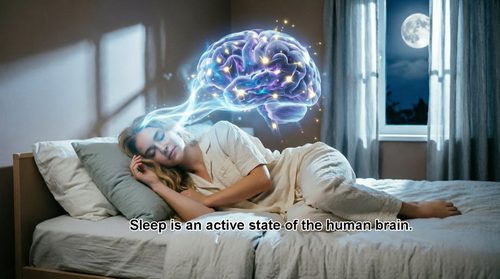
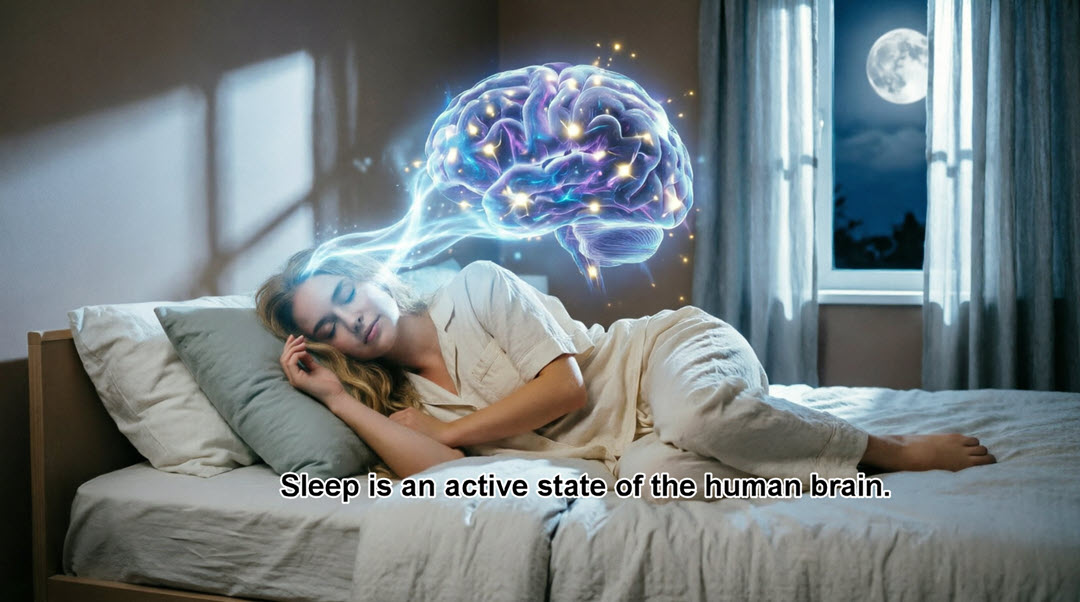
Modern sleep research is beginning to show why. The sleeping brain is not simply switched off. We feel rested after a good night’s sleep but the brain is actually very busy in those hours. It’s changing its electrical activity, its chemistry and the way different regions communicate. Memory is processed. Neural connections are remodelled. Hormones, metabolism and immune activity change. Even the movement of fluid through and around the brain changes during sleep. See also: Sleep through a socio-biological lens, Jan 2025..
1. Sleep is not switching off
Sleep is not one uniform state. The brain cycles repeatedly through different forms of non-REM sleep and then into REM sleep.
The current system used by the American Academy of Sleep Medicine divides non-REM sleep into N1, N2 and N3. N3 is deep, slow-wave sleep. REM is quite different: the brain becomes electrically more active again, while most skeletal muscles are strongly inhibited.
These states repeat several times across a normal night. Deep slow-wave sleep is more prominent earlier in the night, while REM periods tend to become longer towards morning.
For a general understanding, that is enough architecture to keep in mind. The important point is that each state creates a different physiological environment. The brain is not merely becoming more or less unconscious. It is repeatedly changing how it operates.
Much of the recent excitement in sleep research comes from looking inside those states in greater detail. Researchers can now follow brief electrical events lasting less than a second, track communication between the hippocampus and cortex, and watch changes in cerebral blood flow and cerebrospinal fluid while people sleep.
The question is no longer simply how deeply are we asleep?
It is ‘What how much has sleep done its work for my brain and body?’
2. The sleeping brain is busy with memory and remodelling
One of the clearest examples of sleep’s activity is what happens to memory. Experiences acquired during the day are not simply filed away. During non-REM sleep, recently formed memories can be reactivated while the hippocampus and cerebral cortex communicate in a highly organised way.
Several brief electrical events appear to help co-ordinate this process. Slow cortical oscillations provide a broad rhythm. Within them come sleep spindles, generated through communication between the thalamus and cortex. Even faster bursts, called hippocampal sharp-wave ripples, can occur at particular moments within those spindles.
Human intracranial recordings have shown that this timing matters. Work by Staresina and colleagues demonstrated that slow oscillations, spindles and ripples can become tightly coupled during sleep. Geva-Sagiv and colleagues went further, showing that carefully timed stimulation during sleep could strengthen this synchrony and improve later memory performance.
The sleeping brain therefore seems to replay and reorganise some of the day’s information. Researchers can even bias which memory is reactivated. In targeted memory reactivation experiments, a sound linked to previously learnt material is presented quietly during sleep. Under the right conditions, the associated memory is preferentially reprocessed.
Sleep also appears to reshape the physical connections between neurones. In animal studies, researchers including Chiara Cirelli, Giulio Tononi and Luisa de Vivo have shown that many synapses become smaller during sleep, while some important or newly formed connections are preserved. Other work has shown that selected dendritic spines can be strengthened or pruned.
The picture is not simply one of strengthening or weakening. Sleep seems to edit. Some connections are reinforced, some reduced and others reorganised, leaving neural networks better able to learn again the next day.
3. Sleep changes the brain and body’s internal environment
Sleep also changes the physical environment in which the brain operates.
In 2019, Laura Lewis and colleagues used rapid MRI and EEG to observe large waves of cerebrospinal fluid moving through the human brain during non-REM sleep. These fluid movements were linked to changes in electrical activity and cerebral blood volume. The sleeping brain was not merely electrically different; its circulation and fluid dynamics were changing as well. See cerebrospinal fluid pathways below.
Animal studies have begun to suggest how this may happen. Work by Li-Feng Jiang-Xie and colleagues showed that neuronal activity itself can influence cerebrospinal fluid movement through brain tissue. More recently, Maiken Nedergaard’s group reported that slow fluctuations in noradrenaline during non-REM sleep cause cerebral blood vessels to rhythmically constrict and dilate. This vasomotion may help drive fluid movement around the brain.
The popular phrase that sleep “washes toxins from the brain” is still too simple. Human studies show large sleep-related changes in fluid movement, and Per Kristian Eide’s group found slower clearance of an experimental tracer after one night of sleep deprivation. What remains uncertain is how much natural sleep increases the removal of specific substances such as amyloid or tau from the normal human brain.
In NREM sleep, the interstitial space between brain cells expands by up to 60 per cent during sleep, which dramatically reduces resistance and allows CSF to flow more freely through the perivascular channels.
The effects extend beyond the brain. Slow-wave sleep is associated with major changes in hormone secretion, including growth hormone. Experimental suppression of deep sleep can reduce insulin sensitivity, while normal sleep alters immune-cell behaviour.
A 2024 human study led by Luciana Martínez-Albert showed that sleep increased the tendency of some T cells to migrate towards chemical signals associated with lymph nodes. Other studies have found that insufficient sleep around vaccination can weaken later antibody responses.
So sleep is not simply preserving awareness for the next day. It creates a physiological state in which neural, vascular, metabolic, hormonal and immune processes all change together.
4. What happens when sleep is repeatedly curtailed?
The effects of a bad night are familiar, but they are also measurable. Sleep loss impairs sustained attention and reaction time. Working memory, inhibitory control and mental flexibility can deteriorate as well. A 2025 meta-analysis covering 79 studies found impairment across these core areas of executive function.
Memory is particularly vulnerable. A 2024 review led by researchers at Royal Holloway, University of London examined 39 studies in which sleep had been restricted rather than removed altogether. Even partial restriction impaired the formation of new memories.
Repeated short nights matter too. People may become accustomed to feeling tired, but that does not mean their cognitive performance has returned to normal. Errors and lapses can accumulate even when the person believes they have adapted reasonably well.
One of the strangest findings concerns local sleep. In 2017, Yuval Nir, Itzhak Fried and colleagues recorded individual neurones in people undergoing intracranial monitoring. After a night without sleep, some neurones in the medial temporal lobe became slower and less responsive immediately before the person made a cognitive error. Nearby electrical activity also became more sleep-like.
The person was still awake. The whole brain had not entered sleep. However, small populations of neurones were temporarily behaving differently, as though parts of the normal machinery of wakefulness were beginning to fail locally.
This may help explain why severe tiredness can produce sudden, inexplicable mistakes. Being awake does not necessarily mean that every part of the brain is functioning in a fully wakeful state.
5. The longer-term health picture
The longer-term evidence needs more caution. Experiments can show what happens after several nights of restricted sleep. It is not possible for researcher to keep people chronically sleep-deprived for years. Evidence about disease consequent to chronic sleep-deprivation comes mainly from large observational studies.
Poor or disrupted sleep has been associated with type 2 diabetes, cardiovascular disease and several other adverse health outcomes. Sleep duration also shows associations with mortality, although these are not straightforward. Both unusually short and unusually long sleep can be associated with poorer outcomes, and long sleep may sometimes be a marker of underlying illness rather than its cause.
Dementia is especially intriguing. A 2026 meta-analysis of 31 longitudinal studies, involving more than 13 million people, found that sleep disturbances were associated with a higher subsequent risk of Alzheimer’s disease. The association remained after adjustments and in studies with long follow-up periods.
That still does not establish that poor sleep causes Alzheimer’s disease. Neurodegenerative changes can themselves disturb sleep, possibly years before diagnosis. The relationship may run in both directions.
So the responsible conclusion is not that losing sleep will inevitably cause diabetes, heart disease or dementia. It is that persistent poor sleep accompanies a surprisingly broad range of adverse health outcomes, while experimental research increasingly provides plausible biological mechanisms for some of those associations.
6. Conclusion: biology has not negotiated with modern life
Modern life has become good at competing with sleep. Artificial light extends the day. Shift work ignores the clock. Phones, entertainment and global communication can follow us into bed. We can even suppress some of the resulting tiredness with caffeine.
None of that appears to have removed the underlying biological requirement.
Sleep gives the brain access to states that waking life cannot readily reproduce. Neural networks synchronise differently. Memories are reprocessed. Synapses are remodelled. Hormonal, metabolic and immune activity changes. Even blood flow and cerebrospinal fluid move in different patterns.
That may explain why poor sleep reaches so widely into how we think, feel and function.
For centuries we have found increasingly ingenious ways to delay sleep, shorten it and work around it. The neuroscience now suggests something rather humbling: we may be able to postpone sleep, but the brain still expects the opportunity to do what only sleep allows. As some point the brain will make serious demands. You cannot escape and you should try to.