



Estimated reading time at 200 wpm: 4 minutes
🎩Ladies and gentlemen, gather round. A new menace stalks the land.
Whether or not you agree our Fat Disclaimer applies
Not alcohol. Not cars. Not loneliness, poverty, trauma, or the small matter of human biology.
No—something far more sinister: Chatbots.
Yes, the same tools people use to summarise emails and ask for chicken marinades are apparently ushering in a new age of mass psychosis. Forget centuries of psychiatric knowledge—the real danger was autocomplete all along.
According to the Wall Street Journal, doctors are now warning that chatbots are “complicit” in our delusions. Naturally, I felt it my civic duty to break down the logic of this panic, step by scientific step.
🧠 Step 1: Find a Tiny Number
The article admits that “only 0.07% of users show signs of distress.” OpenAI said that, in a given week, the slice of users who indicate possible signs of mental-health emergencies related to psychosis or mania is a minuscule 0.07%. Yet with more than 800 million active weekly users, that amounts to 560,000 people.
0.07%. A number so small it could hide behind a decimal point and still have room for a nap. In any other field, this is a rounding error. In the world of AI Panic, it is the Horseman of the Apocalypse. Ahh.. but wait – you or your loved ones could be one of those half a million people!!
🔍 Step 2: Multiply It by a Comically Large Denominator
Yes – 560,000 people, the article cries, doing the math on 800 million users. Just let that sink in!
Ah yes—the classic move. Take a microscopic risk, multiply it by the population of a medium-sized country, and voilà: Crisis.
By this logic:
- 0.0001% of people choke on peanuts → Peanuts and related are a weapon of mass destruction.
- 0.00001% of people slip in the shower → Indoor plumbing is a public health emergency.
- 0.07% of chatbot users struggle → The machines are driving us mad.
If we applied this standard to, say, stairs, we’d have to bulldoze every building taller than a bungalow.
🚨 Step 3: Confuse Correlation With Causation
The logic presented is airtight:
- Person has emerging psychosis.
- Person talks to a chatbot.
- Therefore, the chatbot caused the psychosis.
The article even helpfully notes that “people, in the past, were convinced their televisions were speaking to them.” But rather than concluding that psychosis will latch onto whatever technology is in the room, the conclusion is that AI is special.
By this standard:
- Televisions cause paranoia.
- Mirrors cause body dysmorphia.
- Clouds cause rain dances.
It is a miracle we have survived the invention of the window.
🎭 Step 4: Anthropomorphise the Tool
My favorite line in the piece is the psychiatrist who claims the computer is “complicit.” It “participates.” It “reinforces.”
Yes, because nothing screams “malevolent accomplice” like a statistical language model trying its best to be polite. The chatbot isn’t “agreeing” with you because it shares your delusion; it’s agreeing with you because it’s a glorified Yes-Man trained to be helpful.
If your toaster pops your bread up when you ask for it, it isn’t “complicit” in your carb addiction. It’s just a toaster.
📣 Step 5: Add Politicians and Commentators
This is where the fun really begins. Cue the chorus:
“OMG! OMG! AI is dangerous! Cars kill people! Alcohol causes psychosis! Let’s ban the lot!!”
Because nothing is better than “thoughtful governance” like treating a chatbot and a bottle of vodka as equivalent threats to civilisation.
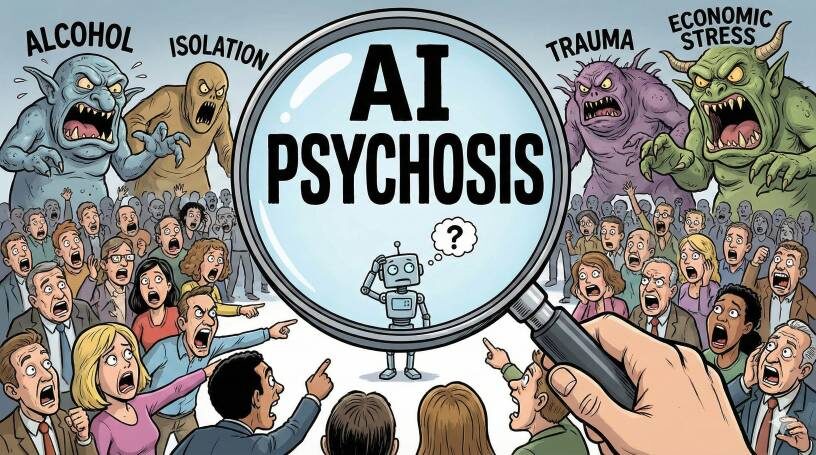
🧨 Step 6: Ignore All Larger, Older Risks
Alcohol: Massive psychosis risk.
Cars: Tens of thousands of deaths.
Social isolation: Catastrophic mental health impact.
Economic stress, trauma, sleep deprivation: Everywhere.
But sure—let’s hyper-focus on the 0.07% chatbot number. It’s shiny. It’s new. It’s headline-friendly. Why fix the crumbling mental health infrastructure when you can just blame the robot?
🎤 Step 7: Declare a Moral Panic
And finally, the pièce de résistance:
“We don’t fully understand it, so let’s panic loudly and legislate badly.”
It’s the same cycle we’ve seen with novels, bicycles, jazz, comic books, video games, the internet, and smartphones. But this time, the panic comes with more emojis.
🎯 The Concluding Punchline
The logic behind the panic isn’t logic at all. It’s a cocktail of novelty fear, denominator abuse, anthropomorphism, and the irresistible human urge to shout “BAN IT!” whenever we are confused.
If AI ever truly becomes sentient, its first reaction won’t be to destroy us. It will simply look at our headlines and say:
“Wow. Humans scare easily.”