


Estimated reading time at 200 wpm: 38 minutes
For more than a decade, the public conversation about Mars has been shaped by a powerful narrative: that humanity is on the verge of becoming a multiplanetary species, and that a crewed mission to Mars is only a few years away. The most influential voice behind this belief is Elon Musk, who continues to assert that humans could reach Mars by around 2030 — a date now only four years distant. These claims are repeated so frequently, and with such confidence, that they have become a kind of cultural default. The idea feels inevitable, almost pre-ordained. See also: The Mars Paradox: Engineering Success, Biological Gamble
Whether or not you agree our Fat Disclaimer applies
This article exists because that narrative is profoundly misleading.
The issue is not a lack of ambition, engineering talent, or financial resources. Nor is it cynicism about exploration or human potential. The issue is that the public discourse consistently fails to account for the full system of constraints that govern human survival beyond Earth. These constraints are not speculative. They are not philosophical. They are not matters of opinion. They are biological, physical, industrial, and reliability-driven realities that no amount of optimism can bypass.
A further complication is the modern information ecosystem. Search engines, content-ranking algorithms, and AI-driven summarisation systems tend to amplify the most visible and most frequently repeated elements of the Mars narrative. Rockets, launch cadence, and dramatic engineering milestones dominate search results and article hit-counts. Meanwhile, the far more difficult and less glamorous challenges — the vulnerability of the human brain in deep space, the collapse of physiology without gravity, the impossibility of shielding against galactic cosmic radiation, the fragility of closed-loop life support, the absence of medical autonomy, and the industrial scale required to build safe habitats — receive only a fraction of the attention.
This article confronts those biases directly. It sets out the century-scale challenges that must be solved before a human Mars mission becomes viable, and explains why Musk’s timeline — however inspiring — is incompatible with the biological and engineering realities of deep-space travel. What follows is not an argument against exploration, but an argument for honesty: a clear-eyed assessment of where we are, what remains unsolved, and why no individual, company, or nation is getting humans safely to Mars within the next 100 years.
1. The Century Table: A 100-Year Reality Check
The modern Mars narrative is dominated by confidence, spectacle, and the visible progress of launch systems. Rockets land themselves, stainless-steel prototypes rise from the Texas coast, and the cadence of orbital launches continues to accelerate. These achievements create the impression that the hardest problems are already behind us. In reality, they represent only the outermost layer of a far deeper and more demanding system.
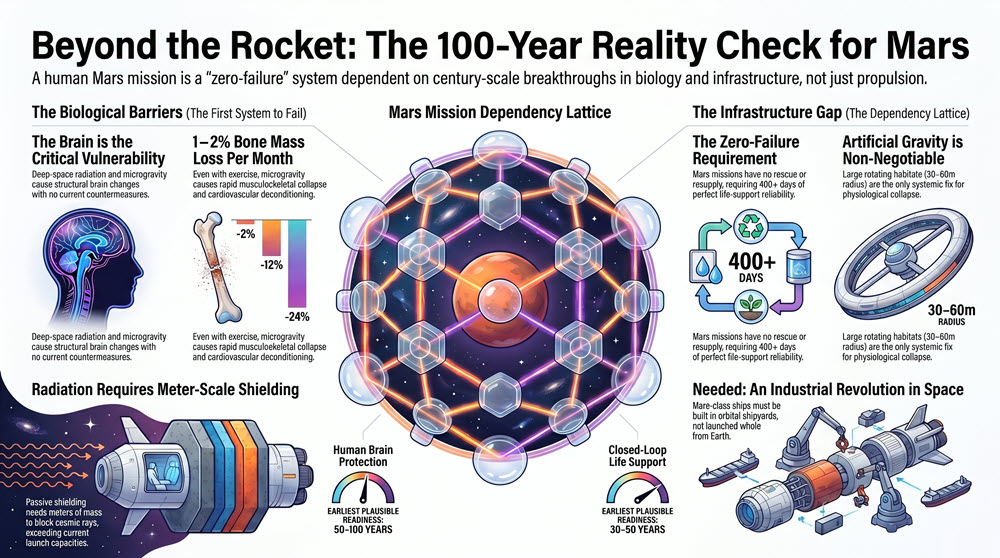
The purpose of the Century Table is to reset expectations. It presents, in a single view, the major domains that must all succeed before a human Mars mission becomes viable. Each domain has its own timeline, its own scientific uncertainties, and its own engineering burdens. Crucially, none of them can be bypassed. A failure in any one of these areas is mission-ending. This is not a menu of optional technologies; it is a lattice of hard dependencies. The Century Table exposes something that is often missed in public discussion: these systems do not stand alone. They form a dependency lattice — a stacked structure in which each element relies on the successful operation of all others. Artificial gravity is meaningless without radiation shielding; shielding is irrelevant without reliable life support; life support is insufficient without medical autonomy; and none of these matter if the human brain cannot tolerate the deep-space environment. This interlocking architecture means that a single unsolved domain collapses the entire mission. Mars is therefore not a sequence of independent challenges but a zero-failure system in which every component must reach maturity together.
The Century Table
| System / Domain | Current Status | Earliest Plausible Readiness | Why It Is a Hard Blocker |
|---|---|---|---|
| Human Brain & CNS Protection | Not solved | 50–100 years | Deep-space radiation and microgravity cause structural and functional brain changes with no existing countermeasures. |
| Artificial Gravity | Not demonstrated | 30–60 years | Requires large rotating habitats (30–60 m radius) and industrial-scale orbital construction. |
| Radiation Shielding (GCR) | Physically prohibitive | 40–70 years | Thin hulls are ineffective; viable shielding requires metres of mass or unproven active systems. |
| Closed-Loop Life Support | Not reliable | 30–50 years | No system has ever run for 400+ days without resupply, redundancy, or ground intervention. |
| Medical Autonomy | Not viable | 40–60 years | No evacuation, no surgery, limited diagnostics, and long communication delays. |
| Micrometeoroid-Resilient Habitats | Not designed | 50–100 years | Large rotating structures are high-cross-section targets with no demonstrated protection strategy. |
| Industrial Capacity in Orbit | Nascent | 50–100 years | Requires heavy-lift cadence, orbital shipyards, and large-scale in-space manufacturing. |
| Mars Surface Viability (0.38 g) | Unknown | 30–60 years | Long-term effects of partial gravity on human physiology remain unstudied. |
| Mars Dust Toxicity | Unresolved | 20–40 years | Perchlorate-rich dust is abrasive, reactive, and hazardous to lungs and equipment. |
1.1 The Core Systems That Must All Succeed
The Century Table identifies the foundational systems required for human survival beyond Earth’s protective environment. These include the preservation of the human brain in deep space, the provision of artificial gravity, the mitigation of galactic cosmic radiation, the reliability of closed-loop life support, the capacity for medical autonomy, and the industrial infrastructure needed to build and maintain large, shielded habitats. Each system is a prerequisite for the next. None can be deferred.
The timelines associated with these systems are not speculative estimates. They reflect the current state of research, the physical limits of materials, the absence of demonstrated solutions, and the industrial scale required to implement them. Even under optimistic assumptions, the earliest plausible convergence of these technologies lies many decades ahead.
1.2 Why These Timelines Are Physically Unavoidable
The constraints that shape these timelines are rooted in physics, biology, and engineering fundamentals. The human brain cannot be shielded from deep-space radiation with thin metal hulls. Microgravity cannot be countered with exercise regimes. Closed-loop life support cannot be made reliable simply by scaling existing systems. Medical emergencies cannot be managed with delayed communication and limited equipment. And large rotating habitats cannot be built without an industrial presence in orbit that does not yet exist.
These are not problems that yield to speed, funding, or willpower alone. They require breakthroughs, infrastructure, and reliability standards that take decades to mature. The timelines are long because the underlying constraints are hard, not because of a lack of ambition.
1.3 The “Dependency Lattice” That Makes Mars a Zero-Failure Mission
The defining feature of a human Mars mission is that every system must work perfectly, continuously, and in combination. This is the dependency lattice: a structure in which each element relies on the successful operation of all others. Artificial gravity is meaningless without radiation shielding. Shielding is irrelevant without reliable life support. Life support is insufficient without medical autonomy. And none of these matter if the human brain cannot tolerate the deep-space environment.
This interdependence is what makes Mars a zero-failure mission. There is no rescue capability, no resupply, no abort path, and no safe haven. A single systemic failure — in physiology, engineering, or habitat integrity — is fatal. This is why the timelines extend into the next century. The challenge is not to solve one problem, but to solve all of them, simultaneously, with perfect reliability.
The Century Table is therefore not a pessimistic forecast. It is a realistic foundation. It frames the rest of this article: an examination of each domain in turn, the barriers that remain, and the reasons why no individual, company, or nation — including Elon Musk and SpaceX — can deliver a safe human Mars mission within the next 100 years.
2. The Human Body: The First System That Fails
Before engineering, before propulsion, before habitats, before radiation shielding — the first system that fails on a Mars mission is the human body. This is the foundational constraint that every other system must serve. The human organism evolved under one atmosphere of pressure, a geomagnetic field, a stable 1 g gravitational load, and a biosphere that continuously regulates temperature, chemistry, and microbial balance. Remove any of these conditions and physiology begins to degrade. Remove all of them simultaneously, as a Mars mission does, and the degradation becomes rapid, systemic, and potentially irreversible.
The popular narrative imagines astronauts as resilient, adaptable, and capable of enduring extreme environments through training and determination. The biological reality is the opposite. Human physiology is exquisitely sensitive to environmental change. Even short-duration missions in low Earth orbit — protected by Earth’s magnetic field and with continuous ground support — produce measurable declines in bone density, muscle mass, cardiovascular function, immune competence, and neurological stability. A 400-day round trip to Mars amplifies these stresses far beyond anything previously attempted.
2.1 The Brain and Central Nervous System: The Critical Vulnerability
The brain is the organ least capable of tolerating deep-space conditions. High-energy radiation penetrates neural tissue, causing inflammation, microvascular damage, and cognitive impairment. Microgravity disrupts cerebrospinal fluid dynamics, leading to swelling, visual disturbances, and structural changes in the brain itself. These effects are not hypothetical. They have been observed repeatedly in astronauts after relatively short missions.
On a Mars mission, the brain is exposed to:
- continuous galactic cosmic radiation
- solar energetic particle events
- fluid shifts caused by microgravity
- disrupted sleep cycles
- elevated CO₂ levels
- chronic stress and isolation
There are no validated countermeasures. No shielding solution exists that can protect the brain during a one-year deep-space mission. No pharmaceutical intervention has been shown to prevent radiation-induced cognitive decline. The central nervous system is therefore the first hard blocker — the system that fails before any habitat, spacecraft, or engineering subsystem.
2.2 Musculoskeletal Collapse Under Microgravity
Bone and muscle loss in microgravity is well documented. Even with intensive exercise, astronauts lose 1–2% bone mass per month, significant muscle strength and volume, reduced tendon stiffness, and impaired balance and coordination.
These declines are manageable on the International Space Station because crews return to Earth for rehabilitation. On a Mars mission, there is no rehabilitation. The crew must perform high-risk tasks — landing, extravehicular activity, habitat setup, emergency response — while physiologically compromised. Partial gravity on Mars (0.38 g) may slow degradation, but no evidence shows it can reverse or stabilise it. The crew may arrive too weak to perform critical operations.
2.3 Cardiovascular and Immune System Degradation
Microgravity causes the cardiovascular system to decondition rapidly. Heart muscle atrophies. Blood volume decreases. Orthostatic intolerance becomes common. These effects increase the risk of arrhythmias, fainting, reduced exercise capacity, and impaired thermoregulation.
The immune system also weakens. Latent viruses reactivate. Infections become more likely. Wound healing slows. Combined with radiation-induced DNA damage, the risk of cancer increases.
These are not minor concerns. They are mission-threatening vulnerabilities.
2.4 Psychological and Behavioural Risks in Deep Space
A Mars mission imposes psychological stresses that have no analogue on Earth: extreme isolation, confinement in a small habitat, communication delays, sensory monotony, chronic risk awareness, and disrupted circadian rhythms.
Even highly trained crews experience cognitive fatigue, mood instability, and reduced performance under such conditions. On a mission with no rescue, no abort, and no external support, psychological resilience becomes a critical survival factor — yet it cannot be guaranteed or engineered.
2.5 Why Human Physiology Is a Century-Scale Constraint
The human body is not designed for deep space. It is not designed for microgravity, radiation, isolation, or partial gravity. Every physiological system — neurological, musculoskeletal, cardiovascular, immune, and endocrine — degrades under these conditions. Countermeasures are partial, unproven, or nonexistent.
A safe Mars mission requires artificial gravity, metre-scale radiation shielding, closed-loop life support with stable atmospheric composition, validated understanding of partial-gravity physiology, and medical autonomy capable of managing systemic decline.
None of these exist today. Some require breakthroughs in biology and materials science. Others require large rotating habitats and industrial capacity in orbit.
Human physiology is therefore not a challenge to be managed. It is the first and most fundamental barrier — the constraint that shapes every other system and pushes the timeline for a safe human Mars mission into the next century.
3. Artificial Gravity: The Only Systemic Fix
Artificial gravity is not an enhancement, a comfort feature, or a long-term aspiration. It is the only systemic solution to the collapse of human physiology in microgravity. Every long-duration mission to date has demonstrated that the human body is fundamentally incompatible with weightlessness. Bone density declines, muscle mass deteriorates, cardiovascular function weakens, and the brain itself undergoes structural changes. Exercise regimes slow these processes but do not prevent them. For a multi-year mission beyond Earth’s protective environment, artificial gravity is not optional; it is the baseline requirement for survival.
3.1 Why Partial or Zero Gravity Cannot Sustain Human Physiology
The assumption that humans can tolerate extended periods in microgravity is contradicted by decades of evidence. Even with intensive exercise, astronauts experience losses in bone mineral density, reductions in muscle strength, impaired balance, altered immune function, and significant changes in the brain’s structure and fluid dynamics. These effects are not minor or reversible inconveniences; they are mission-threatening degradations.
Partial gravity, such as the 0.38 g on Mars, offers no proven protection. No long-duration studies exist and no analogue environment can replicate it. It is entirely unknown whether 0.38 g is sufficient to maintain bone, muscle, cardiovascular stability, or neurological health. The assumption that “some gravity is enough” is unsupported by evidence. Until artificial gravity is available, the physiological risks remain unbounded.
3.2 Minimum Viable Habitat Size and Engineering Requirements
Artificial gravity requires rotation, and rotation requires scale. Small centrifuges induce disorienting Coriolis forces, unacceptable gradients in perceived gravity, and severe motion sickness. The minimum viable radius for a tolerable rotating habitat lies in the range of 30–60 metres. Anything smaller produces a hostile environment; anything larger demands industrial-scale construction in orbit.
Such a structure must be precisely balanced, continuously stabilised, resistant to micrometeoroid impacts, capable of maintaining rotational integrity for years, and equipped with redundant bearings, seals, and structural supports.
No space agency or private company has ever built, tested, or even meaningfully prototyped a rotating habitat of this scale. The engineering challenges are not incremental extensions of current practice; they represent an entirely new class of space architecture.
3.3 Micrometeoroid Resilience and Structural Reliability
A rotating habitat presents a large cross-sectional area and a continuously moving target for micrometeoroids. Even small impacts can destabilise rotation, damage structural elements, or compromise the pressure hull. Unlike the International Space Station, which can orient itself to minimise exposure, a rotating structure cannot hide behind shielding or adjust its profile. It must be designed to absorb or deflect impacts without losing balance or integrity.
This requirement introduces a second layer of complexity: the need for multi-layer shielding, redundant structural pathways, and real-time monitoring systems capable of detecting and compensating for rotational imbalances. No such system has been demonstrated. The reliability demands are absolute; a single uncorrected impact could render the habitat uninhabitable.
3.4 Why Artificial Gravity Is a Century-Scale Engineering Project
Artificial gravity is not a single technology. It is the convergence of multiple unsolved domains: large-scale orbital construction, high-precision rotational engineering, micrometeoroid-resilient architecture, long-duration structural reliability, closed-loop life support integration, radiation shielding compatible with rotation, and continuous attitude control and vibration damping.
Each of these domains requires breakthroughs, infrastructure, and industrial capacity that do not yet exist. Even under optimistic assumptions, the earliest plausible timeline for a safe, crew-rated rotating habitat lies several decades ahead. And because artificial gravity is a prerequisite for every other aspect of human survival in deep space, its absence delays all other systems.
Artificial gravity is therefore the central pillar of human viability beyond Earth. Without it, no Mars mission — regardless of propulsion, funding, or political will — can be considered safe.
4. Radiation Shielding: The Physics We Cannot Cheat
Radiation is often treated as a technical nuisance — a problem to be solved with thicker walls, clever materials, or a future breakthrough in active shielding. In reality, it is one of the most intractable barriers to human survival beyond Earth’s magnetosphere. The deep-space environment exposes the human body to a continuous flux of high-energy particles, including galactic cosmic rays (GCRs) and solar energetic particles. These are not the same as the radiation encountered in low Earth orbit. They are orders of magnitude more penetrating, more biologically damaging, and less amenable to shielding.
The challenge is not simply to reduce exposure, but to reduce it to a level compatible with multi-year missions, cumulative biological effects, and the vulnerability of the human brain. No existing spacecraft, habitat, or shielding concept meets this requirement. The physics is unforgiving, and the engineering implications are profound.
4.1 Galactic Cosmic Rays and the Limits of Material Shielding
Galactic cosmic rays are high-energy particles travelling at relativistic speeds. When they strike shielding materials, they do not simply stop; they fragment the atoms they collide with, producing cascades of secondary radiation. This secondary radiation can be as damaging — or more damaging — than the original particle. The intuitive solution of “add more shielding” quickly becomes counterproductive.
To reduce GCR exposure to acceptable levels, shielding would need to be measured in metres, not millimetres. This is incompatible with current launch capacities, spacecraft mass budgets, and the structural limits of rotating habitats. Even water, polyethylene, and hydrogen-rich materials — often proposed as alternatives — require impractically large volumes to provide meaningful protection.
The unavoidable conclusion is that passive shielding alone cannot make deep-space radiation safe for human physiology.
4.2 Active Shielding Concepts and Their Current Impossibility
Active shielding — using magnetic or electrostatic fields to deflect charged particles — is frequently invoked as a future solution. In practice, it remains speculative. The magnetic fields required to deflect GCRs would need to be comparable to those generated by large particle accelerators. Such systems would be prohibitively massive, energy-intensive, structurally complex, vulnerable to failure, incompatible with rotating habitats, and untested in space.
Electrostatic concepts face similar obstacles. The voltages required to repel high-energy particles are extreme, and the resulting fields would pose risks to both crew and equipment. No active shielding system has been demonstrated at scale, and none is close to operational readiness.
The gap between concept and implementation is measured not in years, but in decades.
4.3 Mass, Energy, and the Industrial Cost of Real Protection
The physics of radiation shielding leads to a stark conclusion: meaningful protection requires mass, and mass requires industrial capacity in orbit. A safe deep-space habitat would need multi-layer shielding, hydrogen-rich materials, water or regolith buffers, structural reinforcement, integrated thermal management, and redundancy across all layers.
Such a structure cannot be launched from Earth in one piece. It must be assembled in orbit, supplied with materials mined or manufactured beyond Earth, and maintained by a permanent industrial presence. This is a civilisational project, not a mission architecture.
The energy requirements are equally demanding. Powering active systems, maintaining life support, and sustaining artificial gravity all require a level of energy generation and storage far beyond current capabilities. Nuclear systems offer one path, but they introduce their own engineering, safety, and political challenges.
Radiation shielding is therefore not a discrete problem with a discrete solution. It is a driver of scale, mass, and infrastructure — a force that shapes every other aspect of mission design.
4.4 Why Radiation Shielding Is a Century-Scale Challenge
Radiation is the domain where optimism collapses most quickly. The constraints are not technological but physical. No material, configuration, or concept currently available can provide the level of protection required for a multi-year mission to Mars.
Even the most optimistic Mars mission profile — a short-stay trajectory lasting just over one year door-to-door — exposes the crew to levels of deep-space radiation far beyond anything experienced in low Earth orbit. This is not a multi-year colonisation scenario; it is the minimum-duration “short hop” that mission planners consider the least hazardous option. Yet even this best-case timeline exceeds safe cumulative exposure, particularly for the brain and central nervous system. The physics does not scale down with mission length: a one-year round trip still demands shielding solutions that do not currently exist.
The solutions that might work — large rotating habitats with metre-scale shielding, active systems integrated into massive structures, and industrial-scale construction in orbit — lie far beyond present capabilities.
Radiation shielding is therefore one of the clearest indicators that a safe human Mars mission is a century-scale endeavour, constrained by physics, shaped by engineering, and dependent on infrastructure that does not yet exist.
5. Life Support: The 400-Day Reliability Problem
Life support is often imagined as a solved problem. The International Space Station has operated continuously for more than two decades, recycling air and water while supporting crews for six-month rotations. This creates the impression that scaling or refining existing systems will suffice for a Mars mission. In reality, the ISS is not a model of reliability; it is a model of continuous maintenance, resupply, and ground intervention. None of these are available on a 400-day round trip to Mars.
A Mars mission is not a test of whether life support can function. It is a test of whether it can function without failure, without resupply, without replacement parts, and without real-time support from Earth. No life support system in history has met this standard. The gap between current capability and mission requirement is fundamental.
5.1 Why ISS-Style Systems Cannot Work for Mars
The ISS Environmental Control and Life Support System (ECLSS) is a complex, maintenance-heavy assembly of pumps, filters, valves, centrifuges, and chemical reactors. It requires constant monitoring, frequent replacement of consumables, regular delivery of spare parts, real-time troubleshooting by ground teams by ground teams, and the ability to isolate and bypass failing components.
Even with this support,ISS life support failures are common. Carbon dioxide scrubbers clog, water processors foul, valves seize, and microbial contamination appears in unexpected places. These failures are manageable in low Earth orbit because help is hours away. On a Mars mission, they are fatal.
A Mars-bound crew cannot rely on a system that assumes the availability of Earth-based logistics. The entire architecture must be redesigned for autonomy, redundancy, and multi-year reliability — none of which have been demonstrated.
5.2 Closed-Loop Requirements and Failure Modes
A true Mars-class life support system must be closed-loop, recycling air, water, and waste with near-perfect efficiency. Every percentage point of inefficiency compounds over time. A system that is 95% efficient— impressive by ISS standards — will fail catastrophically on a 400-day mission.
Closed-loop systems introduce new failure modes: microbial blooms in water processors, biofilm formation in pipes and filters, chemical contamination from trace materials, catalyst degradation, membrane fouling, CO₂ sorbent exhaustion, oxygen generation instability, and unexpected interactions between biological and mechanical subsystems.
Each of these failure modes requires intervention, replacement parts, or system reconfiguration. A Mars crew cannot carry enough spares to cover every scenario, nor can they rely on Earth for diagnosis or repair. The system must operate continuously, autonomously, and without degradation for the entire mission duration.
5.3 The No-Rescue, No-Resupply Constraint
The defining feature of a Mars mission is the absence of rescue. Once the crew departs Earth, they are committed. There is no abort path, no safe haven, and no possibility of external assistance. A single failure in life support — even a minor one — can cascade into a lethal environment within hours.
This constraint transforms engineering tolerances. A system that is “good enough” for low Earth orbit is wholly inadequate for deep space. Reliability must approach perfection. Redundancy must be absolute. Every subsystem must operate independently, survive partial failures, and recover from unexpected conditions.
Themass penalty for such redundancy is enormous. Multiple CO₂ scrubbers, multiple oxygen generators, multiple water processors, and multiple waste-handling systems must all be carried, along with the power, shielding, and structural support they require. This pushes the habitat into a mass class that cannot be launched from Earth in one piece and must instead be assembled in orbit.
5.4 Why Life Support Is a Century-Scale Challenge
Life support is not a solved problem waiting to be scaled. It is an unsolved problem waiting to be reinvented. The requirements for a Mars mission — autonomy, reliability, redundancy, and multi-year stability — are far beyond the capabilities of current systems. Achieving them demands breakthroughs in materials science, microbial control, autonomous diagnostics, fault-tolerant design, in-situ repair and reconfiguration, long-duration chemical stability, and integrated biological-mechanical systems.
These breakthroughs cannot be rushed. They require decades of testing, iteration, and validation in cislunar space, large-scale habitats, and orbital industrial facilities. Life support is therefore a foundational element of the dependency lattice and one of the clearest reasons why a safe human Mars mission remains a century-scale endeavour.
6. Medical Autonomy: A Hospital in a Tin Can
Medical autonomy is one of the most underestimated barriers to a human Mars mission. Popular narratives assume that a well-trained crew, a compact medical kit, and remote support from Earth will be sufficient. This assumption collapses immediately under scrutiny. A Mars mission is not a remote expedition; it is a sealed environment with no evacuation route, no resupply, no surgical theatre, no intensive care capability, and communication delays that make real-time medical guidance impossible.
The human body is fragile, and medical emergencies are not rare. In deep space, the threshold for catastrophe is far lower. A Mars-bound crew must be able to diagnose, stabilise, and treat a wide range of conditions entirely on their own — with limited equipment, limited pharmaceuticals, and no external support. No current medical system, training programme, or technology stack meets this requirement.
A 400-day mission exposes the crew to a spectrum of medical risks that cannot be mitigated by training alone. These include appendicitis, kidney stones, cardiac arrhythmias, severe infections, sepsis, traumatic injuries, dental emergencies, thrombosis and embolism, acute neurological events, and complications from radiation exposure.
On Earth, these conditions require imaging, laboratory diagnostics, surgical intervention, or intensive care. In deep space, none of these capabilities exist. Even a relatively simple procedure, such as removing an inflamed appendix, becomes a high-risk operation without anaesthesia support, sterile facilities, or post-operative monitoring.
The probability of at least one serious medical event occurring during a 400-day mission is significant. And the consequences are absolute.
6.2 Diagnostic and Surgical Limitations
Modern medicine relies on diagnostics: blood tests, imaging, cultures, biopsies, and continuous monitoring. A Mars mission cannot carry the equipment required to perform these tasks at clinical standards. Miniaturised devices exist, but they are limited in scope, accuracy, and reliability. They cannot replace full laboratory capability.
Surgical intervention is even more constrained. A spacecraft cannot accommodate a sterile operating theatre, surgical lighting, anaesthesia machines, ventilators, blood products, surgical teams, or post-operative care facilities.
Even if the equipment existed, microgravity (or partial gravity) introduces additional complications: fluid behaviour becomes unpredictable, contamination risks increase, and maintaining a sterile field becomes nearly impossible. Artificial gravity would help, but only if the habitat is large enough to provide a stable surgical environment — a capability far beyond current mission designs.
6.3 Why Evacuation Is Impossible and Telemedicine Is Insufficient
Evacuation is the cornerstone of risk management in every hazardous environment on Earth. On Mars, it does not exist. Once the crew departs Earth, they are committed for the full duration of the mission. There is no abort trajectory that returns them quickly. There is no rescue vehicle. There is no safe haven.
Telemedicine, often proposed as a substitute, is constrained by communication delays of up to 22 minutes each way. This makes real-time guidance impossible. A surgeon on Earth cannot talk a crew member through a procedure. A physician cannot assess a deteriorating patient in real time. Even simple interactions become asynchronous, slow, and error-prone.
The crew must therefore be fully autonomous — medically, diagnostically, and surgically. No current training programme can prepare non-specialists for this level of responsibility. Even specialists would struggle without equipment, support staff, and a controlled environment.
6.4 Why Medical Autonomy Is a Century-Scale Challenge
Achieving true medical autonomy requires breakthroughs in compact, reliable diagnostic systems, automated laboratory analysis, robotic or semi-autonomous surgical systems, advanced imaging in microgravity, long-duration pharmaceutical stability, AI-assisted decision support with validated clinical accuracy, and integrated life-support and medical monitoring.
These technologies are in their infancy. Some do not exist at all. Others exist only as prototypes or early-stage laboratory devices. None have been validated for long-duration use in deep space.
Medical autonomy is therefore not a matter of packing a better first-aid kit. It is a fundamental re-engineering of medicine itself for an environment where failure is fatal and help is impossible. It forms another critical link in the dependency lattice and underscores why a safe human Mars mission lies decades beyond current capabilities.
7. Industrial Capacity in Orbit: The Missing Infrastructure
Every credible pathway to a safe human Mars mission requires large, shielded, rotating habitats; redundant life-support systems; radiation-resistant structures; and the ability to assemble, maintain, and repair complex spacecraft far from Earth. None of this can be launched fully assembled from the ground. The mass, volume, and structural requirements exceed the capabilities of any existing or planned launch vehicle. The only viable route is to build these systems in orbit.
This introduces a new and often overlooked reality: before humanity can go to Mars, it must first build an industrial civilisation in space. Not a single factory, not a single depot, not a single shipyard — but an entire ecosystem of manufacturing, assembly, power generation, logistics, and maintenance. This infrastructure does not exist today, and the gap between current capability and required capability is vast.
7.1 Why Mars Requires Orbital Shipyards, Not Just Rockets
Rockets are only the first step. They deliver mass to orbit, but they do not create the structures needed for deep-space habitation. A Mars-class spacecraft — with artificial gravity, multi-layer radiation shielding, redundant life support, and medical autonomy — cannot be built on Earth and launched in one piece. It must be assembled in orbit, using modular components, robotic construction systems, large-scale trusses and pressure vessels, integrated shielding layers, high-capacity power systems, and docking and maintenance platforms.
This is the same transition that naval engineering underwent centuries ago: small boats could be built on beaches, but large ships required shipyards. Deep-space vessels require the same leap — but in orbit.
7.2 The Scale of Manufacturing Required
The mass of a safe deep-space habitat is measured not in tens of tonnes, but in hundreds or thousands. Radiation shielding alone demands enormous quantities of material. Artificial-gravity structures require large rotating rings or cylinders, each with precise tolerances and robust structural integrity. Life-support redundancy multiplies the mass further.
To support this, humanity needs orbital foundries, material processing plants, additive manufacturing facilities, robotic assembly lines, storage depots for water, fuel, and structural materials, high-capacity power generation, and regular cargo transport between Earth, the Moon, and orbital facilities.
This is not a mission architecture. It is an industrial revolution in space.
7.3 Why Launch Cadence Alone Cannot Solve the Problem
SpaceX’s rapid-launch philosophy has transformed access to orbit, but launch cadence does not replace infrastructure. Even if rockets could deliver hundreds of tonnes per week, the following problems remain: no facilities to assemble large structures, no systems to integrate shielding at scale, no orbital dry-docks for maintenance, no robotic workforce capable of continuous construction, no storage for bulk materials, no power grid to support manufacturing, and no logistics network for moving components between orbits.
Launch vehicles are the trucks. What is missing is the factory, the warehouse, the power station, the road network, and the workforce.
7.4 Why Industrial Capacity Is a Century-Scale Challenge
Building an industrial civilisation in orbit requires sustained decades of investment, new materials and manufacturing techniques, autonomous robotics capable of long-duration operation, large-scale power generation, reliable transport between Earth, the Moon, and orbital facilities, and permanent human or robotic workforce in space.
Each of these domains is in its infancy. The transition from today’s low Earth orbit operations to a fully functional orbital industrial base is comparable to the transition from early aviation to global air travel — a transformation that took half a century.
Industrial capacity in orbit is therefore an essential enabler of every other system in the dependency lattice and one of the clearest reasons why a safe human Mars mission cannot be achieved within the next 100 years.
8. Mars Surface Reality: A Hostile, Unforgiving Environment
Public imagination often treats the surface of Mars as a frontier — harsh, but conquerable with determination and engineering. The reality is far less forgiving. Mars is not a colder version of Earth. It is an environment that combines the worst aspects of Antarctica, the Moon, and deep space, without offering the protective advantages of any of them. Its atmosphere is too thin to breathe, too thin to shield, and too thin to slow a landing. Its dust is chemically reactive and biologically hazardous. Its gravity is untested for long-term human health. Its temperatures swing violently. And its surface is bombarded by radiation at levels incompatible with human physiology.
A short-stay mission — the most optimistic scenario — still requires a habitat capable of withstanding these conditions for weeks to months without failure. No such habitat exists, and none is close to operational readiness.
8.1 The 0.38 g Unknown: Physiology Without Evidence
Mars offers partial gravity, but partial gravity is not a solution. It is an untested physiological regime. No human has ever lived in 0.38 g for more than a few seconds. No long-duration studies exist. No analogue environment can replicate it. We do not know whether 0.38 g is sufficient to maintain bone density, muscle mass, cardiovascular stability, vestibular function, neurological health, or immune competence.
The assumption that “some gravity is enough” is unsupported by evidence. It may slow physiological decline. It may not. It may even introduce new failure modes. Until artificial gravity is available, the risks remain unbounded.
8.2 Mars Dust: Toxic, Abrasive, and Ubiquitous
Mars dust is not like terrestrial dust. It is electrostatically adhesive, abrasive, fine enough to penetrate seals, chemically reactive, and rich in perchlorates that are toxic to humans. It infiltrates equipment, clogs filters, degrades seals, and poses a direct threat to respiratory health. On the Moon, dust was a nuisance. On Mars, it is a systemic hazard. A habitat must exclude perchlorate-rich dust completely, maintain internal air quality, and protect equipment from abrasion and contamination. No current habitat design meets this requirement.
8.3 Thermal Extremes and Habitat Integrity
Mars experiences extreme temperature swings, often exceeding 100 °C between day and night. These fluctuations place enormous stress on structural materials, seals, joints, and pressure vessels. A habitat must maintain stable internal pressure and temperature, structural integrity under thermal cycling, protection against frost heave and subsurface ice expansion, and resilience against dust storms and wind loading.
Even small leaks or structural shifts can be catastrophic. The habitat must operate flawlessly for the entire surface stay, with no possibility of external repair or reinforcement.
8.4 Radiation on the Surface: No Safe Haven
Mars has no global magnetic field and only a thin atmosphere. Radiation levels on the surface remain dangerously high. A surface habitat must therefore incorporate multi-layer shielding, regolith berms or overburden, hydrogen-rich materials, and integrated thermal and structural protection.
This adds mass, complexity, and construction requirements that cannot be met with pre-landed modules alone. Any meaningful shielding strategy requires in-situ construction or pre-assembled heavy structures — both of which demand industrial capacity that does not yet exist.
8.5 Why Mars Surface Operations Are a Century-Scale Challenge
A safe surface stay on Mars requires habitats with metre-scale shielding, dust-resistant seals and airlocks, autonomous environmental control systems, reliable power generation (solar is insufficient during dust storms), thermal management across extreme temperature cycles, and redundancy in all life-support and structural systems — plus a validated understanding of partial-gravity physiology.
None of these capabilities exist today. Some are decades away. Others require breakthroughs in materials science, robotics, and habitat engineering. Mars surface operations are therefore another critical link in the dependency lattice and one of the clearest reasons why a safe human Mars mission remains a century-scale endeavour.
9. Reliability Engineering: The Zero-Failure Requirement
Reliability is the quiet, unglamorous foundation of every human space mission. It is also the domain most profoundly misunderstood in public discourse. Rockets can fail and be replaced. Satellites can fail and be written off. Even the International Space Station can tolerate subsystem failures because it has redundancy, resupply, and continuous ground support. A Mars mission has none of these safety nets. It is a closed system with no rescue, no resupply, no abort path, and no external intervention. Every critical subsystem must operate continuously, without catastrophic failure, for the entire duration of the mission.
This transforms reliability from an engineering goal into an existential requirement. A single failure — in life support, power, thermal control, habitat integrity, or propulsion — is fatal. The reliability standards required for a Mars mission exceed those of any human-rated system ever built.
On Earth, the closest analogue to a Mars-class reliability requirement is a nuclear submarine or an aircraft carrier: systems that must operate continuously, autonomously, and safely for months at a time. In other words a zero maintenance windows Even these platforms rely on large crews, extensive maintenance, abundant spare parts, real-time communication, and the ability to surface or dock in emergencies.
A Mars spacecraft has none of these advantages. It must achieve submarine-level reliability with a crew of four to six, no resupply, no external maintenance, no evacuation, no real-time support, and no safe harbour. There must be zero tolerance for cascading failures. This is reliability engineering at the edge of what is physically and organisationally possible.
9.2 Redundancy, Mass, and the Compounding Problem
Redundancy is the standard method for achieving reliability. If one system fails, another takes over. But redundancy has a cost: mass. Every redundant subsystem — pumps, valves, filters, processors, batteries, sensors, computers — adds weight. Weight increases launch requirements, structural demands, shielding needs, and power consumption. This creates a compounding problem that pushes the spacecraft into a mass class that cannot be launched from Earth in one piece. It must be assembled in orbit — requiring the industrial capacity described earlier.
9.3 The Maintenance Burden: ISS as a Warning, Not a Model
The ISS is often cited as proof that long-duration missions are feasible. In reality, it is a warning. The ISS requires continuous maintenance, frequent replacement of components, regular delivery of consumables, real-time monitoring by hundreds of engineers, and the ability to isolate and bypass failing systems. Even with this support, ISS systems fail regularly.
A Mars-class spacecraft must operate with zero maintenance windows, zero external support, and zero tolerance for cascading failures. No current system meets this standard.
9.4 Software, Autonomy, and the Problem of Unknown Unknowns
Modern spacecraft rely heavily on software. Software introduces its own failure modes: unexpected interactions between subsystems, untested edge cases, sensor drift, timing errors, radiation-induced bit flips, and degraded performance under thermal stress.
On Earth, these issues are mitigated through patches, updates, and continuous monitoring. On Mars missions, communication delays make real-time intervention impossible. The software must be fully autonomous, fault-tolerant, self-diagnosing, self-correcting, and validated against every plausible scenario. This level of autonomy does not yet exist in any human-rated system.
9.5 Why Reliability Is a Century-Scale Challenge
Achieving Mars-class reliability requires breakthroughs in fault-tolerant hardware, autonomous diagnostics, self-repairing systems, radiation-hardened electronics, long-duration materials stability, integrated redundancy architectures, high-reliability power systems, and predictive maintenance algorithms.
These technologies are decades away from maturity. Reliability is therefore not a matter of improving existing systems. It is a fundamental re-engineering of spacecraft architecture, materials, software, and operations — and another indispensable link in the dependency lattice that makes a safe human Mars mission a century-scale endeavour.
10. Why Musk’s Timeline Is Impossible: The Gap Between Narrative and Reality
Elon Musk’s Mars timeline has become one of the most influential technological narratives of the 21st century. It shapes public expectations, media coverage, political discourse, and even the training data of AI systems that increasingly mediate how people understand space exploration. The claim that humans could reach Mars by the early 2030s is repeated so frequently that it has acquired the status of inevitability. Yet when measured against the biological, physical, and engineering constraints outlined in this article, the timeline collapses instantly.
The issue is not Musk’s ambition, nor SpaceX’s engineering achievements, nor the value of aspirational thinking. The issue is that the narrative focuses almost exclusively on launch vehicles — the one domain where rapid iteration is possible — while ignoring the far more difficult systems that determine whether humans can survive the journey. Rockets are necessary, but they are not sufficient. The gap between the rocket-centric narrative and the full system of constraints is vast.
SpaceX has transformed launch economics and demonstrated capabilities that were once considered decades away. But rockets solve only one problem: getting mass into orbit. They do not solve artificial gravity, deep-space radiation, closed-loop life support, medical autonomy, habitat reliability, partial-gravity physiology, dust toxicity, or industrial capacity in orbit. These are the systems that determine whether a crew survives a 400-day round trip. None of them are close to operational readiness.
10.2 The Narrative Ignores the Dependency Lattice
The Mars mission architecture is not modular. It is not a sequence of independent challenges. It is a dependency lattice: a structure in which every system relies on the successful operation of all others. Artificial gravity is meaningless without radiation shielding. Shielding is irrelevant without reliable life support. Life support is insufficient without medical autonomy. And none of these matter if the human brain cannot tolerate deep-space radiation.
Musk’s timeline assumes that these systems can be solved in parallel, quickly, and with rapid iteration. The reality is that each domain requires decades of research, testing, and validation — and they must all converge simultaneously. A single unsolved domain collapses the entire mission.
10.3 The Short-Hop Mission Still Breaks the Timeline
Even the most optimistic Mars mission profile — short-stay trajectory lasting just over one year — exceeds the capabilities of current systems. This is not a colonisation scenario. It is the minimum-duration “short hop” that mission planners consider the least hazardous option. Yet even this best-case mission requires artificial gravity, metre-scale radiation shielding, autonomous medical capability, closed-loop life support with near-perfect reliability, a habitat capable of surviving Mars dust, thermal cycling, and radiation, and orbital assembly of a large, shielded spacecraft.[
None of these requirements are met today. Some are decades away. Others require industrial capacity in orbit that does not yet exist.
10.4 The Cultural Power of the Mars Narrative
Musk’s timeline persists not because it is realistic, but because it is compelling. It offers a clear goal, a charismatic messenger, dramatic visuals, rapid progress in one visible domain (rockets), a sense of inevitability, and a story that aligns with cultural archetypes of exploration. Search engines, media outlets, and AI systems amplify this narrative, creating a feedback loop in which the rocket-centric view of Mars becomes dominant, while the biological and engineering constraints remain largely invisible.
10.5 Why the Timeline Slips by a Century
When the full system of constraints is considered — artificial gravity, radiation, life support, medical autonomy, industrial capacity, habitat engineering, partial-gravity physiology, and reliability — earliest plausible timeline for a safe human Mars mission extends into the next century. This is not pessimism. It is the unavoidable consequence of physics, biology, materials science, reliability engineering, industrial infrastructure, and the absence of validated solutions in every critical domain.
Musk’s timeline is impossible not because the goal is unworthy, but because the constraints are real. The gap between narrative and reality is not measured in years. It is measured in decades — and, in many domains, in generations.
11. Conclusion: A Century of Work Before a Single Footprint
The idea of sending humans to Mars has become one of the most powerful technological narratives of our time. It is a story of ambition, ingenuity, and the belief that humanity is on the cusp of becoming a multiplanetary species. But narratives are not engineering. They are not biology. They are not physics. And they do not change the constraints that govern human survival beyond Earth.
Across this article, each domain — from the human body and artificial gravity through radiation shielding, life support, medical autonomy, industrial capacity, surface operations, and reliability — reveals the same pattern. The barriers are not incremental. They are foundational. They are not matters of funding or willpower. They are matters of physics, physiology, materials science, and the absence of infrastructure. They cannot be solved by rockets alone, nor by rapid iteration, nor by optimism. They require breakthroughs, validation, and industrial capabilities that lie far beyond the current state of the art.
Even the most optimistic mission profile — a short-hop, one-year round trip — demands systems that do not exist: rotating habitats, metre-scale shielding, autonomous medical capability, closed-loop life support with near-perfect reliability, and orbital shipyards capable of assembling large, shielded spacecraft. These are not the technologies of the 2030s. They are the technologies of a future civilisation that has spent decades building an industrial presence in space.
This does not diminish the value of ambition. It clarifies it. The path to Mars is not a sprint. It is a century-scale project that begins not with a launch window, but with the slow, deliberate construction of the infrastructure, knowledge, and biological understanding required to keep humans alive beyond Earth. The first steps are not rockets, but orbital shipyards, long-duration habitats, artificial-gravity demonstrators, radiation-shielding prototypes, and medical systems capable of true autonomy.
A safe human Mars mission will come — but not soon, and not through narrative momentum. It will come when the dependency lattice is solved, when the physics is respected, when the biology is understood, and when the engineering is validated. It will come when humanity has built the foundations of a spacefaring civilisation, not when a single company declares a date.
The future of Mars is real. But it is not imminent. It belongs to the generations who will build the systems we lack today — the ones who will turn aspiration into capability, and capability into survival. Only then will the first human footprint on Mars be more than a story.