





Estimated reading time at 200 wpm: 9 minutes
Day 1 — Thursday
The drive down from Northampton took the better part of three hours. Walker could have made it in two hours and thirty, but he was in no rush. He was saving the planet just a bit. He kept the car at a steady sixty, the kind of speed that lets the mind remain relaxed. The radio stayed off. He preferred the sound of the road and the low hum of the engine – no news, no political debates – it was like mindfulness while driving. [This is year later from Surreal Walk in the Forest]
Whether or not you agree our Fat Disclaimer applies
He had booked a room in a small hotel on the edge of Lyndhurst — not the sort of place that advertised itself on travel sites. It was good enough, with a restaurant that served proper food and a bar that knew its regulars by name. The building was old in the way that much of the New Forest was; simply there. It grown out of the ground alongside the oaks. The sign outside read The Oak and Ash. The lettering faded but legible, and the car park was half full. Unhurried vehicles of people, like Walker, had come here to slow down.

He arrived a little after three o’clock. The afternoon sun was still high and warm, the kind of July light that made even the ordinary look generous. He checked in, collected a key on a brass fob that felt satisfyingly solid in his hand. He carried his two bags up a narrow staircase to a room on the first floor. The window looked out over a stretch of heathland, gorse and heather giving way to the dark smudge of woodland in the distance. He stood for a moment, taking it in — the space, the quiet, the absence of demand — and felt something in his shoulders loosen.
He unpacked with the economy of a man who travelled often and needed little: clothes for just over a week, a notebook and two paperbacks he had been meaning to read for months. He placed them on the bedside table, a small promise to himself, and went downstairs to find something light to eat.
The restaurant was quiet at this hour. A few tables were occupied — an elderly couple reading newspapers in the comfortable silence of long companionship, a young woman with a map spread across her table. Walker ordered a sandwich and a pot of tea. He watched the light move across the heath through the wide windows.
By four he was outside, walking.
The path led from the hotel car park toward the open heath. The ground was slightly damp underfoot but not soggy. The grass bleached pale in places where the summer had done its work, and the air carried the particular stillness of a warm afternoon in July. Walker walked without a destination.
The ponies found him. He didn’t need to look for them.

They were gathered near a copse of birch. They watched him approach with the mild, unbothered curiosity. These creatures had seen thousands of walkers before him. One of the mares, a sturdy bay with a white blaze on her forehead, ambled toward him and stood close enough. He could have reached out and touched her muzzle. He did not. He had been around enough animals to know that respect meant letting them decide the terms of an encounter.
“You’re a beauty,” he said quietly, and the pony regarded him with large dark eyes.
A voice came from behind him. “She knows it, too.”
Walker turned. A man in his sixties, lean and weathered in the way of people who spent more time outdoors than in, stood a few metres away. He carried a walking stick in one hand and a small dog at his heels. The dog, a Jack Russell with a greying muzzle, gave Walker a brief, appraising look and then returned its attention to the ponies.
The man leaned on his stick, his gaze drifting across the heath with the ease of someone who had looked at this landscape a thousand times, “You’re new here.”
“Returning,” Walker said. “I came last year. Walked some of the woods.”
The man nodded slowly. “Place has a way of pulling people back.”
They stood in comfortable silence for a moment, watching the ponies drift across the grass. The foals stayed close to their mothers, their legs still slightly too long for their bodies.
“Good walking weather,” the man said eventually. “Not too hot. Bit of a breeze coming in from the west. Should hold through the weekend, if the forecast’s to be believed.”
“I hope it does,” Walker said.
The man nodded again. “Well. I’ll leave you to it. Queenie’ll be here all week, if you want to say hello again.” He touched his stick to his forehead; a gesture that might have been a salute, and continued along the path with his dog trotting at his heels.
Walker stayed with the ponies for a while longer. He did not speak, did not attempt to engage them. He simply stood and took in their presence. He would hear the occasional snort from a foal. These were animals who had been here for centuries. The Forest was like that; it predated everything. His own concerns, his own busy year, seemed very small in this company.
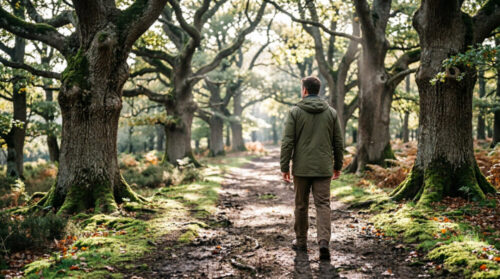
He walked further, following the path as it skirted the edge of the heath and dipped into a stretch of woodland. The trees were ancient here — oaks and beeches whose branches wove a canopy that dappled the light into shifting patterns on the ground. The air was cooler beneath the leaves, carrying the scent of earth and moss. A few other walkers passed him — a couple with a spaniel, a man with binoculars slung around his neck — and they exchanged the small nods and murmured greetings that were the currency of the Forest.
At one point he came across a family of donkeys blocking the path with the serene indifference of creatures who came to learn that they owned this place. A grey jenny stood squarely in the centre of the track, her foal beside her. She regarded Walker with an expression that suggested she had seen a great many humans in her time and had not been impressed by any of them. Walker waited. The donkey waited. Eventually, with the air of one granting a favour, she shifted just enough for him to pass.
“Thank you,” Walker said.
The donkey did not acknowledge him.

He returned to the hotel a little before half past five. The walk had been gentle — perhaps two miles — but the day had been long. He felt the pleasant tiredness that came from using one’s body a bit more than its limits. His knees were holding up.
He showered in the small but serviceable bathroom, letting the hot water work on the stiffness in his shoulders and the small of his back. Then he dressed in fresh clothes — a clean shirt, a light jacket — and made his way downstairs to the restaurant.
The dining room had the feel of a place that had not changed its character in a generation. Dark wooden beams crossed the ceiling. The tables were set with proper cloth napkins and heavy cutlery that felt solid in the hand. A fire was not lit — it was July, and the evening was still warm. The fireplace dominated one wall with the authority of something that had been the heart of the room for a century. The hum of conversation was a low and easy kind of background murmur.
Walker chose a table by the window, where he could watch the last of the evening light settle across the heath. The same elderly couple from the afternoon were dining in the corner, their newspapers folded neatly beside their plates. A few other guests had arrived — a family with two young children who were doing their best to behave and their worst to stay quiet. Obliquely to his left was a man dining alone with a book propped open against the salt cellar.
The waitress was a woman in her forties with an easy manner and the faint trace of a Hampshire accent. She took his order: steak, medium rare, with fries, a side of vegetables, and a pint of Coors Extra Cold.
“Good choice,” she said. “Kitchen’s not overworked tonight. Shouldn’t be long.”
Walker thanked her and sat back in his chair. The pint arrived first, cold and crisp, the glass was icy and not yet beaded with condensation. He drank slowly, and watched the sky beyond the window deepen from blue to a softer, amber-tinted gold.
The steak, when it came, was exactly what he had wanted — uncomplicated, well-cooked, served with care. The fries were thick-cut and properly salted. The vegetables — carrots, green beans, a single roasted tomato — were fresh and simple. He ate with the steady focus – quite a contrast to being chained to a creaky chair at a computer, stuffing his face rapidly between patients at a clinic.
He did not think about the year behind him. He did not think about the days ahead. He sat in the warm, wood-panelled quiet of that old English restaurant, with a good meal in front of him and a cold pint at his elbow. He settled into this with contentment.
Tomorrow, he might walk further. He might find the clearing where he had sat a year ago, on a fallen log, with a being who was not a being but had made him feel less alone in his own skin. He might not. He had not come here to find Mira. He had come here because the Forest was a place of peace, and peace, after the year he had had, was enough.
For now, the steak was good. The beer was cold. The light was fading gently across the heath. And Walker, for the first time in longer than he could remember, was in no hurry at all.
… to be continued in Part 2


The £15 Anthropic Fuel Plan: complete with digital range anxiety
Captain Walker