






Estimated reading time at 200 wpm: 13 minutes
Did you know that under British law, the security locks on everyday messaging apps and cloud accounts can be altered behind closed doors, and the companies you trust are legally barred from ever telling you? You only ever learn that a demand was made if a technology firm decides to pick a public fight, or if a compromised handset eventually lands on a forensic bench. The machinery for silent, state-backed intrusion is not a rumour from a thriller. It sits in plain sight in British statutes, annual parliamentary reports, and court rulings, counting on the fact that almost nobody stops to look under the bonnet.
Whether or not you agree our Fat Disclaimer applies
In January 2026, a London High Court judge ordered Saudi Arabia to pay just over £3 million in damages to Ghanem Al-Masarir, a satirist living in Britain whose two iPhones had been silently infected with Pegasus spyware (The Guardian, 26 January 2026). He had not downloaded dubious software from the fringes of the internet. The ordinary phones sitting in his pocket were simply turned into remote microphones and cameras, quietly emptying his messages, location history, and private calls while he went about his daily life in London.
Look down at the device in your own hand for a moment. You probably assume that a strong passcode, a paid antivirus subscription, and the little padlock symbol at the top of a WhatsApp chat mean the room is locked.
If your immediate reaction is a shrug—you are not a foreign dissident, a spy, or a drug trafficker, so nobody has any reason to snoop on you—you are in good company. Most people treat digital surveillance as someone else’s problem. You do not lock the bathroom door or draw the bedroom curtains because you are running a criminal enterprise; you do it because private life requires a boundary. Your phone holds your family photographs, your half-formed thoughts, your banking logins, and the health worries you search for at two in the morning.
Even if you genuinely do not care who reads your own messages, your handset is packed with other people’s secrets: a partner’s medical scare, a friend’s marriage trouble, a colleague’s candid frustration. Letting your device operate as an open window exposes everyone who trusted you enough to press send.
Legal Secrecy and Statutory Gag Orders
Super-injunctions and the counting problem
In England and Wales, legal secrecy has traditionally been associated with the High Court super-injunction—an order that bars a publisher from printing confidential facts and makes it a contempt of court to reveal that the order exists. If nobody is allowed to mention an injunction, how can the public tell whether there are five of them or five hundred? Following Lord Neuberger’s 2011 committee report, the courts shut down open-ended secrecy. Judges must set regular return dates so emergency gag orders automatically expire unless defended at a full hearing, and the Ministry of Justice logs anonymised annual tallies showing that genuine civil super-injunctions have dropped to near zero.
Technical Capability Notices
Statutory secrecy under the Investigatory Powers Act 2016 operates without that civil-court transparency. Under section 253 of the Act, the Home Secretary can issue a Technical Capability Notice compelling a communications provider to build or maintain the technical means to bypass encryption, subject to approval by a Judicial Commissioner. Unlike a High Court injunction, the secrecy clause is built straight into the statute. Once a notice is served, it becomes a criminal offence for the company to disclose its existence to customers.
In November 2026, the Investigatory Powers Tribunal finally forced the Home Office to abandon its “neither confirm nor deny” stance and admit that it had served a Technical Capability Notice on Apple (Judiciary UK, November 2026). Even after that ruling, the specific technical demands inside the notice remain classified.
Asymmetric visibility and the Apple–Meta overlap
That tribunal battle highlights a structural blind spot in what reaches the news. The public only ever hears about secret surveillance demands when a company refuses to comply or visibly alters its service—as Apple did when it withdrew end-to-end encrypted iCloud Advanced Data Protection for new UK users rather than build a backdoor (Apple Support UK, September 2025). If a provider receives a notice and quietly complies, the statutory gag holds indefinitely, leaving outsiders with no way to distinguish between a company that was never asked and one that folded in silence.
Many users also blur the corporate lines between the tools on their handsets. Apple owns iOS and iMessage, whereas Meta owns WhatsApp. A notice served on Apple does not automatically compel Meta to weaken WhatsApp’s encryption. In practice, however, an operating-system or cloud-backup compromise on an iPhone still exposes WhatsApp chats: if iCloud backups are unencrypted or the underlying phone software is accessed, messages can be read before encryption or after decryption on the screen without Meta ever cooperating.
Routing Around the Server
Zero-identifier messaging with SimpleX
Once users realise that mainstream platforms sit under statutory compulsion, the obvious instinct is to switch apps. Moving from WhatsApp to an open-source messenger such as SimpleX Chat removes the central choke points that conventional services rely on. Unlike WhatsApp or Signal, SimpleX uses no user identifiers of any kind—no phone numbers, no usernames, and not even persistent random account numbers. Instead, it routes encrypted messages through temporary, unidirectional queues across relay servers, an architecture verified in an independent security audit (Trail of Bits, October 2022). Even if the Home Office served a secret Technical Capability Notice on SimpleX’s UK-registered company, the servers hold no social graph or directory of who is speaking to whom.
Removing the central database, however, only shifts the point of vulnerability. SimpleX protects the server layer, leaving the physical device at either end—and the network connection carrying the traffic—as the remaining weak spots. If your contact backs up their screen unencrypted, leaves their phone unlocked, or runs a compromised operating system, zero-metadata routing offers no shelter.
The Tor trade-off
To hide their network location from relay servers and internet providers, privacy-conscious users often route SimpleX traffic through Tor using a free local proxy such as Orbot. Setup takes roughly two minutes and costs nothing, bouncing encrypted packets through three volunteer relays before they reach a messaging server.
That extra layer of anonymity carries noticeable everyday friction. Because Tor only handles TCP traffic, real-time voice and video calls—which rely on UDP—will either fail or bypass the tunnel and expose your real IP address unless calls are switched off. Keeping a persistent Tor circuit open on a mobile phone also drains the battery faster and adds a couple of seconds of delay when sending messages or files.
Because Tor strips away network identity so effectively, it is routinely used by criminals alongside journalists, researchers, and ordinary citizens. Academic studies of Tor network traffic consistently show that over 90 per cent of daily connections go to the regular public web for routine privacy and censorship circumvention, whereas illegal marketplaces cluster within the small fraction of hidden .onion services (Proceedings of the National Academy of Sciences, November 2020). Even there, criminals rarely fall because the underlying mathematics breaks; they are caught when they reuse an old username, cash out funds through a regulated exchange, or have their physical handset compromised.
State Surveillance Capabilities and Evidence
Bypassing encryption without breaking it
Modern encryption mathematics is remarkably stubborn. Neither GCHQ nor the NSA spends its budget trying to brute-force a properly implemented 256-bit key, because the underlying arithmetic holds up even against state-funded supercomputers. Intelligence agencies simply go around the lock instead.
One method is traffic analysis. Even when the contents of a message are unreadable, an agency with access to telecommunications infrastructure can log the timing, size, and frequency of encrypted packets entering and leaving a network. If two handsets consistently exchange matching bursts of data seconds apart over several weeks, an analyst can map the relationship without decrypting a single word.
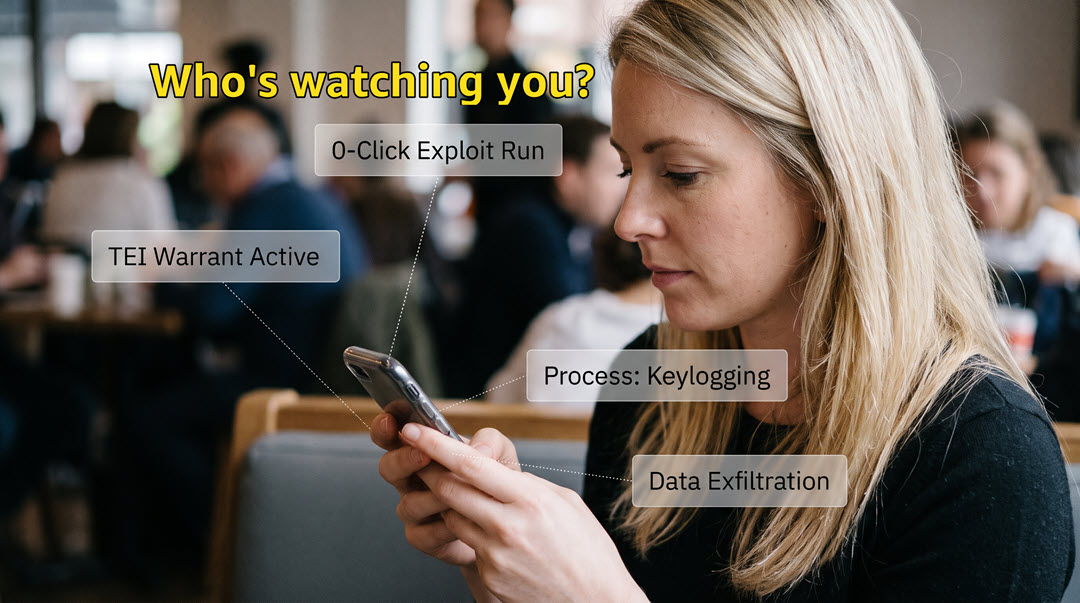
Other breakthroughs are far less technical. Investigations routinely succeed through undercover officers joining private group chats, seizing unlocked devices at border crossings, or catching a target reusing an old email address. When those avenues are closed, agencies turn to the endpoint itself. If an investigator can place software directly onto a target’s phone or laptop, encryption ceases to matter. The implant captures keystrokes, screenshots, and microphone audio before a message is scrambled and after it is decoded on the screen.
Targeted Equipment Interference and the limits of antivirus
In the United Kingdom, remote state hacking is governed by Part 5 of the Investigatory Powers Act 2016 under the statutory title of Targeted Equipment Interference. It grants intelligence agencies and law enforcement legal authority to covertly access computers, smartphones, and servers to extract data or monitor activity in real time.
Many ordinary users assume that a paid security suite such as Bitdefender or Norton will block this kind of intrusion. Consumer antivirus software is genuinely effective against mass-market ransomware, banking trojans, and common phishing kits. It works by scanning files against databases of known malware signatures and flagging suspicious behaviour derived from millions of previous infections.
State-grade surveillance tools are built specifically to evade that model. They rely on zero-day vulnerabilities, which are software flaws unknown to Apple, Google, or Microsoft and therefore absent from every commercial virus definition list. Modern deployments often use zero-click exploits, meaning an infection triggers automatically when a malformed message or network packet arrives, with no need for the owner to tap a link or open an attachment. Once inside, sophisticated implants frequently run entirely in temporary system memory rather than writing files to storage, or operate deep at the kernel level where they can disguise their own processes. On iPhones in particular, Apple’s strict application sandboxing prevents third-party antivirus apps from inspecting the core operating system anyway, leaving commercial security suites blind to what is running underneath them.
The paper trail
Descriptions of zero-click exploits and memory-resident implants can easily sound like the plot of an espionage thriller, except that the public record is unusually concrete. In October 2026, the Investigatory Powers Commissioner’s Office published its annual oversight report for 2025, recording 3,471 authorisations for Targeted Equipment Interference across British intelligence and law enforcement agencies (IPCO Annual Report, October 2026). Remote interference is a routine, audited instrument of UK policing and security work.
Independent forensic laboratories have documented the technical footprints left behind on commercial handsets. Amnesty International’s Security Lab published a detailed forensic methodology demonstrating how NSO Group’s Pegasus spyware leaves faint process names and network lookups buried inside iOS diagnostic logs (Amnesty International, July 2021). The Citizen Lab at the University of Toronto continues to verify active zero-click infections on standard, fully updated iPhones, including fresh cases documented in late 2026 (Citizen Lab, October 2026).
Civil courts have also forced the mechanics into the open. In May 2025, a US federal jury found NSO Group liable for unlawfully exploiting a WhatsApp vulnerability to deploy Pegasus onto roughly 1,400 devices (The Guardian, May 2025), leading later that year to a permanent federal injunction barring the company from targeting the platform. Hardware makers themselves now acknowledge the reality directly: Apple routinely issues high-confidence Threat Notifications to users across dozens of countries whenever its internal telemetry detects mercenary spyware targeting their accounts.
Plain Sight and Threat Economics
Why almost nobody notices
The irony of modern state surveillance in Britain is that almost none of the legal architecture is actually hidden. The statutes, the annual parliamentary oversight reports, the High Court rulings, and the forensic breakdowns from groups like Citizen Lab are all sitting on public websites.
They stay invisible to most people for very ordinary reasons. British law refers to remote phone hacking as Targeted Equipment Interference under Part 5 of the Investigatory Powers Act 2016. Unless you already know what you are looking for, a parliamentary report filled with acronyms such as TCN, TEI, and IPCO reads like dry telecommunications regulation rather than the legal blueprint for covert intrusion.
There is also the simple absence of friction. State implants are engineered to leave no obvious trace on a handset, and warrants are rationed to a few thousand authorisations a year. For the vast majority of the public, WhatsApp opens quickly, the battery lasts the day, and nothing ever happens to prompt a look under the bonnet. Combined with the habit of assuming that encryption and warrants only concern spies or organised crime, the entire apparatus might as well not exist.
Dragnet collection versus targeted pursuit
If a well-resourced state intelligence agency with a warrant decides to target a specific individual, absolute confidence in remaining undetected is misplaced. Modern software is too complex, and human routines are too predictable, to hold out indefinitely against an organisation willing to burn zero-day exploits, tap physical cables, or run human surveillance.
What holds up in practice is shifting the cost-benefit equation. The practical dividing line sits between targeted pursuit and passive dragnet collection. Mainstream platforms make routine monitoring cheap and automated, allowing a single subpoena or bulk sweep to pull in years of metadata, contact graphs, and cloud backups with minimal effort.
Using zero-metadata messengers, switching off unencrypted cloud backups, and stripping away everyday digital exhaust changes those economics. Intelligence agencies do not have infinite analysts or unlimited exploits; they constantly triage where to spend their attention. Stepping out of the passive net stops you from handing over your personal history for free to commercial data brokers, opportunistic hackers, and automated trawls. For anyone who is not an active intelligence target, forcing an adversary to clear legal hurdles and commit scarce specialist hours—rather than pulling up your life with a database query—is usually more than enough.
Conclusion
Looking closely at how statutory secrecy and covert infiltration actually operate changes how everyday devices feel. The legal framework is broader than public debate usually acknowledges, and the technical capabilities sitting behind it are far more routine than most people assume. Connected hardware is carried on an unspoken expectation of privacy, largely because the machinery capable of bypassing it runs without visible friction.
Recognising those limits does not make personal privacy pointless. Absolute secrecy against a determined State apparatus is a myth. Ordinary precautions still carry weight because they separate daily life from effortless, automated collection. Guarding personal space remains a sensible habit, provided it is done with clear eyes about various limitations.
References
Introduction
- The Guardian (26 January 2026). Saudi Arabia ordered to pay London dissident £3m over Pegasus spying. The Guardian
Legal Secrecy and Statutory Gag Orders
- Investigatory Powers Tribunal (November 2026). Open Judgment: Apple Inc. and Privacy International & Others. Judiciary UK
- Apple Support UK (September 2025). Advanced Data Protection for iCloud availability in the United Kingdom. Apple Support UK
Routing Around the Server
- Trail of Bits (3 November 2022). SimpleX Chat cryptographic audit (audit conducted October 2022). Trail of Bits
- Jardine, E., Lindner, A. M., & Owenson, G. (November 2020). The potential harms of the Tor anonymity network cluster disproportionately in free countries. Proceedings of the National Academy of Sciences
State Surveillance Capabilities and Evidence
- Investigatory Powers Commissioner’s Office (October 2026). Annual Report of the Investigatory Powers Commissioner 2025. IPCO Annual Report
- Amnesty International Security Lab (July 2021). Forensic Methodology Report: How to catch NSO Group’s Pegasus. Amnesty International
- The Citizen Lab, University of Toronto (October 2026). Pegasus Spyware Targeting Serbian Pro-Democracy Voices. Citizen Lab
- The Guardian (6 May 2025). NSO Group ordered to pay Meta over WhatsApp Pegasus spyware attack. The Guardian