







Estimated reading time at 200 wpm: 26 minutes
Let’s say you’re an adult woman in your thirties. You’ve invited a man round for a meal. He’s physically very attractive. You serve a nice apple pie after dinner. You’re getting on well. There’s been plenty of flirting over a couple of glasses of wine.
Whether or not you agree our Fat Disclaimer applies
You give him a wink, grab him by the shirt and pull him over to the settee. A few more sips of wine and you’re both snogging. Then a hand reaches well up between your legs. You realise, Oops. Things are getting really steamy here.
And suddenly you realise that this has gone further than you wanted. You thnk, Hang on. This is getting properly sexual now. I don’t want this to go any further. Not on a first date.
You say: “Stop.”
He stops.
But he looks completely shocked. “What do you mean?”
This article assumes sexual activity between biological man and woman, only to keep it simple.
Well, you mean stop. That’s easy enough. But wind the clock back a few minutes. When exactly did you say yes to being touched sexually? Yes to what, exactly? Was it when you invited him round? Surely not.
Was it the apple pie? Presumably not, although my eventual paperwork may need a box ruling that out. Was it the wink? Was it grabbing him by the shirt and pulling him onto the settee? Was it the wine? Was it the snog? Was it all of that taken together? At some point a perfectly ordinary evening moved from flirting, to physical intimacy, to sexual contact. Nobody called a legal meeting to decide when one ended and the next began.
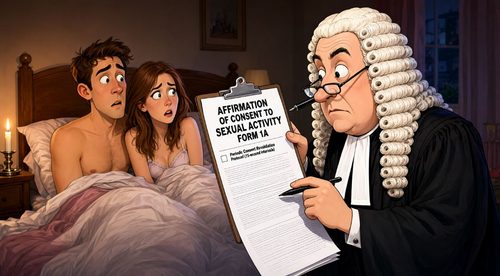
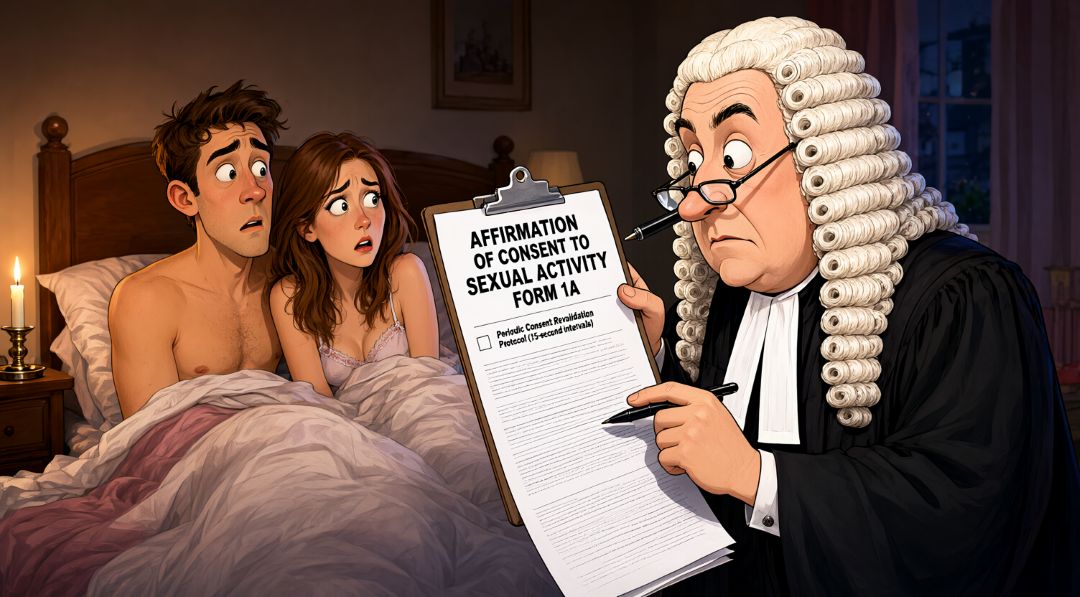
Let’s get real about this. If further sexual ‘activity’ was to proceed to something more substantial, nobody raises a hand at that moment and says: “Before proceeding any further, could we complete a five-page legal Affirmation of Consent to Sexual Activity?” Caution: The ridiculous form presented below is not to make fun of a serious matter. For non-speed-readers, they will see how it draws out various complex issues in the Law Commission’s review.
What do we actually mean by consent?
This article is not to be construed as legal advice.
The starting point looks straightforward. Under section 74 of the Sexual Offences Act 2003, a person consents if they “agree by choice” and have the freedom and capacity to make that choice. There is quite a lot packed into that short sentence.
First there has to be a choice. Then there has to be sufficient capacity to make it. And the person has to be free to make it, rather than being forced, coerced or otherwise deprived of a genuine choice. So far, so good. But sexual offences law doesn’t stop with the person who is consenting.
For rape, sexual assault and the other principal non-consensual sexual offences, another question concerns the person accused: did that person reasonably believe that the other person consented?
That word reasonably matters. It isn’t enough simply to say, “Well, I thought she wanted it.” The Sexual Offences Act requires the reasonableness of that belief to be judged in all the circumstances, including any steps taken to find out whether the other person consented.
We therefore have two different viewpoints in play. One is about the person whose body and choice are involved:
Did that person actually consent?
The other is about the person who acted:
Did that person reasonably believe there was consent?
Usually those two questions may travel quite happily together.
Then life interferes.
Alcohol
People drink alcohol and have sex. The law does not say that having a few drinks automatically removes the ability to consent.
But suppose a few drinks become rather a lot.
A person may be plainly drunk and still capable of making choices. Carry on down that road, however, and eventually intoxication may become so severe that the capacity to make a choice disappears.
The Court of Appeal confronted that problem in R v Bree. The difficulty is obvious enough without knowing anything about the case.
There is no convenient moment when a moderately drunk person suddenly crosses a brightly painted line marked:
CAPACITY ENDS HERE.
Alcohol affects people differently. Someone may make a choice while intoxicated that they bitterly regret when sober. Regret does not retrospectively remove consent.
The much harder question is whether there was sufficient capacity to make the choice in the first place.
Even if the intoxicated person’s actual capacity later becomes disputed, what did the other person see? What did they hear? What reason did they have for believing that this person was capable of choosing and was actually choosing?
Already our simple definition of consent has acquired some rough edges.
Drugs
Drugs – in this part meaning illicit mind-altering substances – produce some of the same questions, but not always the same circumstances.
Someone may voluntarily take a recreational drug and later engage in sexual activity. The important question is not simply whether a substance has been taken, but what effect it has had upon the person’s freedom and capacity to choose.
But change one fact and the situation becomes very different.
Suppose somebody puts a substance into another person’s drink without their knowledge.
The Sexual Offences Act specifically anticipates this sort of situation. Section 75 deals, among other circumstances, with a substance being administered without consent where it is capable of causing or enabling the person to be stupefied or overpowered.
Now we are no longer simply asking whether somebody who consumed an intoxicating substance retained the capacity to consent.
Someone else has deliberately interfered with the circumstances in which that choice is being made.
The distinction matters.
A person having several drinks, taking a drug voluntarily, being affected unexpectedly by prescribed medication and being secretly drugged may all eventually present questions about capacity.
Once we move away from alcohol and drugs, the question isn’t always whether someone had the capacity to say yes.
Sometimes the difficulty is working out what, or even whom, they were saying yes to.
When yes becomes complicated
Capacity is only one source of difficulty. A person may be perfectly sober, wide awake, acting freely and quite capable of making a choice. They may even say an unmistakable yes.
The trouble is that the yes may not be quite as straightforward as it sounds.
You consented, but to whom?
Suppose A agrees to have sex with B.
Except Party B isn’t actually B. Are you scratching your head? Yes it has happened and will happen again.
So Party B is actually C, who has deliberately pretended to be Party B in order to obtain A’s agreement. Don’t ask – thing get really complicated, so much so that Statute caters for it.
There is something rather peculiar about this. A may have knowingly and willingly agreed to the physical act. A wasn’t unconscious, intoxicated or incapable of choosing. But the choice A actually made was to have sex with B, and Party B wasn’t B.
The law has an unusually firm answer to this one.
Section 76 of the Sexual Offences Act 2003 covers intentional deception about the nature or purpose of the sexual act and also the situation where someone induces consent by impersonating a person known personally to the complainant. In those particular circumstances, the Act conclusively presumes that the complainant did not consent and that the defendant did not believe there was consent.
That disposes of our straightforward impersonator.
Deception about circumstances
But it also opens a much larger door. What if nobody was impersonated?
Suppose somebody consents because their partner has lied about something enormously important to them.
They discover the truth afterwards and say:
“If I had known that, I would never have had sex with you.”
That can be completely true without necessarily meaning that there was no consent in law.
And now we have to ask which deceptions affect the choice sufficiently to matter legally, and which leave us with a genuine choice made on the basis of a lie.
“I wouldn’t have said yes if I’d known” and “I didn’t consent” are not necessarily the same thing.
The courts have had to grapple with that distinction, including in cases such as R v Jheeta.
The facts of R v Jheeta were unusual. Jheeta and the complainant were in a sexual relationship, but when she tried to end it he used bogus communications, pretending that they came from police officers. Among other things, the messages told her that she had to continue the relationship and have sex with him, with threats of penalties if she did not comply. She consequently had intercourse with him when she did not want to. The deception was elaborate, but the Court of Appeal held that it was not deception about the “nature or purpose” of the sexual act within the narrow wording of section 76. That did not rescue Jheeta. The ordinary definition of consent under section 74 still applied. The complainant had not agreed to intercourse by free choice, and Jheeta knew that she was submitting because of the fictitious messages. His rape convictions therefore stood. The case demonstrates why deception and consent cannot be reduced to a simple rule that a lie either does, or does not, invalidate consent.
Yes, but only if…
‘Yes’ may come with conditions.
Suppose Party A says: “Yes, but only if you use a condom.”
That’s hardly an obscure requirement. Sex then begins with a condom. What happens if Party B deliberately removes it? What if it breaks? What if neither person notices that it has broken? What if B notices and Party A doesn’t?
The wider point is that consent can have conditions attached to it. Party A person need not choose simply between consenting to every possible form of sexual activity and consenting to nothing.
The courts have already encountered this territory.
But the underlying question isn’t ridiculous at all. It is becoming clear that asking simply “Did Party A consent?” can conceal rather a lot. Party A may have consented to one person but not another.
Party A may have agreed because of a deception. Party Party A may have agreed to one sexual act but not another. Or Party A may have said yes subject to a condition. The word yes therefore doesn’t finish the enquiry.
Sometimes it merely tells us where to start.
Conditions on premature ejaculation
Another English case, R (F) v Director of Public Prosecutions, raised a related problem where a woman alleged that intercourse was agreed on the basis that her partner would not ejaculate inside her. The High Court made an important distinction. It expressly said it was not dealing with an accidental or premature ejaculation where a man intended to withdraw as agreed but failed to do so. “These things happen,” the Court observed.
The allegation before it raised something different: what if a person deliberately does the very thing which the other person had said they did not agree to? That brings us back to choice. Party A may be saying yes to sex, but not necessarily that sex, on those terms. Condoms introduce an especially awkward practical variation.
Assange: Condoms shall not break without notice
The Julian Assange allegations brought the problem of conditional consent sharply into view. In Sweden in 2010, two women made complaints following separate sexual encounters with him. Of particular relevance here, one allegation was that a woman had made condom use a prerequisite of intercourse, but that unprotected intercourse nevertheless took place without her knowledge. A separate allegation concerned intercourse with another woman while she was asleep, in circumstances where condom use was again relevant. These were allegations, not factual findings following a criminal trial. They reached the English courts because Sweden sought Assange‘s extradition, requiring the courts to consider whether the alleged conduct corresponded to offences under English law. The case nevertheless highlighted an important question about consent: agreeing to sexual intercourse is not necessarily an unrestricted agreement to intercourse however it happens. A person may agree to sex on a particular condition, and condom use may be that condition.
Suppose the condition is clear: intercourse only with a condom. Both parties agree. A condom is used. During intercourse it breaks without either person noticing. Has anybody ignored the other’s choice? Obviously not deliberately.
But if continuing consent depends upon a condition which has unknowingly ceased to exist, we have stumbled into another problem altogether. Must somebody notice? Whose responsibility is it to notice?
And, if the law were ever to demand some positive continuing assurance that the condition remained satisfied, how often would anyone be expected to check? We are beginning to creep dangerously close to the more ridiculous parts of Form 1A (above)
When consent changes
There is another complication. Consent is not fixed at the moment sexual activity begins.
Someone may freely choose to have sex and then change their mind. Consent can be withdrawn during sexual activity. The CPS puts the point plainly: consent may be withdrawn at any time, and consent to one form of sexual activity does not necessarily amount to consent to another.
That sounds straightforward, until two people disagree about what happened.
When “stop” apparently means something else
Suppose two people have willingly progressed from kissing to sexual activity.
One says:
“Stop.”
The other continues.
Later the explanation is:
“Yes, she said stop, but she was giggling. She didn’t push me away. I thought she wanted me to carry on.”
Now two things have to be kept separate. The first is whether she actually continued to consent. The second is whether he reasonably believed that she continued to consent.
For rape, section 1 of the Sexual Offences Act 2003 expressly requires consideration of whether the accused reasonably believed that the other person consented. In deciding whether that belief was reasonable, the law looks at all the circumstances, including any steps taken to ascertain consent.
That makes the hypothetical explanation rather more interesting than simply asking whether he genuinely believed it. He says he heard “stop”. What did he do to find out whether “stop” actually meant stop?
The fact that someone did not physically push another person away does not itself answer that question—nor does the fact that sexual activity had previously been consensual.
This is one point where the absurd Form 1A accidentally stumbled upon something serious. Its instruction that STOP means STOP NOW was funny because nobody normally negotiates sexual intimacy with contractual definitions.
But the problem it was trying to abolish is real: the possibility of someone retrospectively explaining straightforward words by reference to supposedly contradictory behaviour.
Changing your mind halfway through
Withdrawal need not involve a dispute about the meaning of a word. Someone who enthusiastically agreed ten minutes earlier may simply decide that they have had enough.
That does not mean the original consent was somehow defective. It means that it no longer exists.
The difficult cases arise around what follows.
Was withdrawal communicated? If so, how? Did the other person notice? If the communication was unclear, what did the other person reasonably understand? And if there was obvious uncertainty, what steps were taken to find out?
Again, the questions about actual consent and reasonable belief begin to separate.
The law already recognises that consent may be withdrawn after intercourse has begun. In R (F) v Director of Public Prosecutions, the High Court discussed that principle while considering allegations concerning intercourse subject to an agreement about withdrawal before ejaculation.
So the law is not dealing with a single moment at which consent is permanently switched from OFF to ON. It can change.
What if capacity changes as well?
Now add alcohol or drugs back into the picture.
At the beginning of the evening somebody plainly has capacity and plainly consents.
Later that person becomes much more intoxicated.
The difficulty is no longer simply the one considered earlier: was this person too intoxicated to consent?
There is now a timeline. They may have possessed capacity and consented at one point, while their condition later became very different.
That produces the question that our five-page form turned into bureaucratic farce: how does the other person know whether consent is still there?
Is the law going to expect people to conduct a formal capacity assessment every few seconds or minutes. But neither does genuine consent at the beginning provide unlimited authority for everything that happens afterwards.
That is why the present law’s reference to the steps taken to ascertain consent matters. The question of reasonable belief is tied not merely to what someone privately thought, but to the circumstances and what they did to establish whether consent existed.
At this point you may be wondering, ‘If consent can move around like this, what should another person actually be expected to do to make sure it is there?’
Would affirmative consent solve this?
After all those complications, affirmative consent can begin to sound rather attractive.
Instead of asking afterwards whether somebody resisted, pushed another person away or said no loudly enough, why not start somewhere else?
Securing the ‘yes’ is not the end of the story.
The affirmative expression needs care. “Affirmative consent” does not necessarily mean that somebody must actually utter the word yes, nor does it mean signing a form.
The Australian state of New South Wales (NSW) provides a useful example. Its consent laws changed in 2022. Consent remains a free and voluntary agreement, but a person must say or do something to communicate that consent. Consent can therefore be communicated through words or gestures. Silence alone does not do the job. Nor does simply failing to resist.
That sounds considerably less revolutionary than some of the headlines suggest. Two people do not need to pause proceedings – sounds like court doesn’t it – and exchange formal declarations. They can still communicate through ordinary human interaction.
From “no means no” towards “yes means yes”
Return to the woman from our opening example.
She invites the man home, flirts, grabs his shirt, pulls him towards her and enthusiastically snogs him.
There is plenty of affirmative communication there.
But affirmative consent immediately forces us to ask an awkward question we encountered earlier:
Consent to what?
This is where things become less tidy.
Consent to one sexual act does not automatically mean consent to another in most Western jurisdictions. In the Australian state of New South Wales, the official guidance makes that explicit.
Take a perfectly ordinary progression. Two people are engaged in consensual oral sex. Things develop and one of them moves towards penetrative sex.
Does the other person have to consent afresh? In principle, yes: consent to oral sex cannot simply be treated as consent to penetration.
But what does that mean in practice?
It does not necessarily require somebody to stop and ask, “Do you now consent to penetrative intercourse?” New South Wales allows consent to be communicated through words or gestures.
That preserves the spontaneity of ordinary sexual interaction, but it also brings back something we might have thought affirmative consent was going to remove: interpretation.
Suppose penetration occurs and there is later an allegation of rape.
The complainant says:
“I consented to oral sex. I never consented to penetration.”
The accused says:
“Before penetration, she pulled me towards her. I understood that as her clearly communicating that she wanted intercourse.”
There may be no dispute that the earlier sexual activity was consensual. There may be no dispute that penetration occurred.
The dispute is now about the alleged gesture. Did it happen? If it did happen, what did it mean? Was it affirmative communication of consent to penetration, or has an ambiguous movement acquired that meaning only afterwards?
Those are potentially difficult questions in a criminal trial.
If affirmative consent can be established through conduct, we have not eliminated the need to interpret conduct. We have changed what that conduct must establish.
Instead of:
“Her behaviour made me think she consented.”
we may hear:
“Her behaviour affirmatively communicated consent.”
Those are not the same legal propositions. But when the evidence consists only of two conflicting accounts of an unrecorded sexual encounter, the factual dispute may look remarkably similar.
Of course, we could demand something much clearer. An explicit verbal yes to each new sexual act would provide a clearer rule. Something written or recorded would provide better evidence still.
But follow that road very far and an unwelcome document begins rustling in the background.
Form 1A: Scope of Affirmative Consent. Tick as required.
The joke points towards a serious difficulty. The more flexibility we allow in how affirmative consent is communicated, the more room remains for disagreement about what was communicated. The more we try to eliminate that disagreement by requiring explicit and provable affirmation, the more formal sexual intimacy would have to become.
Affirmative consent therefore tackles one problem very directly: consent to X is not automatically consent to Y.
What it cannot so easily answer is how, months or years later in a courtroom, we reliably establish that the transition from X to Y was affirmatively agreed at the time.
Consent to kissing does not automatically answer whether there was consent to sexual touching. And consent to one sexual act does not establish consent to another.
So affirmative consent does not give us one big YES at the beginning of an encounter. It remains attached to what is actually happening.
The other side of affirmative consent
The more interesting change may concern the person relying upon that consent.
New South Wales goes beyond requiring consent to be communicated. Its law also provides that a person’s belief in consent will not be reasonable if that person did not, within a reasonable time before or at the time of the sexual activity, say or do something to find out whether the other person was consenting.
That shifts the question.
Our hypothetical man can no longer rely simply upon:
“I thought she wanted it.”
We can ask:
“What did you say or do to find out?”
English law already moves some way in this direction. Under the Sexual Offences Act 2003, whether a belief in consent was reasonable is judged in all the circumstances, including any steps taken to ascertain consent.
But New South Wales makes taking some such step a much more explicit requirement.
That takes us back to our troublesome “Stop”.
Suppose someone says:
“Yes, she said stop, but she was giggling and didn’t push me away, so I thought she wanted me to continue.”
Under an affirmative model, the obvious question becomes much harder to avoid:
What did you do to find out?
The lack of physical resistance cannot simply be turned into affirmative communication.
Perhaps that is the real significance of affirmative consent. It may be less about making one person formally prove consent and more about limiting how far another person can rely upon assumption.
Canada goes further down the same road
Canada approaches the issue somewhat differently, but with a similar emphasis on communicated agreement.
Canadian law defines consent as the voluntary agreement of the complainant to engage in the sexual activity in question. The Canadian courts have rejected the idea of implied consent, and the law restricts a defence based upon a mistaken belief in consent where reasonable steps were not taken to ascertain it.
Canada also exposes something else that our earlier examples have repeatedly shown.
Consent cannot simply be carried forward indefinitely.
It relates to the sexual activity in question and can be withdrawn. Canadian law has also confronted advance consent to sexual activity taking place during unconsciousness, another example of the difficulty of treating an earlier yes as permanent authority for what happens later.
So the contrast between our present law and affirmative consent is not quite:
England and Wales: no means no.
Canada and Australia: yes means yes.
Reality is messier.
And then comes the old problem: proof
Suppose two people are alone.
One later says:
“I asked whether she wanted to have sex and she said yes.”
The other says:
“He never asked me and I never said yes.”
Affirmative-consent legislation cannot make that factual dispute disappear.
Or suppose the alleged communication was conduct.
One person says a particular action clearly communicated consent.
The other says it did nothing of the sort.
Once again a court may have to decide what happened and what the communication meant.
That does not necessarily make affirmative consent pointless.
A rule can change what people are expected to ascertain without providing a perfect way of proving afterwards what they actually did.
But it does expose an important distinction.
Affirmative consent can change the legal standard. It cannot manufacture evidence that does not exist.
Perhaps, then, the attraction of affirmative consent is not that it eliminates uncertainty.
It may instead alter where the risk of uncertainty falls.
Rather than asking primarily why one person didn’t object more clearly, it asks what gave the other person a proper basis for proceeding.
That brings the idea rather closer to the autonomy with which we started.
But it also brings us towards another question.
If we keep demanding greater certainty about consent, how far are we prepared to go in making that certainty demonstrable?
At which point, unfortunately, Form 1A is waiting for us.
Pouring cold water on certainty
By this point affirmative consent has some obvious attractions.
It puts the emphasis on agreement rather than resistance. It makes it harder to turn silence into consent. It asks the person proceeding with sexual activity to have some basis for believing the other person actually wants it.
There is much to like in that.
But there is a danger in making the idea sound more certain than it is.
The moment affirmative consent can be communicated through conduct as well as words, somebody may later have to decide what that conduct meant. And if two people give entirely different accounts of what happened in private, changing the legal test cannot magically produce evidence that never existed.
The Law could, of course, demand greater certainty or require an explicit verbal affirmation.
But then how do will be be proved that it was given? She the law require something recorded – like a voice note, or signed document?
Seriously? We would have better evidence, but a much stranger form of intimacy.
And once we start trying to make consent not merely clear but provable, some familiar problems return.
Form 1A makes an unwelcome return
This is where my ridiculous five-page Affirmation of Consent to Sexual Activity stops being entirely ridiculous. It’s not because anybody should use it. They most certainly should not.
Its absurdity comes from taking a reasonable desire for certainty and pursuing it much too far. But what yardstick will be used to measure ‘too far?’
If an affirmation is supposed to prove consent, it needs to identify what has been agreed.
Hence Form 1A’s magnificently preposterous Periodic Consent Revalidation Protocol, offering intervals down to fifteen seconds.
Nobody seriously proposes this form. For some victims I can imagine that a version of the form may be supported. But victims do not have to consider the sexual activities among a nation of 66 million people.
Some reflections
What began as a fairly simple question about affirmative consent turns out not to have a simple answer.
At the centre of it is autonomy. Sexual consent belongs to the person making the choice. Nobody else should be able to manufacture that consent, assume it from silence, or substitute their own wishes for it.
But autonomy creates its own difficulty. A choice known only to the person making it cannot tell another person what they may or may not do. Somehow that choice has to be communicated.
That is where things become complicated. The law has to protect people from sexual activity they did not choose. It also has to deal fairly with an accused person who may say that consent was communicated and reasonably understood. The consequences of getting either judgement wrong can be profound.
There is also the question of legal certainty. Criminal law should, as far as possible, tell people where its boundaries lie. However, sexual intimacy is not normally conducted through a sequence of clearly defined legal decisions. Words, actions, context and expectations interact. Intentions can change. Capacity can change. Consent can be limited to one activity, made subject to a condition, or withdrawn altogether.
Affirmative consent has an obvious attraction in that setting. It begins with the idea that there should be something positive upon which another person bases a belief in consent, rather than treating silence or lack of resistance as sufficient.
But the greater the flexibility allowed in what counts as affirmative communication, the more the familiar difficulties of interpretation and proof remain. Tighten the requirement in pursuit of greater certainty, and the law risks becoming increasingly detached from how people actually conduct intimate relationships.
There is no obvious reason why those competing interests should fit together neatly.
Greater protection of autonomy matters. So does effective protection for victims of sexual offences. So does a criminal process capable of deciding allegations fairly. And so does the principle that people should have a reasonable opportunity to know what the criminal law requires of them.
Perhaps that is why changing the wording of consent law deserves rather more thought than the appealing simplicity of “yes means yes” might suggest.
The difficult question is not whether consent should matter. Of course it should, nor is it whether people should make reasonable efforts to establish that sexual activity is wanted.
The harder questions concern where the law draws its lines: how clearly agreement must be communicated, what another person must do to ascertain it, what happens when circumstances change, and how disputed private interactions are subsequently judged without sacrificing either protection or fairness.
There may be no formulation that removes all of those difficulties. The challenge is finding one that respects individual choice, gives meaningful protection when that choice is absent, provides sufficient certainty for the criminal law, and remains workable in the untidy circumstances of real human lives.
Whether affirmative consent gets us closer to that balance is precisely the question worth asking.