






Estimated reading time at 200 wpm: 22 minutes
You reach for a mug of tea in the morning, glance at the clock on the wall, and check the balance on a banking app before leaving the house. None of these gestures feels historical. They sit inside your day like air, too ordinary to notice and too familiar to question. Or maybe you are a mum who has to do the school run in the morning and afternoon. You have to plan your day, every day during term time. Every one of those things is a fossil left behind by upheavals that reshaped human life long before you were born.
Whether or not you agree our Fat Disclaimer applies
Your tea—the tea leaf evolved through imperial trade routes and opium wars. The clock on the wall carries the discipline of nineteenth-century factory bells. Even the numbers on your bank screen descend from paper promises minted to finance coal mines, railways, and transatlantic shipping. You move through the modern world believing your tastes, habits, and instincts are entirely your own. In reality, you are walking across floorboards laid down by centuries of coal, empire, slavery, and political compromise.
The Colonisation of the Clock
Time
Modern life treats the division of the week as an unremarkable fact of nature. Monday morning carries a distinct psychological weight, Friday afternoon brings a familiar loosening of tension, and Sunday evening often settles into a mild, anticipatory dread. People speak of wasting time, saving time, or buying time as though hours were discrete bricks stacked in a warehouse. Leisure has acquired its own schedule, fenced off into approved windows between shifts, commutes, and administrative chores. An unplanned afternoon spent staring out of a window can trigger an obscure sense of guilt. Nothing in human biology dictates that existence should be sliced into sixty-minute intervals or that a person ought to feel uneasy for sitting idle on a Tuesday. That reflex was installed slowly, painfully, and against fierce resistance over roughly a century and a half of industrial transformation.
Work
Before the late eighteenth century, most people in Britain inhabited what historians call task-oriented time. A rural weaver, a blacksmith, or a farm labourer worked according to the demands of the job, the weather, and the daylight rather than the sweep of a minute hand. Harvests required gruelling stretches from dawn until dusk, yet winter brought long periods of relative stillness. Village calendars were punctuated by local saint days, fairs, and customary holidays. Work and domestic life occupied the same physical space and bled into one another throughout the day. When a cobbler stopped to talk to a neighbour or a cottage spinner paused to tend a hearth, nobody logged a breach of contract. Time was not yet an independent currency separate from the task being performed.
Energy
The arrival of water-powered mills and steam-driven factories shattered that arrangement. Expensive machinery could not be left idling while workers followed the irregular rhythms of rural life. Nor could factory owners tolerate “Saint Monday,” the widespread habit among eighteenth-century artisans of taking the first day of the week off to recover from Sunday drinking and socialising. Proprietors had invested vast sums in iron, boilers, and brick buildings that generated profit only when turning continuously. To make those machines pay, human beings had to be synchronised with pistons and looms. Mill gates were locked precisely at five or six in the morning, latecomers were fined a steep fraction of their daily wage, and clocks were placed inside factory yards under the sole control of the master. Workers quickly noticed a recurring phenomenon in the early textile districts of Lancashire and Yorkshire: factory clocks seemed to run mysteriously fast in the morning when the gates closed and mysteriously slow in the evening when the shift was meant to end.
Orchestration
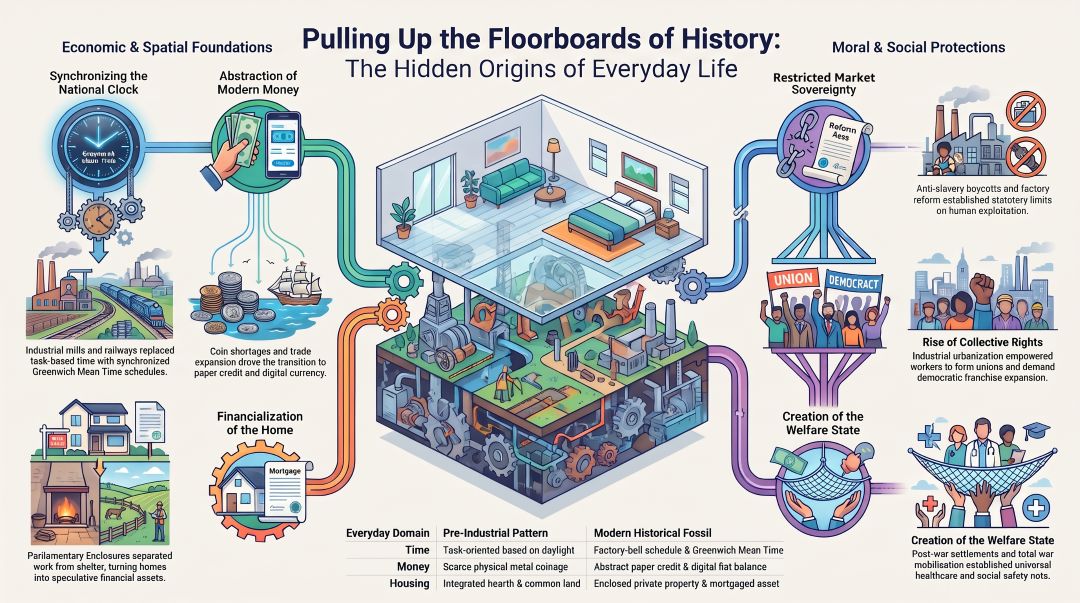
Synchronising human bodies to machinery required more than factory bells. It demanded the abolition of local time itself. Until the 1840s, every town in Britain set its clocks by the local position of the sun. Noon in Bristol arrived roughly ten minutes after noon in London, and Plymouth was nearly twenty minutes behind the capital. In an agrarian society where news travelled on horseback, those discrepancies mattered to nobody. Once the railway network knitted the country together, however, twenty different local times along a single line became an operational hazard and a scheduling nightmare. In November 1840, the Great Western Railway ordered that all its stations and timetables operate on London time, transmitted telegraphically from the Royal Observatory at Greenwich. Other railway companies followed suit over the next decade. By 1855 almost every public clock in Britain had surrendered local solar time to Greenwich Mean Time, a shift finally codified by Parliament in 1880. A uniform national grid of minutes now covered the island, binding remote valleys and coastal ports to a single central pulse.
The struggle over who owned those minutes became one of the defining battles of nineteenth-century British politics. Nobody cared about “work-life balance” back then. Factory owners claimed fourteen or sixteen hours of a worker’s day, six days a week, leaving time only for exhausted sleep. Early factory reformers, trade unionists, and working-class radicals fought inch by inch to claw back hours from the engine. The Ten Hours Movement of the 1830s and 1840s, the gradual establishment of the Saturday half-holiday in northern industrial towns, and the eventual recognition of the weekend were never gifts bestowed by enlightened employers. They were concessions extracted through strikes, petitions, parliamentary inquiries, and relentless agitation. Even the Bank Holidays Act of 1871, introduced by Sir John Lubbock, had to disguise basic human rest behind the respectable facade of banking closures so that commercial interests would accept four guaranteed days off a year.
What remains in the modern mind is the compromise left behind after that long tug-of-war ended. Contemporary workers enjoy protections and leisure hours that would have astonished a Victorian mill hand, yet the underlying bargain remains intact. Time is still experienced primarily as an economic resource owned either by an employer or by the individual as a self-managing enterprise. The clock on the kitchen wall and the calendar on a smartphone screen are direct descendants of the factory bell and the railway timetable, quietly enforcing the assumption that an hour unspent on measurable output is an hour lost.
The Ledger and the Coin
Few objects in everyday life provoke as much quiet contradiction as money. People pursue it with lifelong urgency and measure their security and social standing by its accumulation, yet they routinely speak of it with suspicion or distaste. Money is blamed for corroding friendships, commercialising human care, and reducing complex lives to numbers on a statement. At the same time, it serves as the primary instrument through which modern citizens secure privacy, mobility, and freedom from personal dependence. That ambivalence is no quirk of individual psychology. It reflects the double nature of a system that evolved to liberate commerce from ancient physical limits even as it bound human survival ever more tightly to abstract financial ledgers.
Money – Let’s talk about that
For over two millennia after the invention of stamped metal coinage in the seventh century before the common era, money was tethered to physical substance. A silver penny or a gold sovereign carried value largely because the metal inside it was scarce, durable, and universally prized. That arrangement offered a reassuring tangibility, yet it imposed a severe brake on economic expansion. By the eighteenth century, Britain’s growing commercial and industrial ambitions were colliding with a chronic shortage of physical coin. Silver was continually drained away to pay for Asian imports such as tea and silk. Meanwhile, the Royal Mint struggled to keep enough small denomination coins in circulation to pay wages across rapidly expanding manufacturing towns. Employers in Birmingham, Manchester, and South Wales frequently found themselves unable to pay their workforces on Saturday nights. Many resorted to private copper tokens, credit notes redeemable only at company-owned shops, or wage payments delayed for weeks at a time. An industrial economy capable of producing cloth and iron at unprecedented speed could not run on medieval metallic scarcity.
Financial transformations
Breaking that bottleneck required a financial transformation every bit as radical as the invention of the steam engine. Following the establishment of the Bank of England in 1694 to finance war with France, Britain developed an intricate architecture of public debt, commercial credit, and paper banknotes. Hundreds of provincial “country banks” sprang up across market and industrial towns during the late eighteenth century, issuing their own paper notes backed by local reserves and faith in their solvency. A mill owner no longer needed chests of silver coins to build a spinning shed or pay three hundred weavers. Credit could be created on a ledger and circulated on paper. When the strain of the Napoleonic Wars exhausted Britain’s gold reserves in 1797, Parliament suspended cash payments altogether, forcing the country to run for twenty-four years on unbacked paper currency. Britain returned to gold in 1821 and anchored the global economy to the classical Gold Standard for nearly a century, yet the decisive psychological leap had already been made. Paper promises, backed by institutional credibility and legal enforcement, could function as everyday money.
Emergence of fiat
That transition from metal to paper altered social relationships at their root. Under feudal arrangements, obligations were personal, customary, and lifelong; a tenant owed labour, deference, and loyalty to a specific lord in exchange for protection and access to land. Paying rent and wages in portable currency dissolved those personal bonds. Once a worker could take paper notes or coins at the end of the week and spend them in any shop, or buy a railway ticket to another city without seeking a landlord’s permission, money became a genuine engine of personal autonomy. It allowed strangers to cooperate without knowing one another’s lineage and gave ordinary people a degree of privacy and self-determination unimaginable in a village economy. Yet that same liberation carried an unforgiving edge. In a fully monetised society, anyone without cash or credit was stripped of customary rights to common land, gleaning, or parish charity and left exposed to destitution. Money freed the individual from personal masters only to place everyone under the impersonal authority of the market.
Money untethered
During the twentieth century, even the lingering anchor of gold proved too restrictive for modern industrial states managing mass democracies, welfare systems, and total wars. Britain left the domestic Gold Standard during the economic crisis of 1931, and the United States severed the final international link between the dollar and gold bullion in 1971. From that point onward, major currencies became pure fiat money, resting entirely on state authority, tax collection, and collective confidence in future economic output. Today, physical notes and coins account for only a tiny fraction of the money supply in Britain. The vast majority exists as electronic entries generated when commercial banks extend loans and mortgages. The familiar wording printed across every Bank of England note, promising to pay the bearer on demand, survives as a historical fossil from an era when paper could be exchanged for precious metal at a counter.
Modern ambivalence toward money sits squarely inside this history. The digital balance glowing on a phone screen is the culmination of a centuries-long journey away from physical weight toward pure abstraction. It grants unprecedented convenience and personal independence, allowing goods, shelter, and travel to be summoned on personal whim. At the same time, it rests on an invisible architecture of debt and institutional trust that few people ever inspect. People love money because it remains the cleanest passport to autonomy in a complex society, and they resent it because every aspect of daily existence now passes through its tollgate.
The Price of a Roof
In modern Britain, few subjects generate as much anxious conversation as housing. A house is rarely spoken of merely as bricks, timber, and shelter from the rain. It is discussed as a rung on a ladder, a pension pot, a store of equity, and a quiet verdict on personal success or failure. Parents fret over whether their children will ever accumulate a deposit. Homeowners track street valuations with the vigilance of commodity traders, and tenants hand over half their monthly income for rooms they cannot repaint without permission. That double identity—treating a home simultaneously as an intimate sanctuary and a speculative financial asset—feels so entrenched that it is easily mistaken for an eternal human instinct. In reality, it is the product of two sharp historical breaks: the enclosure of common land and the industrial separation of work from the domestic hearth.
Enclosing the commons
For centuries prior to the industrial takeoff, most ordinary people in rural Britain inhabited a world where shelter, livelihood, and community rights were woven into the same patch of ground. Peasant cottages were often modest, smoky, and damp, yet they sat inside a web of customary entitlements. Families grazed livestock on common pasture, gathered fallen wood for fuel, drew water from shared streams, and worked the land around their doors. Even among urban artisans and shopkeepers, the workshop and the home occupied the same building. A weaver’s loom stood in the upper room, a baker’s oven warmed the floor beneath the family bed, and apprentices ate at the master’s table. Shelter was inseparable from productive life, and land was governed as much by inherited obligation as by commercial price.
Between the sixteenth and early nineteenth centuries, Parliamentary Enclosure Acts systematically dismantled that common inheritance. Millions of acres of open fields, heaths, and village commons were fenced off, consolidated into private estates, and converted into commercial agricultural enterprises. Deprived of grazing rights and fuel, hundreds of thousands of rural labourers had little choice but to migrate toward the rapidly expanding mill and foundry towns. There, speculative builders threw up rows of back-to-back terraced houses at breakneck speed to accommodate the influx. For the first time in British history, the workplace was physically severed from the home. Men, women, and children walked out of their front doors at dawn to sell their labour inside a distant factory or colliery, returning at night to rented rooms that produced nothing of their own.
Sanctuary and rent
That spatial split invented the modern idea of the home as a private refuge sealed off from the harshness of commerce. Victorian culture elevated domesticity into a moral sanctuary—a quiet, curtained interior where family life could recover from the noise, soot, and competition of the industrial city. Yet that very sanctuary was built on precarious commercial footing. Throughout the nineteenth century, roughly ninety per cent of British households rented their homes from private landlords. Families lived exposed to sudden rent increases, arbitrary eviction, and squalid overcrowding whenever wages faltered. Owning the roof over one’s head was the preserve of the wealthy and a thin upper layer of the middle class.
Mortgaged lives
The transformation of Britain into a nation of mortgaged homeowners unfolded across the twentieth century through deliberate political engineering. Following the First World War, municipal authorities constructed hundreds of thousands of council houses under the promise of “homes fit for heroes,” establishing the principle that decent shelter was a public responsibility rather than a pure market commodity. At the same time, building societies expanded aggressively, extending long-term mortgages to salaried clerks and skilled workers seeking suburban semi-detached houses along new bus and rail corridors. By the 1980s, policies such as the Right to Buy transferred over two million council homes into private ownership and deregulated mortgage credit. Housing gradually ceased to be merely a place to live or a public utility and became the primary vehicle through which ordinary families accumulated wealth.
Today’s housing friction sits directly atop those layered histories. The modern homeowner carries the Victorian longing for a private castle alongside the twentieth-century expectation that property should appreciate faster than wages. Meanwhile, younger generations confront the scarcity created when land and shelter are treated primarily as financial instruments. Every debate over interest rates, planning permission, or tenant rights is still wrestling with the unfinished consequences of enclosing the commons and turning the family hearth into a tradable asset.
The Moral Reckonings Under the Engine
Everyday consumer life rests on a quiet assumption that commercial exchange is morally neutral. A shopper picks up a packet of sugar, a cotton shirt, or a bar of chocolate without expecting the transaction to carry ethical weight beyond the price tag. Alongside that, modern employment law guarantees minimum wages, safety standards, and limits on working hours as basic entitlements of citizenship. Those assumptions feel self-evident, yet they were forged in one of the fiercest moral collisions of the industrial era, when Britain’s economic ascent ran headlong into the human cost of the labour systems sustaining it.
The Atlantic supply chain
During the late eighteenth and early nineteenth centuries, the flagship industry of the British Industrial Revolution was Lancashire cotton. Steam-powered spinning jennies and power looms turned Manchester and its surrounding towns into the manufacturing workshop of the world, generating immense wealth for mill owners, merchants, and port cities. Yet Britain grew none of the raw material feeding those machines. The cotton spun in Lancashire was harvested across the Atlantic by enslaved Africans working on plantations first in the British West Indies and subsequently in the American South. At the same time, Caribbean sugar cultivated by enslaved labour sweetened the tea consumed by British factory workers. Profits from the transatlantic slave trade and plantation estates flowed straight into British banks, insurance houses, railways, and country estates. Britain’s industrial modernity depended upon slavery at every stage of the supply chain.
Grassroots pressure
Challenging that system required ordinary people to invent forms of political pressure that had never existed before. Because the vast majority of British citizens lacked the vote, parliamentary change could not be achieved through the ballot box alone. Beginning in the late 1780s, abolitionists mobilised public opinion on an unprecedented scale. Hundreds of thousands of working people signed petitions demanding an end to the slave trade, and Josiah Wedgwood’s Staffordshire pottery mass-produced ceramic medallions bearing the figure of a kneeling enslaved man to be worn as political emblems. In 1791, roughly three hundred thousand British consumers—led largely by women—boycotted slave-grown Caribbean sugar, cutting sales by a third across parts of the country. Alongside relentless uprisings by enslaved people across the Caribbean, from Haiti to Jamaica, that grassroots campaign forced Parliament to abolish the slave trade in 1807 and pass the Slavery Abolition Act in 1833. Even then, the political settlement revealed the strength of entrenched property interests. The British government borrowed twenty million pounds—roughly forty per cent of its annual national budget, a debt not fully repaid until 2015—to compensate slave owners for their lost property, leaving the newly freed with nothing.
Abolition turns inward
The moral shockwaves of abolition refused to stay safely across the ocean. Almost immediately, working-class radicals and factory reformers turned the language of emancipation inward on Britain’s own industrial towns. Critics such as William Cobbett and Richard Oastler pointed out the glaring hypocrisy of wealthy manufacturers and politicians who wept over plantation slavery in the colonies yet locked seven-year-old British children inside boiling, lint-choked cotton mills for fourteen hours a day. The phrase “wage slavery” entered everyday political argument, forcing Parliament to confront an uncomfortable logic. If human beings could not be treated as disposable instruments of profit in Jamaica or Barbados, neither could they be worked to early graves in Leeds, Preston, or Birmingham.
Out of that collision emerged the early Factory Acts of the 1830s and 1840s, which restricted child labour, mandated basic safety guards around spinning machinery, and appointed government inspectors with legal authority to enter private mills. Those statutes established a principle that still governs modern economic life: the market does not possess absolute sovereignty over human bodies. Consumer boycotts, ethical labelling, workplace inspections, and statutory labour protections all trace their lineage directly back to those nineteenth-century reckonings, when a society enriched by global trade and steam power was forced to draw a line between legitimate commerce and human exploitation.
The Safety Net Beneath the Market
Modern political instincts in Britain rest on a quiet assumption that certain human essentials sit outside pure market pricing. A sudden medical emergency does not prompt a calculation of bank balances before dialling for an ambulance. Old age, unemployment, and disability are widely understood to trigger collective obligations rather than abandonment to charity or the parish gate. Those expectations feel like basic decency, so deeply woven into civic life that debates usually centre on funding and competence rather than the underlying principle. Yet that consensus was forged under severe pressure, emerging from the wreckage left when an unbridled industrial economy collided with human biology and democratic politics.
The workhouse test
Throughout the early decades of industrialisation, British economic doctrine largely treated poverty as a moral failing rather than a structural consequence of market volatility. When trade cycles collapsed or new machinery displaced handloom weavers, families were thrown back onto the Poor Law. The Poor Law Amendment Act of 1834 sharpened that severity by constructing workhouses designed to be deliberately harsher than the lowest-paid labour outside their walls. Families were separated at the gate, uniforms replaced personal clothing, and relief carried a stigma meant to deter the able-bodied from seeking help. At the same time, rapid urbanisation packed millions into unsewered streets around factories and docks, turning cholera and typhus into regular visitors that respected no class boundary.
Power in numbers
Concentrating millions of workers inside industrial towns eventually produced a political counterweight that the old agrarian order had never faced. Scattered rural labourers rarely mounted sustained national challenges, whereas factory hands, miners, and railway workers stood shoulder to shoulder every day. They formed trade unions, built friendly societies to insure one another against sickness and burial costs, and marched in Chartist demonstrations demanding the vote. Once the franchise expanded across the late nineteenth and early twentieth centuries, political parties could no longer govern solely on behalf of landowners and mill proprietors. Nineteenth-century socialist thought splintered under that pressure. Revolutionary branches argued that industrial capitalism had to be overthrown entirely through the seizure of factories and land. In Britain, however, a parliamentary tradition took root instead, seeking to tame the market through taxation, public ownership of key utilities, and statutory welfare without dismantling private enterprise.
The post-war settlement
Two total wars accelerated that compromise beyond recognition. Mobilising the entire population between 1914 and 1918, and again between 1939 and 1945, forced the state to plan production, ration food, and guarantee civilian health on a national scale. Millions of citizens endured shared sacrifice under the Blitz and on distant fronts, making a return to the mass unemployment and means-tested humiliation of the 1930s politically unthinkable. Out of that reckoning came the post-war settlement: the Beveridge Report, the creation of the National Health Service in 1948, and a commitment to full employment funded through progressive taxation. Britain evolved into a social democratic transfer state, collecting revenue from a complex industrial and financial economy and redistributing it as healthcare, pensions, and social security. Modern expectations of fairness are anchored directly in those mid-century bargains, even as the industrial base that originally financed them has shrunk and shifted toward global finance and services.
Overview
Look closely at any ordinary day in contemporary Britain and the past refuses to stay buried. The habits, objects, and assumptions that feel most natural are rarely self-authored inventions. They are inherited compromises, shaped by specific historical pressures and passed down until their origins faded from view.
A mug of morning tea carries the residue of eighteenth-century taxation, imperial trade routes, and plantation sugar. The clock on the kitchen wall enforces a uniform national time invented to keep Victorian trains from colliding and factory shifts running on schedule. The digits on a banking screen descend from paper credit devised to overcome a shortage of silver coin during the industrial takeoff, long before currencies broke free from gold bullion altogether. Even the emotional contradiction attached to housing—revered as a private sanctuary yet tracked as a speculative financial asset—traces back to the enclosure of common land and the industrial separation of work from the domestic hearth.
Beneath those material arrangements lie deeper moral and political reflexes. Modern assumptions about fair wages, consumer responsibility, and statutory limits on working hours were hammered out in the friction between overseas slavery, domestic factory reform, and grassroots campaigning by people who did not yet possess the vote. Expectations of publicly funded healthcare and social security grew out of the collision between urban industrial poverty, trade union pressure, and the shared sacrifices of two world wars.
None of these anchors is permanent, and the ground beneath them continues to shift. Britain has moved from an agrarian economy to an industrial workshop, and from there into a financialised, post-industrial state now entering another upheaval driven by digital networks and automated intelligence. Recognising the historical architecture beneath everyday life does not trap the present inside the past. Instead, it strips inherited habits of their false inevitability, making visible the human choices that built the room and leaving open the question of which arrangements still deserve to stay.